

When to Get Your Jewelry Professionally Inspected: A Guide to Protecting Your Legacy
Imagine the heart-sinking realization that the center stone of your diamond engagement ring is gone, leaving only an empty, jagged setting behind. It's a scenario no one wants to face, yet many of us wait until a tragedy occurs to ask when to get your jewelry professionally inspected. We understand that your 14K gold and diamond treasures are more than just beautiful objects. They're the physical touchstones of your family's most precious milestones, from the first pair of children's gold earrings to the custom nameplate that defines your identity.
You deserve to feel absolute confidence that your diamond tennis bracelets and religious pendants are structurally sound. This guide reveals the critical signs of micro-wear and the recommended maintenance schedules that protect your investment from loss or damage. We'll explore how routine professional care restores the breathtaking brilliance of your gold and ensures that every prong and clasp remains a steadfast guardian of your legacy for generations to come.
Key Takeaways
- Learn why a professional inspection is a technical audit of structural integrity, moving beyond simple surface cleaning to identify "invisible wear" in your 14K gold settings.
- Discover how to identify immediate warning signs, such as the "Snag Test" or audible rattling, that signal when to get your jewelry professionally inspected to prevent stone loss.
- Understand the critical differences between at-home maintenance and a jeweler's 10x magnification loupe for detecting hairline fractures in high-value diamond pieces.
- Establish a reliable maintenance schedule based on the six-month industry benchmark for daily-wear items like diamond engagement rings and tennis bracelets.
- Recognize the value of master craftsmanship in preserving your family's history through expert prong repair and resizing performed by seasoned, on-site artisans.
The Art of Preservation: Why Professional Jewelry Inspections Are Essential
A professional jewelry inspection is far more than a simple aesthetic refresh. It is a comprehensive technical audit of your piece's structural integrity and stone security. While a quick cleaning at home might restore a temporary shine, it cannot reveal the microscopic shifts in metal that occur over years of wear. Understanding when to get your jewelry professionally inspected is the first step in a partnership between you and our master artisans, ensuring that your most cherished symbols of love remain intact. This process often begins with understanding jewelry appraisal, which establishes a baseline for both the replacement value and the physical condition of your collection.
We often speak of the "Invisible Wear" phenomenon to describe the subtle, gradual thinning of gold prongs that the naked eye simply cannot detect. Gold is a remarkably resilient metal, yet it is also malleable. Over time, the very act of wearing your jewelry causes it to lose microscopic amounts of metal. Choosing proactive maintenance over reactive repair is a vital emotional safeguard. It is the difference between a routine prong retipping and the devastating loss of a center stone that has been in your family for decades. We view these inspections as a shared commitment to protecting a lifelong investment, moving beyond the romantic allure of the object to the technical reality of its composition.
Beyond the Surface: Protecting the Integrity of 14K Gold
14K gold is celebrated as the industry standard for durability, striking a perfect balance between purity and strength. Even so, it is not immune to the laws of physics. Your 14K gold religious pendants or bangles experience constant friction against skin and clothing during your daily activities. Micro-wear is the gradual thinning of metal caused by contact with skin and fabrics. Without expert intervention, this thinning can eventually lead to structural failure in the most delicate parts of your jewelry, such as the fine loops of a pendant or the hinges of a bangle.
Securing Your Brilliance: The Role of Diamond Settings
Your diamond engagement rings are designed to be worn and admired, yet their high-set profiles make them vulnerable to everyday impacts. A simple knock against a granite countertop or a car door can shift a prong just enough to compromise stone security. Tension and movement within the setting can occur without you ever feeling a change in the ring's weight or balance. Our professional checks use high-magnification tools to guarantee that every diamond remains nestled safely in its home, protecting the brilliance you've come to rely on. To explore high-quality settings designed for both elegance and security, you can discover Javda Jewelry and their extensive collection of engagement ring designs.
Key Indicators: When Your Fine Jewelry Requires Expert Attention
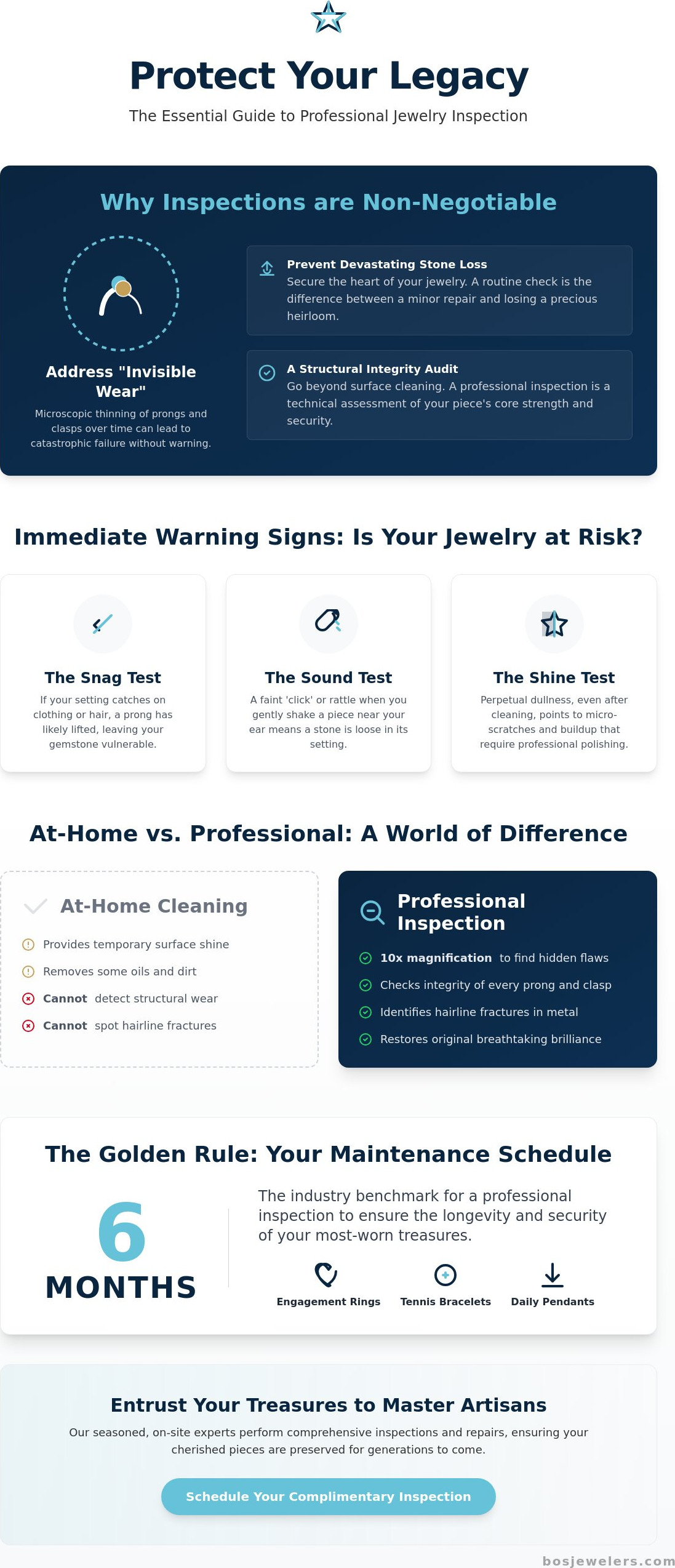
While we often view our jewelry as indestructible symbols of our journey, the reality is that fine metal and gemstones respond to the world around them. Knowing when to get your jewelry professionally inspected requires a keen eye and a bit of sensory awareness. One of the most telling signs is what we call the 'Snag Test.' If your ring or bracelet starts catching on your favorite silk blouse or your hair, it isn't just a minor annoyance; it's a signal that a prong has lifted or shifted. This creates a gap that can easily snag fabric and, more importantly, leave your diamond vulnerable to falling out.
Another subtle warning is an audible one. If you hold your piece close to your ear and give it a gentle shake, you shouldn't hear anything. A tiny 'click' or a faint rattle indicates that a stone has become loose within its setting. This movement, however slight, acts like a hammer against the gold, slowly widening the gap until the stone is no longer secure. Beyond sound, look for visual dullness. When your 14K gold religious pendants lose that warm, sun-kissed glow and appear perpetually cloudy even after a gentle wipe, it's often due to a buildup of oils and microscopic scratches that require professional polishing to resolve.
Warning Signs for Diamond Engagement Rings and Tennis Bracelets
For pieces you wear every day, like diamond engagement rings, structural integrity is paramount. You can perform a quick DIY check by gently tapping the diamond with your fingernail while looking for movement. However, this is only a temporary measure. You should also regularly inspect the clasp integrity on diamond tennis bracelets to ensure the safety latch still snaps firmly into place. If your ring feels looser than usual or spins constantly, it may be time for ring resizing. A poorly fitted band puts unnecessary stress on the metal, potentially leading to a flat spot or a dangerously thin area at the base of the shank.
Specific Needs for Pendants and Children's Jewelry
We often forget that pendants and earrings face their own unique challenges. When inspecting gold religious pendants, pay close attention to the bail, which is the small loop that connects the pendant to the chain. This point of contact experiences constant friction and can wear through over time. Similarly, children's 14K gold earrings require frequent safety checks. Because children are naturally active, the screw-backs can gradually loosen during play. Expert guidance on how often to have jewelry inspected suggests that high-activity pieces may need more frequent eyes than those kept for special occasions. If you've noticed a faint rattle or a persistent snag, our team can provide the meticulous prong repair needed to keep your treasures safe.
The Anatomy of a Professional Inspection vs. At-Home Cleaning
Many of us enjoy the simple ritual of polishing a 14K gold bangle or religious pendant at home. It's a quiet moment of connection with our history. But a surface shine can be deceptive. A professional inspection is a technical audit, not just a bath. While you see the brilliance, our artisans look for the structural integrity that keeps that brilliance on your person rather than lost to the street. Knowing when to get your jewelry professionally inspected is the difference between simply owning a beautiful object and possessing a secure legacy.
We use a jeweler's loupe to enter a world of 10x magnification. At this level, we spot hairline fractures in the metal that are invisible to the naked eye. Under specialized lighting, we analyze prong tension and metal fatigue. This is where we see the stress points in your diamond engagement rings before they become breaks. We don't just wipe the surface; we restore the deep, internal luster of the gold through technical polishing that removes microscopic abrasions that a soft cloth cannot touch.
The Expert’s Toolkit: Magnification and Precision
Our toolkit allows us to identify the need for "prong tipping" before a catastrophe occurs. This involves meticulously adding a tiny bead of 14K gold to a worn prong to reinforce its grip on your diamond. We also examine the "galleries," which are those hidden, intricate spaces beneath your gemstones where dust and oils accumulate. Professional steam cleaning removes biological oils that DIY solutions cannot reach. This deep clean allows us to see the true state of the metal bonds without any obstructions.
Why DIY Methods Can Sometimes Mask Damage
Dirt is deceptive. Paradoxically, a buildup of lotion or skin cells can act as a temporary, brittle adhesive, holding a loose stone in place. When you use an at-home ultrasonic cleaner, the high-frequency vibrations shake this debris away. If the prong was already compromised, the stone may fall out the moment that "dirt glue" is gone. At-home methods also carry the risk of chemical damage. Household cleaners often contain ingredients that can cause stress corrosion in the alloys of 14K gold. Expert verification ensures your piece moves from being merely "clean" to being truly "secure."
Frequency and Timing: Establishing a Maintenance Schedule for Your Collection
Creating a family legacy is an act of love. It's a commitment that extends far beyond the day you first slide a ring onto your finger or clasp a bracelet. To maintain the structural integrity of your most cherished pieces, we recommend establishing a consistent rhythm of care. For any item you wear daily, the industry benchmark for when to get your jewelry professionally inspected is every six months. This biannual wellness check ensures that the tiny mechanical parts of your jewelry, like the hinges on a bangle or the prongs of a ring, remain in peak condition before micro-wear turns into a lost stone.
Life's unexpected moments also dictate your maintenance timing. We suggest a post-impact protocol: if you drop your ring on a tile floor or strike it sharply against a hard surface, bring it in immediately. A single blow can shift a setting or crack a prong in ways you cannot see without magnification. Similarly, schedule a pre-travel inspection before you head on vacation. Ensuring your clasps and settings are secure provides peace of mind, allowing you to enjoy your travels without the fear of losing a treasure in an unfamiliar place.
The Daily Wear Schedule: Rings and Bangles
Daily life is surprisingly rigorous for fine metal. Your 14K gold bangles encounter constant friction against desks, car doors, and other jewelry, which can lead to thinning edges that compromise the piece's strength. For engagement rings worn 24/7, prongs are under constant pressure from bed linens and daily chores. We also observe how seasonal changes affect security. Your fingers naturally shrink in cooler months, and a ring that fits perfectly in July may slide dangerously close to the knuckle in January.
The Occasional Wear Schedule: Heirlooms and Pendants
Heirlooms like religious pendants or custom nameplates deserve an annual wellness check. Even if they spend most of their time in a velvet-lined box, the metal can still experience subtle fatigue at the points of contact. When you store these pieces, keep them in separate compartments to prevent them from scratching one another. Professional cleaning plays a vital role in maintaining heirloom value, as it prevents the buildup of atmospheric pollutants that can dull the warmth of 14K gold over several decades. To ensure your collection remains as brilliant as the day you received it, we invite you to visit us for professional Jewelry Cleaning and Polishing.
Entrusting Your Treasures to Master Artisans: The BOS Jewelers Inc Standard
Choosing the right hands to care for your legacy is as important as the jewelry itself. At BOS Jewelers Inc, we don't merely act as intermediaries between you and a distant repair facility. We are creators. Our 40-year heritage as a family-owned destination for fine jewelry is built on a foundation of trust and technical mastery. When you determine when to get your jewelry professionally inspected, you're looking for more than a simple checklist. You're seeking the quiet confidence that comes from placing your 14K gold and diamond treasures in the care of artisans who have spent decades perfecting their craft right here on our premises.
Our commitment to 14K gold and diamonds ensures that every piece, from a delicate pair of children's 14K gold earrings to a complex diamond tennis bracelet, receives specialized attention. We understand the specific metallurgical properties of the gold we work with and the optical requirements of the diamonds we set. This deep, focused knowledge allows us to perform repairs with a level of precision that preserves the original artistry of your piece. We treat every inspection as a renewal of our promise to help you protect the symbols of your most significant life milestones.
A Tradition of Craftsmanship and Trust
Our multi-generational expertise informs every technical audit we perform. We've seen how jewelry lives and breathes alongside its owner, and we know exactly where to look for the subtle signs of time. Working with on-site artisans at BOS Jewelers Inc offers unparalleled peace of mind. Your diamond engagement rings and custom diamond nameplates never leave our sight, ensuring a level of security and accountability that corporate entities simply cannot match. We focus on building lasting relationships, treating your family's history with the same reverence we give our own.
Next Steps: Your Invitation to Excellence
Preparing for your visit is a simple process of gathering the pieces you wear most often and those you've tucked away for special occasions. When you bring your collection to BOS Jewelers Inc, you'll experience the immediate benefits of our professional cleaning and polishing services. We don't just check for safety; we restore the breathtaking luster of your 14K gold religious pendants and 14K gold bangles, allowing them to catch the light just as they did the day they were first gifted. Knowing when to get your jewelry professionally inspected is the first step toward a lifetime of security. We personally invite you to join the BOS Jewelers Inc family and experience a tradition of excellence and personal care that has defined our workshop for forty years.
Preserving Your Legacy for Generations to Come
Your jewelry is a living record of your family's most beautiful moments. Protecting that history requires more than just careful wear; it demands a commitment to professional oversight. By understanding when to get your jewelry professionally inspected, you move beyond reactive repairs and embrace a proactive standard of care. You've learned how to identify the subtle warning signs of micro-wear and why a technical audit under 10x magnification is essential for stone security.
At BOS Jewelers Inc, we bring over 40 years of family-owned expertise and a specialized focus on premium 14K gold and diamonds to every piece we touch. Our on-site master artisans are dedicated to ensuring your treasures remain as secure as they are brilliant. Restore the brilliance of your collection with BOS Jewelers Inc's professional maintenance services. We invite you to let us help you safeguard your story, ensuring your fine jewelry remains a source of pride and beauty for years to come.
Frequently Asked Questions
How often should I get my diamond engagement ring inspected?
You should have your diamond engagement ring professionally inspected every six months. Because this is a piece you likely wear every day, the prongs and band are constantly exposed to friction and impact. This biannual schedule allows us to catch minor thinning in the 14K gold before it compromises the security of your center stone.
Is a professional jewelry inspection expensive?
Professional inspection fees vary based on the depth of the technical review, but they're a modest investment in your jewelry's longevity. While a detailed appraisal for insurance purposes has its own professional rate, a structural "wellness check" is a preventative measure. It's far more cost-effective to retip a worn prong now than to replace a lost diamond later.
Can I clean my jewelry at home instead of getting it inspected?
At-home cleaning is wonderful for maintaining surface brilliance, but it can't replace a structural audit. DIY methods only address the aesthetic side of your jewelry. Only a professional has the tools to identify the micro-wear and metal fatigue that signal when to get your jewelry professionally inspected to prevent accidental loss or damage.
What exactly does a jeweler look for during a professional inspection?
We focus on stone security, prong integrity, and the overall thickness of the metal. Our artisans use a 10x magnification loupe to search for hairline fractures and thinning areas on 14K gold bangles and ring shanks. We also test the mechanical tension of clasps on diamond tennis bracelets and the bails on gold religious pendants.
How long does a professional jewelry cleaning and inspection take?
A standard cleaning and inspection typically takes about 15 to 30 minutes per item. This allows our experts enough time to meticulously examine every setting under high magnification. If we discover a structural issue that requires specialized prong repair or ring resizing, we'll provide a clear timeline for those on-site artisan services.
What should I do if a jeweler finds a loose stone during an inspection?
You should leave the piece with the jeweler for repair and avoid wearing it until the setting is secured. Even a slightly loose stone can act like a tiny hammer, gradually widening the gap in the gold until the stone falls out. Our on-site master artisans can quickly perform a prong repair to restore the piece's structural integrity.
Can professional cleaning damage my 14K gold jewelry?
Professional cleaning is safe and beneficial for 14K gold when performed by seasoned experts. We use specialized equipment, such as high-pressure steam and calibrated ultrasonic cleaners, that won't harm your metal. In fact, professional care is safer than many DIY methods, as household chemicals can sometimes cause stress corrosion in gold alloys.
Is it safe to leave my jewelry with a jeweler for inspection?
It's perfectly safe to leave your treasures with a trusted, family-owned establishment like ours. We provide full documentation for every item, and our 40-year heritage in the community is built on a foundation of absolute trust. Knowing when to get your jewelry professionally inspected includes choosing a partner where your pieces never leave the secure, on-site premises.