

What Is a GIA Diamond Certificate? The Ultimate Guide to the Industry’s Gold Standard
What if the most significant part of your diamond isn't the brilliance you see, but the invisible details you can't? You've likely spent hours admiring the fire of a potential heirloom, yet felt a quiet worry about whether its true quality matches the price tag. It's natural to feel overwhelmed by technical terms like fluorescence or clarity plotting when you're searching for a piece that symbolizes a lifetime of love. We understand that this purchase is more than a transaction; it's a milestone in your family's history.
Learning what is a GIA diamond certificate is the first step in replacing that uncertainty with the steady confidence of a seasoned collector. This report acts as your stone's immutable DNA, bridging the gap between scientific precision and the emotional weight of a fine jewelry investment. In this guide, we'll show you how a GIA report protects your purchase and ensures the lasting value of your diamond. We'll explore the latest 2026 grading standards, explain the security features that guard against counterfeiting, and help you decode the technical specifications with ease. By the end, you'll possess the clarity needed to choose a diamond that truly honors your story.
Key Takeaways
- Understand that a GIA report is a scientific blueprint of your stone, providing an objective assessment that goes far beyond a simple appraisal.
- Learn exactly what is a GIA diamond certificate and how it uses the universal language of the 4Cs to quantify the brilliance and rarity of your jewelry.
- Discover how to read a clarity plot and proportions diagram to identify your diamond's unique fingerprint and ensure optimal light performance.
- Protect your financial investment by choosing a stone with the industry's gold standard, which facilitates easier future resale and prevents the risk of overgrading.
- See how our expert artisans use these detailed reports to guide the creation of bespoke engagement rings that stand the test of time.
Defining the GIA Diamond Certificate: The Industry’s Most Trusted Voice
Choosing a diamond is one of the most intimate decisions you'll ever make. It's a promise held in light, intended to span generations. To ensure that this symbol is as authentic as your commitment, you need an objective voice that speaks with absolute authority. That voice belongs to the Gemological Institute of America (GIA). Founded in 1931, this non-profit research institution has spent nearly a century protecting the public by setting the standards for gemological excellence. When you ask what is a GIA diamond certificate, you're really looking for a scientific blueprint of a miracle of nature. While people commonly use the word "certificate," the GIA technically issues a "Diamond Grading Report." This isn't just a piece of paper; it's a rigorous, data-driven analysis of a stone's physical properties, conducted by experts who have no financial stake in the diamond's sale.
Report vs. Appraisal: Understanding the Difference
Many of our clients ask us why they need a grading report if they already have an appraisal. It's a vital distinction that protects your heritage. An appraisal assigns a monetary value to a piece of jewelry, which is necessary for insurance coverage. However, a GIA report defines the physical quality of the stone itself. You need both for true long-term security. The report proves what the stone is; the appraisal proves what it's worth in today's market. We often caution against "in-house" certificates. These documents are created by the seller rather than an independent party. Without that third-party verification, there's a significant risk that the diamond's quality has been overstated, leaving you with a stone that doesn't truly match its description or its price.
The Global Authority of the GIA Lab
The GIA remains the global benchmark because of its unwavering impartiality. As a non-profit, their only mission is to provide an accurate, unbiased assessment. They utilize a rigorous "blind" grading system. This means that multiple gemologists examine your diamond independently, and they must reach a consensus on its grades before the final report is issued. This process eliminates individual bias and ensures that every stone is treated with the same meticulous care. When you understand what is a GIA diamond certificate, you see the depth of this commitment. The GIA offers several formats to suit different needs:
- Full Diamond Grading Report: Includes a full clarity plot and detailed proportions, typically for larger stones.
- Diamond Dossier: A more compact version for diamonds under 1.00 carat, often including a laser-inscribed report number on the diamond's girdle.
- eReport: A digital-only version that provides essential grading data for easy online verification.
Decoding the 4Cs: How the GIA Report Quantifies Brilliance
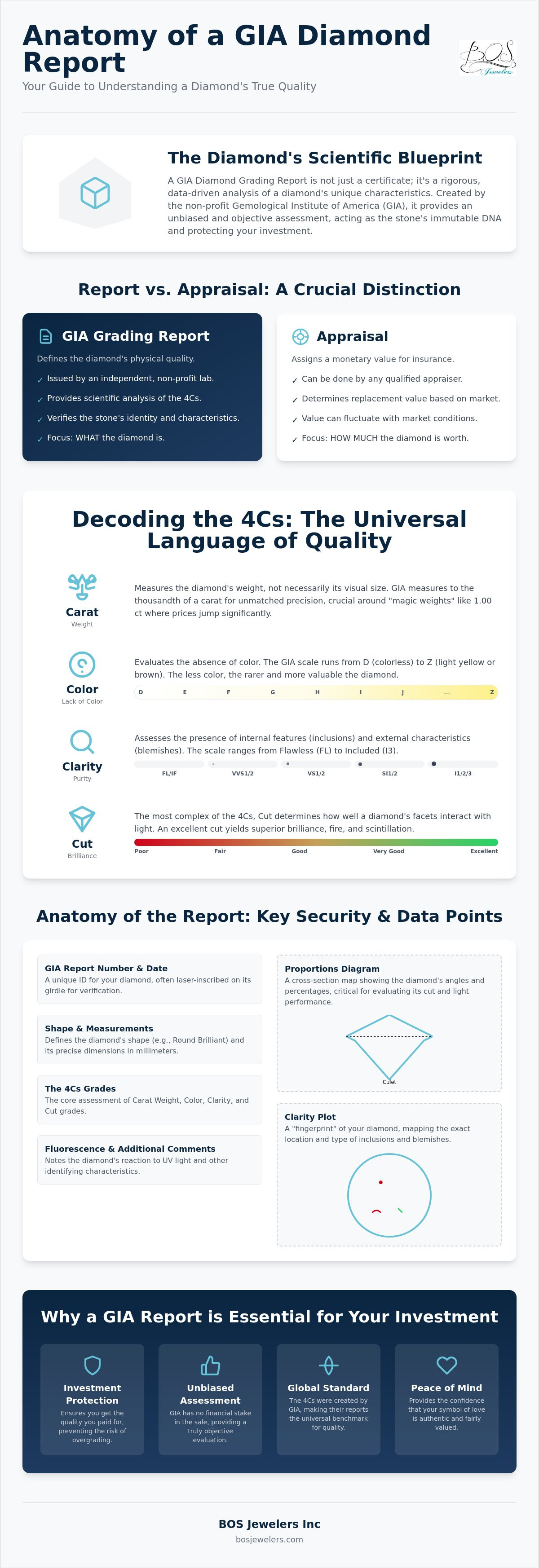
The 4Cs are more than just a marketing framework; they are the universal language of diamond quality. When you investigate what is a GIA diamond certificate, you'll find that it provides the definitive, impartial measurement for each of these characteristics. This transparency allows you to make a true "apples-to-apples" comparison between stones that might otherwise look identical to the untrained eye. Even a slight variation in a color grade or a microscopic inclusion can result in a significant price difference. The report ensures you aren't guessing about the value of your purchase, providing a scientific foundation for your emotional investment.
Carat Weight and Precision Measurement
GIA’s precision in measuring weight is legendary. They weigh diamonds to the thousandth of a carat to ensure the final reported hundredth is perfectly accurate. This level of detail is vital because "magic weights," such as exactly 1.00 or 1.50 carats, often see sharp jumps in price due to their rarity in nature. We also look closely at the dimensions listed in the report, measured in millimeters. If a diamond has a diameter that's too small for its carat weight, it means the stone is "deep" or "bottom-heavy." This indicates the weight is hidden in the base of the stone rather than contributing to the visual size you see when it's set in a ring.
Color and Clarity: The Spectrum of Purity
The D-to-Z color scale is the industry's gold standard for assessing the absence of color. A "D" grade represents a rare, icy white that sits at the peak of the hierarchy, while stones further down the scale show warm, subtle tints of yellow or brown. Clarity is equally nuanced. The GIA report identifies every tiny characteristic, from internal crystals trapped during the stone's formation to surface-level blemishes. Understanding the difference between a Flawless (FL) grade and Very Slightly Included (VS) allows you to choose a stone that is visually perfect to the naked eye while aligning with your specific budget and goals.
The Cut Grade: The Science of Light Performance
The Cut grade is a triumph of mathematical science and artistic vision. GIA evaluates seven distinct components, including brightness, fire, and scintillation, to determine how effectively a diamond returns light to your eyes. While they currently provide a formal Cut grade only for Round Brilliant stones, the Polish and Symmetry grades on the report offer essential clues about the artistry of fancy shapes like pears or ovals. Cut is the factor that most influences a diamond's fire and sparkle. When our experts help you select diamond engagement rings, we focus on these proportions to ensure your chosen stone possesses a captivating, radiant soul that dances in any light.
Anatomy of the Report: Understanding Technical Details and Security
Beyond the grades themselves, the physical report contains a wealth of technical data and security features designed to protect your investment. When you examine what is a GIA diamond certificate, you'll notice it isn't just a list of scores; it's a sophisticated document guarded by holograms, microprint lines, and QR codes. These features ensure the report hasn't been forged or altered, providing a layer of security that matches the rarity of the stone it describes. You'll also find a section for fluorescence, which measures how a diamond reacts to ultraviolet light. While this trait is sometimes debated, a faint blue glow can actually enhance the appearance of diamonds with lower color grades, making them appear whiter and brighter in natural sunlight.
The Proportions Diagram is another vital element. It maps out the exact angles and percentages of the stone's facets, such as the table width and pavilion depth. This data reveals whether a diamond has been cut to reflect light back to your eye or if it suffers from "light leakage" through the sides or bottom. It's the difference between a stone that possesses a captivating soul and one that remains dull. We use this technical data to ensure that every piece of jewelry we craft meets our high standards for brilliance and fire.
The Clarity Plot: Your Diamond’s Fingerprint
The Clarity Plot is perhaps the most personal part of the document. It serves as your diamond's unique fingerprint, documenting its internal journey through time. On this diagram, red marks indicate internal inclusions, while green marks represent surface blemishes. You might see symbols for "feathers," which are small internal breaks, or "crystals," which are tiny minerals trapped inside the stone during its formation. Because no two diamonds have identical inclusion patterns, this plot is your ultimate safeguard. If you ever leave your jewelry for a professional prong repair or resizing, you can use this map to verify that your specific stone has been returned to you with absolute certainty.
Laser Inscriptions and Digital Verification
For modern security, most GIA-graded diamonds feature a microscopic laser inscription on the girdle. This tiny number, invisible to the naked eye, matches the report number exactly. You can use the "GIA Report Check" tool online to instantly verify the data against the GIA’s global database, ensuring the stone in your hand matches the records in their lab. As of 2026, the institute has transitioned many of its services, including the Diamond Dossier, to digital-only formats for stones under 1.00 carat. This digital shift ensures that your diamond's pedigree is always accessible and secure, blending the timeless artistry of gemology with the convenience of modern technology.
Why a GIA Report is Essential for Investment and Peace of Mind
A diamond is more than a beautiful object; it's a significant financial asset and a vessel for your most precious memories. Understanding exactly what is a GIA diamond certificate provides the ultimate peace of mind during this substantial purchase. Without this independent verification, you're essentially taking a leap of faith on the word of a seller who has a vested interest in the transaction. A certified stone is the only way to truly "know" what you're buying, ensuring that the brilliance you see today is backed by a documented pedigree that will hold its authority for decades to come.
Protecting Against Overgrading and Price Inflation
The diamond industry occasionally faces a challenge known as "overgrading," where certain laboratories apply more lenient standards than the GIA. A stone might be labeled as "Colorless" by a secondary lab, but the GIA would grade it as "Near Colorless." This subtle shift can lead to thousands of dollars in price inflation. By insisting on a GIA report, you prevent yourself from paying premium prices for average quality. A GIA report is a shield against market volatility and deceptive grading. It ensures that every dollar you spend is reflected in the actual, physical rarity of the diamond rather than an optimistic label on a less rigorous document.
Ensuring a Legacy: The Heirloom Value
We believe that fine jewelry should be a bridge between generations. Keeping the original GIA report is vital for passing these treasures down to your children or grandchildren. This document preserves the stone's story and value, making it much easier for future generations to secure insurance or verify the stone's identity. The report also plays a practical role during maintenance. Whether you're seeking ring resizing or a simple prong tightening, the clarity plot allows a jeweler to confirm your diamond's identity before and after the work is performed. It’s a permanent record of quality that remains relevant long after the initial purchase.
When you invest in a piece of fine jewelry, knowing what is a GIA diamond certificate helps you navigate the market with the poise of a true connoisseur. It simplifies the process of securing comprehensive insurance coverage, as providers recognize the GIA as the most reliable source for valuation data. If you ever decide to trade in or upgrade your stone, having this "gold standard" report makes the process seamless and transparent. We invite you to browse our collection of GIA-certified diamonds to find a stone that perfectly matches your vision and your values.
Selecting Your Certified Diamond with BOS Jewelers Inc
At BOS Jewelers Inc, our 40-year history is built on a foundation of trust and transparency. We've spent four decades guiding families through their most significant milestones, ensuring that every stone we offer meets the rigorous standards we've discussed. Understanding what is a GIA diamond certificate is just the beginning of our partnership with you. We combine this technical, science-backed quality with the artistry of handcrafted elegance to create pieces that aren't just jewelry, but future heirlooms. Our philosophy centers on the belief that while the report provides the facts, our family provides the heart and the craftsmanship to bring those facts to life.
Beyond the Paper: The Human Element of Curation
Even with the most detailed report, two diamonds with identical grades can possess different personalities. One might have a more pleasing distribution of light, while another might "face up" larger than its carat weight suggests. This is where the human element becomes essential. Our experts hand-select stones that exceed their technical specifications, looking for that elusive fire that a piece of paper can't fully capture. We always encourage you to see a diamond in person alongside its report. It's the only way to truly feel the connection between the stone's scientific pedigree and its visual magic. We take the time to explain every detail, ensuring you feel the quiet confidence that comes from expert guidance.
Crafting Your Story with Certified Brilliance
Once the perfect stone is chosen, our expert artisans begin the meticulous process of integration. Whether we're designing a custom engagement ring or a radiant tennis bracelet, we ensure the setting honors the diamond's unique proportions. We work exclusively with high-quality materials like 14K gold to provide a secure and elegant home for your GIA-certified stone. This focus on craftsmanship ensures that the technical brilliance of the diamond is matched by the artistry of its setting.
Our dedication doesn't end at the point of sale. Because we are creators with expert artisans on the premises, we offer comprehensive on-site services to protect your stone's integrity. From professional jewelry cleaning and polishing to delicate prong repair, we remain your lifelong partners in jewelry care. We invite you to visit us and experience our personalized curation process. Let our family help you find a diamond that doesn't just meet the industry's gold standard, but sets a new standard for your own family's history.
Securing Your Future Heritage with Confidence
Choosing a diamond is a journey that blends scientific truth with personal emotion. By now, you understand that a GIA report is more than a technical document; it's the definitive safeguard for your investment and your legacy. Understanding exactly what is a GIA diamond certificate transforms a complex purchase into a moment of pure celebration, ensuring that the stone you choose today retains its prestige and value for generations. You've learned how the 4Cs quantify brilliance and why the GIA’s impartial grading remains the only trusted benchmark in an evolving market.
At BOS Jewelers Inc, we've spent over 40 years as a family-owned pillar of the jewelry community. Our on-site master jewelers, located in the historic Seybold Building, meticulously pair these certified stones with exclusive 14K gold settings to create pieces of lasting artistry. We invite you to Explore Our Collection of GIA-Certified Diamond Engagement Rings and experience a curation process that values your story as much as the quality of the gem. Your milestone deserves nothing less than the gold standard of brilliance and the warmth of a trusted guide. We look forward to helping you find the perfect symbol for your next great chapter.
Frequently Asked Questions
Is a GIA certificate the same as a diamond appraisal?
No, a GIA report is not an appraisal. While an appraisal assigns a specific dollar value for insurance purposes, the report provides a scientific analysis of the stone's physical properties. We recommend having both; the report proves the diamond's quality, while the appraisal confirms its replacement value in today's market. This dual protection ensures your investment is fully documented and secure.
Do all diamonds come with a GIA certificate?
No, not every diamond is accompanied by a GIA report. It's the jeweler's or manufacturer's choice to submit a stone to the laboratory for grading. We prioritize GIA-certified stones because they offer the highest level of transparency for our clients. Choosing a stone without this independent verification often means relying solely on the seller's subjective opinion rather than scientific fact.
Can I get a GIA report for a diamond I already own?
Yes, you can obtain a report for an existing diamond by submitting it directly to the GIA laboratory. Most people prefer to do this through a trusted family jeweler who can manage the secure shipping and insurance. This is a wise step for heirlooms, as it provides a modern blueprint of the stone's quality and helps in securing accurate insurance coverage for your family treasures.
Why is a GIA-certified diamond more expensive than a non-certified one?
A GIA-certified diamond often commands a higher price because it eliminates the financial risk of overgrading. When you understand what is a GIA diamond certificate, you realize it acts as a guarantee that you aren't paying for quality that isn't actually there. The price reflects the stone's verified rarity and the cost of the rigorous, multi-expert grading process that ensures absolute accuracy.
What happens if I lose my physical GIA diamond certificate?
If your physical report is misplaced, you don't need to worry about the stone's pedigree being lost. You can access all grading data through the GIA's online Report Check tool using your unique report number. Since most modern diamonds also feature this number laser-inscribed on the girdle, a jeweler can easily retrieve the information for you to request a official duplicate from the institute.
Does GIA grade lab-grown diamonds as well as natural ones?
Yes, GIA provides quality assessments for lab-grown stones, though the grading standards were updated on October 1, 2025. They now use "Premium" and "Standard" classifications instead of the traditional 4Cs scale for these diamonds. To earn a "Premium" rating, a lab-grown diamond must possess D color and VVS clarity or higher, providing a clear distinction for those seeking the highest quality in laboratory creations.
How can I tell if a GIA report is real or forged?
You can verify any report's integrity by entering the report number into the GIA's official global database. Physical reports also contain sophisticated security features like a microscopic security screen, a hologram, and specialized inks. These markers are designed to be nearly impossible to forge. When we present a stone to you, we'll show you how to match these digital and physical safeguards for total peace of mind.
Is a GIA 'Dossier' different from a full Grading Report?
A GIA Diamond Dossier is a more compact version of the report, typically used for diamonds weighing between 0.15 and 0.99 carats. The main difference is that a Dossier does not include a clarity plot diagram. Instead, it focuses on the essential 4Cs and includes a laser inscription of the report number on the diamond's girdle as a standard security feature for these smaller, yet significant, stones.