
What Are the 4 Cs of Diamond Quality? The Essential Guide to Brilliance and Value
What if the most expensive diamond in the room isn't actually the most beautiful stone? It's a question we hear often at our Miami showroom because many clients worry they'll pay for technical grades they can't even see with the naked eye. Understanding what are the 4 Cs of diamond quality isn't just about memorizing a GIA report. It's about learning the secret language of light and artistry to find a stone that truly speaks to you. While the GIA introduced these standards in the 1940s to define natural diamonds, the landscape changed in February 2026 when they shifted to simplified grading for lab-grown stones. This makes knowing the original pillars more vital than ever for those seeking a natural masterpiece.
You likely feel that choosing an engagement ring or a milestone gift should be a moment of joy, not a stressful math equation. We'll show you how to master these four pillars so you can invest your budget where it matters most, ensuring your diamond possesses both exquisite brilliance and lasting value. We're going to break down the nuances of cut, color, clarity, and carat weight while sharing a professional strategy to help you prioritize the qualities that create a timeless legacy.
Key Takeaways
- Discover exactly what are the 4 Cs of diamond quality and how this universal GIA standard protects your investment by providing a clear, unbiased roadmap for your purchase.
- Learn why prioritizing Cut is the master jeweler's secret to maximum brilliance, ensuring your stone radiates with the fire and life that defines a true legacy piece.
- Master the art of selecting "eye-clean" clarity to find the perfect harmony between high-end prestige and a smart, family-oriented budget.
- Gain the confidence to interpret a GIA report like a seasoned expert, so you can focus on the visual beauty that truly matters rather than just technical numbers.
- Explore how our Miami-based master jewelers use these grading pillars to help you design a bespoke custom creation that captures your personal milestone perfectly.
Understanding the 4 Cs of Diamond Quality: A Universal Language
Diamonds are more than just brilliant stones; they're the physical vessels for your most cherished memories. Before the mid-20th century, describing a diamond's beauty was a subjective and often chaotic process. One merchant might describe a stone as "water-clear," while another used different, equally vague terms. This inconsistency made it difficult for families to trust the value of their investments. Today, knowing what are the 4 Cs of diamond quality gives you the power to speak the same language as the world's most elite gemologists. This system creates a transparent bridge between a diamond's raw nature and its final, polished prestige.
To choose a stone that balances beauty with value, you must understand how these four factors interact to create a singular masterpiece:
- Cut: The precision of the facets that creates brilliance and fire.
- Color: The measure of how colorless a natural stone appears.
- Clarity: The assessment of internal inclusions and external blemishes.
- Carat: The physical weight of the diamond itself.
The History of the GIA Standard
The GIA introduced the 4 Cs in the 1940s to replace guesswork with science. By standardizing these metrics, they ensured that every natural stone could be evaluated with clinical precision. This history of grading is essential because it guarantees you receive exactly what you pay for. When you examine a GIA report, you're looking at a detailed map of the Diamond gemstone characteristics that determine a stone's rarity and market value. At BOS Jewelers Inc, our family has always prioritized these benchmarks. We select stones that don't just look good under showroom lights; they meet the highest global standards for natural diamonds, which remain the industry's gold standard even as lab-grown grading shifted to simplified descriptors in February 2026.
Evaluating Quality vs. Personal Preference
A diamond's technical grade is a starting point, not the final destination. While the 4 Cs provide the data, a stone's true "personality" emerges through the craftsmanship of the setting and the unique way it catches the light. Sometimes, a diamond with a slightly warmer color grade possesses a fire that outshines a technically "perfect" stone. This is why we invite you to our Miami showroom to experience these gems firsthand. Seeing the stone in person allows you to appreciate the artistry that a certificate cannot fully capture.
Our master jewelers at BOS Jewelers Inc help you see past the numbers on a page to find the brilliance that matches your vision. It's about finding that exquisite balance where technical quality meets your personal aesthetic. Whether you're designing a bespoke engagement ring or a custom anniversary pendant, we ensure the stone you choose reflects the sincerity of your story. We're here to help you find a diamond that doesn't just meet a grade; it captures a moment in time that will be cherished for generations.
The First Two Cs: Diamond Cut and Color
If a diamond is the heart of your jewelry, its cut and color represent its pulse and personality. While every factor is vital in understanding what are the 4 Cs of diamond quality, the first two often have the most dramatic impact on what you actually see when you open that velvet box. Cut is the engine of a diamond's beauty, responsible for that unmistakable sparkle that catches the light across a crowded room. Color, on the other hand, sets the tone for the stone’s character, ranging from icy brilliance to a soft, warm glow. Together, they determine the "fire" and "scintillation" that make a natural stone feel like a living piece of art.
Cut: The Master of Brilliance
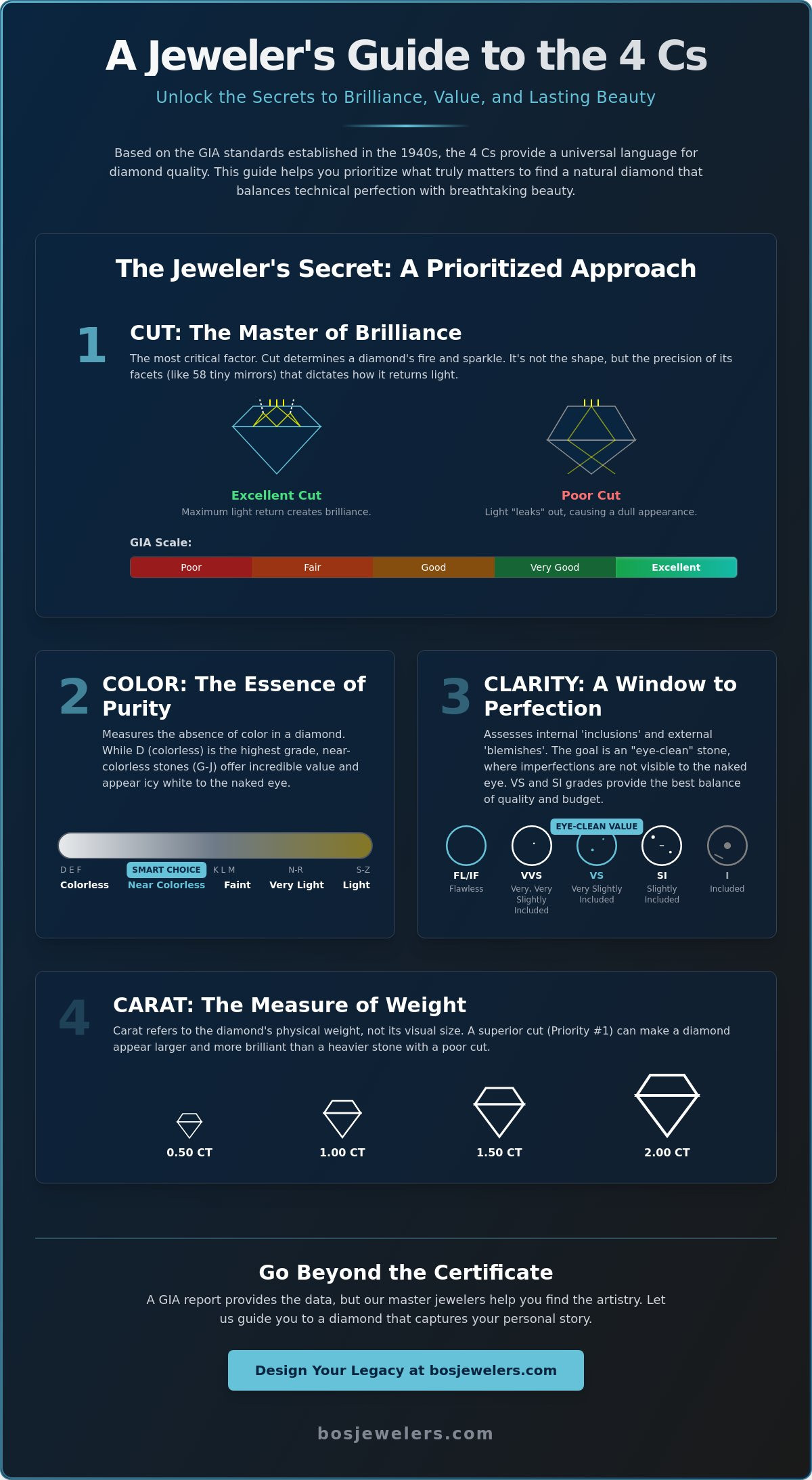
Many people mistake cut for the shape of the diamond, such as round or pear. In reality, cut refers to the technical precision of a stone's facets and how they interact with light. The GIA cut scale, which ranges from Excellent to Poor, evaluates how masterfully a stone was crafted to maximize light return. When a diamond is cut with the correct proportions, its facets behave like 58 tiny, precision-angled mirrors. These mirrors capture light and reflect it back to your eye with breathtaking intensity. This is why high-quality diamond engagement rings always prioritize an Excellent cut grade. A poorly cut stone, even one with perfect color, will appear dull and "leaky," losing light through the bottom or sides instead of reflecting it upward.
Color: The Quest for Colorless Perfection
The GIA color scale measures a diamond's lack of color, starting at D for completely colorless and ending at Z for stones with a visible yellow or brown tint. You can explore the nuances of these grades through The Original 4Cs of Diamond Quality, which remains the definitive resource for natural stones. Most buyers find their perfect match in the "Near Colorless" range (G through J), where the stone appears white to the naked eye but offers significant value compared to the rare D, E, and F grades.
Context is everything when selecting a color grade. For example, if you're designing custom diamond nameplates or intricate gold pendants, the metal choice matters. A diamond with a slight J-grade warmth looks remarkably white when set in 14K yellow gold, as the metal's rich tones mask any subtle tint in the stone. However, for stones set in platinum or white gold, we often recommend staying within the higher color brackets to maintain that crisp, icy aesthetic. If you're ready to see how these grades interact in person, our team is here to help you browse our custom jewelry collections to find the exact brilliance that speaks to your heart.
The Final Two Cs: Diamond Clarity and Carat Weight
After mastering cut and color, you're halfway to understanding what are the 4 Cs of diamond quality. The final two pillars, clarity and carat weight, often involve the most personal decisions in your journey. While clarity speaks to the stone's internal purity, carat weight defines its physical presence and scale. Both factors contribute to the unique story of a diamond, transforming it from a mere gemstone into a masterfully crafted symbol of your legacy. When these elements are balanced correctly, they ensure your jewelry possesses both exquisite beauty and lasting value.
Clarity: Nature's Unique Fingerprints
Clarity measures the rarity of a diamond by examining its internal "inclusions" and external "blemishes." Think of these as nature's fingerprints; they're unique marks formed deep within the earth millions of years ago. The GIA scale ranges from Flawless (FL), where no marks are visible even under 10x magnification, to Included (I), where characteristics may be visible to the naked eye. For most of our clients in Miami, the "sweet spot" for value and beauty lies in the VS1 or VS2 (Very Slightly Included) grades. These stones are typically "eye-clean," meaning the tiny imperfections are invisible without a professional jeweler's loupe. This allows you to choose an exquisite stone that looks perfect to the world while remaining a smart investment. To keep that brilliance alive, regular professional jewelry cleaning at our workshop is essential, as even a thin layer of oil can dull the fire of a high-clarity diamond.
Carat: Beyond the Number
Carat weight is perhaps the most misunderstood of the 4 Cs. A carat is a specific unit of metric weight equal to 200 milligrams. Each carat is divided into 100 "points," much like pennies in a dollar. It's vital to remember that carat refers to weight, not visual size. A diamond's dimensions are heavily influenced by its cut; a stone with an Excellent cut might appear larger than a heavier stone with a Poor, deep cut that hides its weight in the "belly" of the gem.
In the diamond world, "magic numbers" like 1.00 or 2.00 carats carry a heavy psychological weight and a significant price premium. Choosing a stone just under these marks, such as a 0.95-carat diamond, can offer a prestigious look at a more accessible price point. This strategy is particularly effective for milestone pieces like tennis bracelets, where the total carat weight creates a stunning, continuous line of light. We always encourage you to prioritize a masterfully cut stone over a larger, duller one. A slightly smaller diamond with superior light performance will always command more attention than a larger stone that lacks life.
The Art of Selection: Prioritizing the 4 Cs for Your Budget
Mastering the technical definitions is only the beginning of your journey. The true artistry lies in how you balance these factors to create a piece that feels both prestigious and personally meaningful. When you understand what are the 4 Cs of diamond quality, you realize that you don't need a "perfect" grade in every category to own an exquisite stone. Instead, you need a strategy that favors brilliance over technical perfection. We've spent decades at BOS Jewelers Inc helping families in Miami navigate these choices, and we've refined a selection process that maximizes beauty without overextending your investment.
- Prioritize Cut Above All: Never compromise here. An Excellent or Very Good cut grade ensures the stone actually sparkles. A diamond with poor light performance will always look dull, regardless of its size or purity.
- Seek "Eye-Clean" Clarity: Grades like VS2 or SI1 offer incredible value. Since the inclusions are invisible to the naked eye, you're essentially getting the look of a flawless diamond without the extreme price premium.
- Match Color to Your Metal: If you're setting your stone in yellow or rose gold, a Near Colorless grade (G through J) will appear perfectly white. The warmth of the metal masks subtle tints, allowing you to reallocate funds to a larger stone.
- Maximize Carat Last: Once you've secured a brilliant cut and an eye-clean appearance, use the rest of your budget to find the largest carat weight that fits your desired aesthetic.
The Myth of 'Bigger is Better'
A common mistake is chasing a high carat number at the expense of quality. A two-carat stone with a "Fair" cut often looks smaller and less impressive than a 1.5-carat stone with an "Excellent" cut. This is because a well-cut stone reflects light across its entire surface, while a poorly cut one has "dead spots" that make it appear dark and lifeless. This principle applies to everything from solitaire rings to the delicate stones found in 14K gold bangles. A masterfully crafted setting can also enhance a diamond's presence, using clever design to make a modest, brilliant stone look truly substantial.
The Fifth C: Confidence and Heritage
While the technical specs are vital, the source of your diamond provides the final layer of value. Confidence comes from knowing your jeweler isn't just a retailer but a partner in your family's story. Big-box stores often lack the personal touch and technical expertise of an on-site master jeweler. Since our founding, BOS Jewelers Inc has operated as a family-owned pillar of the community. We believe that multi-generational trust is the "Fifth C" that ensures your investment is protected. We invite you to visit our Miami showroom to see these diamonds in motion and receive the expert guidance your milestone deserves.
Crafting Your Legacy with BOS Jewelers Inc
At BOS Jewelers Inc, we believe that understanding what are the 4 Cs of diamond quality is the first step in a lifelong relationship with your fine jewelry. While a GIA report provides the essential technical data, our on-site master jewelers provide the creative soul. We take those four pillars of cut, color, clarity, and carat and weave them into bespoke creations that celebrate your most significant milestones. Whether you're walking through our doors in the heart of Miami for the first time or the tenth, you're treated as part of our heritage. Our expertise ensures that every stone isn't just a grade on a page but a masterfully crafted part of your family story.
Custom Artistry and the 4 Cs
When we design custom diamond nameplates or intricate religious pendants, the 4 Cs become a balancing act of uniformity. A single mismatched stone can disrupt the visual rhythm of a piece, especially in tennis bracelets where light must dance consistently from one diamond to the next. We meticulously hand-select every diamond to ensure a seamless flow of brilliance and color. Beyond the initial creation, we protect your investment through expert ring resizing and technical maintenance. Our master jewelers perform these services on-site; your stone never leaves our trusted hands. This personal oversight is something big-box retailers simply cannot offer, providing you with the peace of mind that your legacy is secure.
A Commitment to Quality for Over 40 Years
Since our founding over 40 years ago, BOS Jewelers Inc has remained steadfast in our commitment to quality over quantity. We focus exclusively on 14K gold and high-grade diamonds because we understand that jewelry is an investment in your future. A diamond's sparkle is only as good as its maintenance; that's why we offer professional cleaning and prong inspection to prevent the loss of your precious stones. Over time, even the strongest settings can wear down. Our team identifies these issues before they become heartaches, performing delicate repairs that preserve the integrity of your piece. We believe that true value is built through longevity and meticulous care.
We invite you to join our family tradition of excellence and artistry. Choosing a diamond is a momentous occasion, and we're honored to be your guides through both the technical specifications and the romantic allure of these timeless gems. Let us help you select a stone that truly reflects the sincerity of your love and the brilliance of your future. Welcome to the family; let us help you create your legacy today.
Begin Your Journey Toward Timeless Brilliance
You now possess the specialized knowledge to navigate the diamond market with absolute confidence. By mastering what are the 4 Cs of diamond quality, you've learned that true brilliance is a deliberate choice led by cut quality and that exquisite value is found in the harmony of eye-clean clarity. These metrics aren't just numbers on a GIA report; they're the foundation of a masterpiece that will tell your family's story for decades to come.
Since 1980, BOS Jewelers has operated with a deep commitment to the Miami community as a family-owned destination for luxury. Our on-site master jewelers maintain an exclusive focus on high-quality 14K gold and hand-selected diamonds to ensure your investment stands the test of time. Explore our masterfully crafted Diamond Engagement Rings and start your legacy today. We're ready to welcome you into our family and help you find the perfect stone that reflects your most sincere milestones.
Frequently Asked Questions
Which of the 4 Cs is the most important when buying a diamond?
Cut is widely considered the most important of the 4 Cs because it directly dictates how a diamond captures and reflects light. A masterfully cut stone can mask a lower color grade or hide tiny inclusions by maximizing brilliance and fire. We always advise our clients to prioritize an Excellent cut grade to ensure their jewelry possesses that unmistakable, head-turning sparkle.
Can I see the difference between a D and an F color diamond with the naked eye?
Most people cannot distinguish between a D and an F color diamond without professional magnification and controlled lighting. Both grades sit within the "Colorless" bracket of the GIA scale. While a D grade represents the absolute peak of rarity, an F grade provides an identical icy appearance to the casual observer, often allowing for a better value on your investment.
What does 'eye-clean' mean in diamond clarity?
An eye-clean diamond is a stone that has no inclusions or blemishes visible to the naked eye when viewed from a standard distance. This characteristic is typically found in diamonds with VS2 or SI1 clarity grades. Choosing an eye-clean stone allows you to enjoy a flawless appearance without paying the significant price premium associated with technically perfect, microscopic clarity grades.
Does a higher carat weight always mean a more expensive diamond?
Carat weight alone does not determine a diamond's price because quality is a balance of all four pillars. A smaller diamond with an Excellent cut and D color will often be more expensive than a larger stone with a Poor cut and visible tint. Understanding what are the 4 Cs of diamond quality helps you see that rarity and beauty are found in the combination of traits, not just size.
How do I know if a diamond's cut is 'Excellent'?
The only certain way to verify an Excellent cut grade is to review the diamond's official GIA grading report. The GIA uses a rigorous scientific process to evaluate light return, fire, and scintillation before assigning a grade. At our Miami workshop, we focus on these top-tier certifications to ensure every custom creation meets the highest standards of craftsmanship and light performance.
Is it worth buying a Flawless (FL) diamond for an engagement ring?
Buying a Flawless diamond is a choice driven by a desire for absolute rarity rather than visual difference. To the naked eye, a Flawless stone looks identical to one in the VVS or VS range. Most families find it more rewarding to invest that portion of their budget into a larger carat weight or a superior cut that provides more visible brilliance.
How often should I have my diamond jewelry professionally cleaned?
You should have your diamond jewelry professionally cleaned and inspected every six months to maintain its radiance and security. Our on-site master jewelers use this time to check the integrity of your prongs and settings, which can wear down over time. Regular maintenance since our founding in 1980 has helped our clients preserve their jewelry as timeless family legacies.
Does the GIA grade lab-grown diamonds using the 4 Cs?
No, the GIA moved away from the traditional 4 Cs for lab-grown diamonds in February 2026. They now use simplified descriptors such as "premium" or "standard" for these stones. This makes knowing what are the 4 Cs of diamond quality even more essential for those purchasing natural diamonds, as it remains the definitive global language for assessing the value of earth-mined gems.