

Traveling with Expensive Jewelry: The Definitive Guide to Security and Care in 2026
In 2024, the global rate for mishandled baggage reached 6.3 bags per 1,000 passengers, a statistic that carries a heavy weight when your luggage holds a cherished diamond tennis bracelet or a custom nameplate. We know the quiet anxiety that follows you through the terminal; the fear that a stone might loosen during an excursion or that a hotel safe isn't as secure as it seems. These traveling with expensive jewelry tips are designed to replace that worry with the quiet confidence of a seasoned traveler. Your legacy pieces deserve to be seen and celebrated, not hidden away out of fear.
You'll learn how to master a foolproof packing system that keeps your 14K gold pendants and engagement rings protected from both theft and physical damage. We'll walk you through the nuances of airport security, including your right to private screenings, and the essential documentation needed for U.S. Customs declarations. This guide offers a complete strategy for technical preparation, logistical discretion, and the professional care required to keep your collection radiant through every time zone.
Key Takeaways
- Perform a simple "Tap Test" at home to ensure your diamond settings are structurally sound before they face the vibrations of international travel.
- Master essential traveling with expensive jewelry tips for maintaining social discretion and utilizing hotel security features to keep your most precious pieces out of sight.
- Learn why your carry-on luggage is the only acceptable place for your 14K gold bangles and diamond tennis bracelets during transit.
- Create a digital inventory of your collection to ensure you have the necessary documentation for customs and specialized insurance coverage.
- Discover the importance of professional post-travel restoration to remove the dulling effects of sunscreens and saltwater from your gold and diamond jewelry.
The Pre-Departure Technical Check: Ensuring Structural Integrity
Before you board your flight, consider the invisible forces at play. The constant, high-frequency vibration of a jet engine or the rhythmic jostling of a train can act as a catalyst for structural failure. Even a secure diamond engagement ring can develop a loose setting after hours of subtle agitation. This is why our first traveling with expensive jewelry tips focus on the physical integrity of your pieces. Throughout the history and significance of jewelry, these objects have been symbols of permanence; yet they require our active stewardship to remain so.
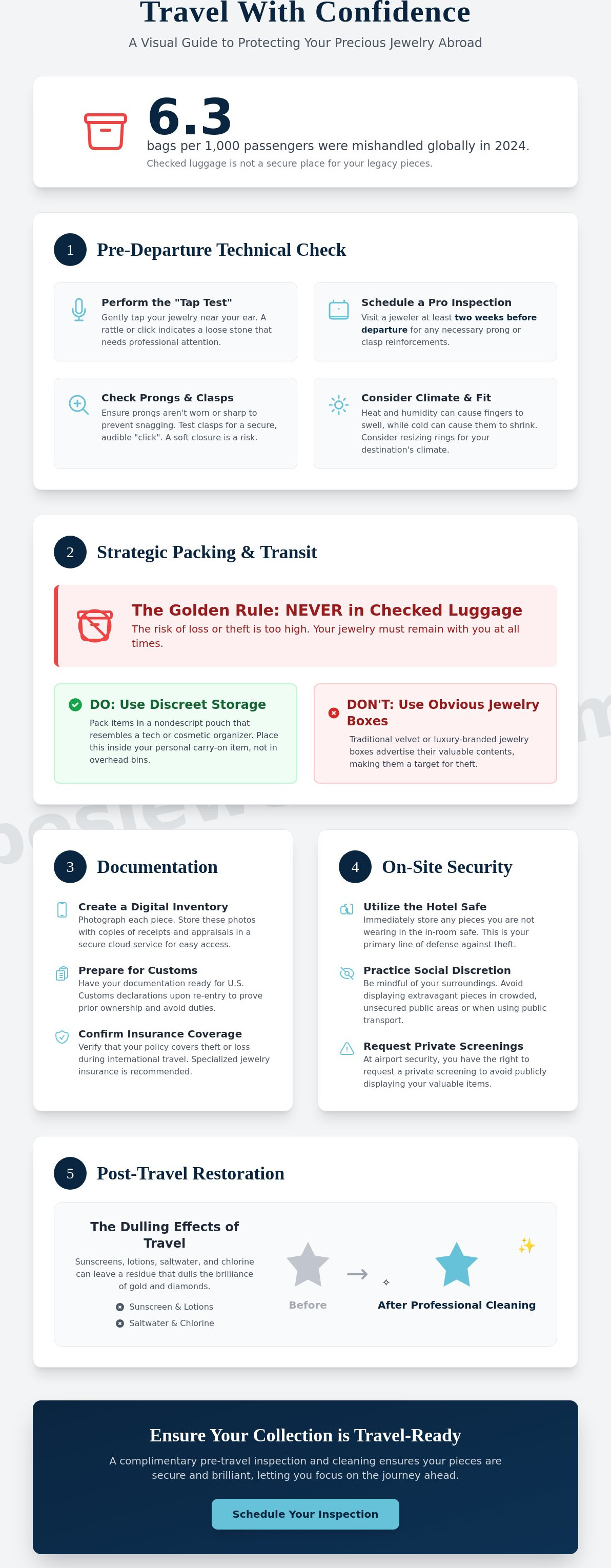
You can perform a preliminary check at home using the "Tap Test." Hold your ring or 14K gold religious pendant close to your ear and gently tap the side of the setting with your fingernail. If you hear a faint metallic click or rattle, the stone is no longer held firmly. While this is a helpful home method, it doesn't replace the trained eye of a master jeweler. We recommend scheduling a professional inspection at least two weeks before your departure. This window allows our artisans to perform any necessary reinforcements without the stress of a looming flight.
The Critical Importance of Prong and Clasp Inspection
Examine your diamond tennis bracelets and 14K gold bangles for thinning prongs. Over time, these delicate metal points can wear down and become sharp, catching on the fine knitwear often worn during travel. A single snag on a cashmere wrap could pull a prong back, leading to the loss of a stone. Testing the audible "click" of a luxury clasp is equally vital. If the closure feels soft or sluggish, it requires attention. Professional prong repair is a small investment that prevents the heartbreak of a lost diamond in a foreign city. We believe that every piece in your collection tells a chapter of your story, and maintaining these small technical details ensures that story continues uninterrupted.
Climate and Fit: Resizing for Your Destination
Your jewelry should feel like a natural extension of your body, but your body changes with the environment. If you're heading to a tropical climate, humidity and heat often cause fingers to swell, making rings uncomfortably tight or even dangerous to circulation. Conversely, cold-water destinations can cause fingers to shrink, creating a risk that your ring might slip off unnoticed during a swim. Ensuring a perfect ring fit through seasonal adjustments ensures your most precious bands stay exactly where they belong. Following these traveling with expensive jewelry tips ensures that your focus remains on the joy of your journey rather than the security of your settings.
Strategic Packing and Transit: The Art of Discreet Luxury
The transition from your home to the airport is the most vulnerable stage of your journey. While your pre-departure technical check ensured your stones are secure, the logistics of transit require a different kind of vigilance. True discretion is an art form. It's about blending the prestige of your collection with the practicalities of modern travel. When considering traveling with expensive jewelry tips, the most vital rule is absolute: never place your valuables in checked luggage. With global mishandled baggage rates holding at approximately 6.3 bags per 1,000 passengers as of 2024, the risk to your legacy pieces is simply too high. Your treasures belong where you can see them.
Choose a travel portfolio that prioritizes protection over outward display. A nondescript, high-quality pouch that looks like a standard tech organizer or a simple cosmetic clutch is far safer than a traditional, velvet-lined jewelry box. Traditional boxes signal their contents to every passerby, whereas a plain pouch keeps your 14K gold pieces hidden in plain sight. For those carrying significant assets, we recommend maintaining comprehensive jewelry insurance to provide an extra layer of peace of mind while you are away from the security of home.
The Carry-On Strategy: Never Let It Leave Your Sight
Your fine jewelry belongs in your personal item, the bag that stays tucked under the seat in front of you. Overhead bins are often reorganized by flight attendants or other passengers, creating opportunities for bags to be shifted or accidentally opened. To navigate security with grace, utilize the "Double Bag" method. Place your jewelry portfolio inside a larger, zippered pouch within your carry-on bag. This prevents small items from falling out if you need to access your passport or tablet. If a security officer needs to inspect your bag more closely, remember that you have the right to request a private screening area. This ensures your diamonds and gold are not exposed in a crowded terminal.
Preventing Tangles and Scratches in Transit
The beauty of 14K gold lies in its radiant finish, but this precious metal can be marred by friction. Each piece, from your 14K gold bangles to your diamond tennis bracelets, should occupy its own soft-lined compartment to prevent metal-on-metal contact. To avoid the frustration of knotted chains, use a simple straw for your gold religious pendants and necklaces. Thread one end of the chain through a clean straw and fasten the clasp; this keeps the links straight and tension-free. Wrapping each item in acid-free tissue paper before placing it in its pouch further preserves the luster of the gold. If your pieces lose their glow during your travels, a professional jewelry cleaning and polishing upon your return will restore their original brilliance.
Security at Your Destination: Safes, Discretion, and Public Presence
Once you arrive at your destination, the focus shifts from the logistics of transit to the nuances of daily awareness. Your hotel room serves as a temporary sanctuary, but it's essential to remember that it remains a semi-public space. Security here is a blend of physical barriers and the psychology of social discretion. We believe that while your diamond tennis bracelet represents a beautiful milestone, it doesn't always need to be the center of attention in unfamiliar environments. These traveling with expensive jewelry tips are designed to help you enjoy your collection with peace of mind, ensuring your legacy pieces remain protected while you create new memories.
Managing in-room services requires a steady, thoughtful approach. When housekeeping or maintenance staff enter your suite, your jewelry should already be secured. Avoid leaving any items, even children's 14K gold earrings, on nightstands or bathroom counters. Even while you're exploring, following expert jewelry care tips from the GIA will help you maintain the integrity of your pieces against the unique environmental factors of your destination, such as different water mineralities or local climates.
Maximizing Hotel Room Security
Your hotel safe is your first line of defense, but you should treat it with healthy skepticism. Before placing your diamond engagement rings or 14K gold religious pendants inside, test the locking mechanism with a simple code and check if the unit is securely bolted to the wall or floor. Some seasoned travelers prefer to use the safe as a primary storage spot while keeping their most significant treasures in a less obvious, portable travel safe. You should never leave jewelry in a suitcase; even a locked bag is easily moved or tampered with. Utilizing the "Do Not Disturb" sign consistently is a simple yet effective way to limit unnecessary foot traffic in your room while you're away.
Discretion in Public: Wear It with Confidence, Not Flash
The art of wearing fine jewelry abroad lies in a balanced presentation. In crowded transit hubs, busy markets, or public squares, consider turning your diamond rings inward so the stones face your palm. This subtle gesture hides the brilliance of the center stone from wandering eyes without requiring you to remove the piece entirely. If you're wearing 14K gold bangles, layering them under the sleeve of a jacket or a light wrap provides a sophisticated look while maintaining a low profile. We often suggest the "Rule of One" for international excursions: choose only one high-value statement piece to wear at a time. This reduces your overall profile while still allowing you to carry a piece of home with you. By following these traveling with expensive jewelry tips, you ensure that your presence is defined by your elegance rather than your vulnerability.
Documentation and Insurance: Protecting Your Legacy Assets
While physical security is your first line of defense, meticulous documentation serves as your ultimate safety net. Your diamond engagement ring or custom diamond nameplate represents more than just gold and stone; these pieces are tangible markers of your most significant life milestones. Protecting that history requires more than a sturdy safe; it requires a digital "Travel Vault." These traveling with expensive jewelry tips ensure that even in the face of the unexpected, you are never without recourse. If an item is lost or stolen abroad, your ability to provide immediate, detailed proof of ownership is the difference between a successful recovery and a permanent loss.
In 2026, the standard for documentation has evolved beyond simple paper receipts. We recommend maintaining a secure, cloud-based folder accessible from any device. This vault should contain high-resolution photographs of each piece, specifically focusing on hallmarks, unique diamond inclusions, and the overall craftsmanship. These "before" photos are critical for insurance claims, as they verify the condition of the item immediately prior to your departure. If you are returning to the U.S., remember that you must declare all jewelry acquired abroad to U.S. Customs and Border Protection. Having your digital receipts ready ensures you can navigate the $800 personal duty-free exemption with ease and transparency.
The Essential Jewelry Travel Inventory
Creating an inventory is a meditative process that reinforces the value of your collection. For every item, from children's 14K gold earrings to intricate diamond tennis bracelets, include the original grading certificates and a professional appraisal dated within the last two years. Markets fluctuate, and an outdated appraisal may leave you underinsured. Storing these documents in an encrypted cloud service allows you to share them instantly with local authorities or insurance agents if needed. This level of preparation provides a quiet confidence that allows you to focus on the beauty of your destination rather than the "what ifs" of travel.
Understanding Travel Insurance Riders
Many travelers mistakenly believe their standard homeowners insurance or basic travel policy provides full international protection. In reality, standard travel insurance policies in 2026 often have low coverage limits for valuables, sometimes capping at a few hundred dollars. You must look for specific language regarding "Replacement Cost" versus "Actual Cash Value." Replacement cost ensures you can acquire a piece of identical quality, whereas actual cash value only pays the depreciated amount. Be wary of exclusions for "mysterious disappearance," a common clause that can void a claim if you cannot prove a specific instance of theft. Before you fly, we invite you to visit us for expert appraisal and maintenance services to ensure your documentation is as flawless as your jewelry itself.
If the unthinkable happens and a piece is lost, act immediately. File a local police report, as this document is almost always required by insurance providers. Contact your insurance agent within 24 hours to initiate the claim while the details are fresh. Finally, reach out to your trusted jeweler; we can often assist by providing duplicate records or advising on the technical specifications needed for a precise replacement of your cherished 14K gold and diamond pieces.
Post-Travel Restoration: Returning Brilliance to Gold and Diamonds
The final chapter of your journey begins once you step back across your own threshold. While the memories of your trip remain vivid, your jewelry often carries a silent, dulling record of the environments it has traversed. These traveling with expensive jewelry tips are incomplete without addressing the essential restoration required after exposure to the elements. From the fine sands of a Mediterranean beach to the treated waters of a resort pool, your 14K gold and diamond pieces have likely encountered substances that compromise their radiance. Your collection deserves a return to its original splendor before it is tucked away for its next occasion.
A thorough post-travel inspection is just as vital as the pre-departure check we performed weeks ago. The rigors of international transit, combined with the chemical toll of sunscreens and lotions, can leave a stubborn film on your diamond engagement rings or custom nameplates. This residue does more than just dim the sparkle; it can hide small structural issues that may have developed during your excursions. Returning your collection to its original state is a celebration of the journey itself, ensuring each piece is ready to tell its next story with clarity and brilliance.
The Impact of Sand, Salt, and Chemicals
Sand is perhaps the most deceptive traveler's companion. While it feels soft underfoot, sand consists of tiny, abrasive minerals that can create micro-abrasions on the surface of 14K gold bangles and religious pendants. Over time, these minute scratches dull the metal's reflective quality, robbing it of its mirror-like finish. Saltwater presents a different challenge. As it evaporates, it leaves behind crystalline deposits that can irritate the skin and lodge themselves deep within intricate diamond settings. If left unaddressed, these crystals can act as a grinding agent against the metal.
Chlorine remains the silent enemy of fine jewelry. It's a harsh chemical that can actually leach the alloys from 14K gold, potentially making settings brittle over time. While a gentle rinse in lukewarm, filtered water at home can remove surface debris, it cannot reach the buildup tucked beneath a diamond tennis bracelet's prongs. Professional care is necessary to safely neutralize these chemicals without damaging the structural integrity of your legacy assets. We recommend a professional assessment to ensure that your time in the sun hasn't compromised the longevity of your gold.
A Personal Invitation to Professional Care
We view ourselves as more than intermediaries; we are the dedicated guardians of your most precious milestones. As a multi-generational establishment, we understand that a diamond religious pendant or a pair of children's 14K gold earrings carries immense emotional weight. Our professional cleaning and polishing service is designed to be the final, restorative step of your travels. Our expert artisans use specialized, non-abrasive techniques to gently lift away every trace of your journey, revealing the untouched brilliance beneath the surface.
During this process, we also re-examine every prong and clasp for any signs of wear. The vibrations of travel and the physical activity of a vacation can occasionally loosen a setting that was secure when you left. By concluding your trip with a visit to our gallery, you ensure your collection is not only clean but structurally sound for years to come. We invite you to share your stories with us while we restore your treasures, continuing the personal history we've built together through every milestone of your life.
Secure Your Legacy for Every Destination
Your most cherished pieces are more than mere adornments; they are the shimmering threads of your personal history. By integrating these traveling with expensive jewelry tips into your travel ritual, you ensure that your 14K gold bangles and diamond engagement rings remain as vibrant as the memories you create abroad. From the initial technical "Tap Test" to the final post-travel restoration, a proactive approach transforms potential anxiety into absolute confidence. True luxury is the ability to enjoy your treasures without a shadow of worry.
We invite you to partner with us to protect the brilliance of your collection. With over 40 years of family-owned expertise and on-site master jewelers dedicated to 14K gold and diamond preservation, we provide the technical mastery your legacy deserves. Ensure your fine jewelry is travel-ready with a professional inspection at BOS Jewelers Inc before you set flight. Whether you're navigating a bustling terminal or enjoying a quiet sunset, your treasures should always reflect the light of your journey. May your next adventure be as radiant as the diamonds you carry with you.
Frequently Asked Questions
Can I wear my diamond engagement ring through airport security?
You can certainly wear your fine jewelry through the security checkpoint. Most gold and diamond pieces don't contain enough magnetic metal to trigger a detector. However, if you're carrying high-value items in your bag, you have the right to request a private screening. This is one of the most essential traveling with expensive jewelry tips to protect your privacy and ensure your treasures aren't exposed in a crowded terminal.
Should I use the hotel safe or a portable travel safe?
The most secure strategy is to use both in a layered approach. While a hotel safe is a standard amenity, hotel staff often have access to override codes for emergencies. By placing your 14K gold bangles and diamond tennis bracelets inside a locked, portable travel safe and then securing that unit inside the hotel safe, you create a dual barrier. This significantly reduces the risk of unauthorized access during your stay.
Is it safe to wear 14K gold jewelry in the ocean or pool?
We strongly advise you to remove your fine jewelry before entering the water. Chlorine is a harsh chemical that can slowly leach the alloys from 14K gold, potentially making your diamond settings brittle and prone to failure. Saltwater is equally problematic, as it can leave abrasive crystalline deposits in delicate hinges. For the longevity of your collection, it's best to leave your pieces secured in your room before you head to the shore.
How do I pack necklaces so they don’t tangle while traveling?
The most effective method to prevent knots is threading your chain through a clean drinking straw. Simply slip one end of the chain through the straw and fasten the clasp. For your 14K gold religious pendants or custom diamond nameplates, wrap the pendant itself in acid-free tissue paper before placing the straw-protected chain into a soft, individual pouch. This simple technique ensures your necklaces are ready to wear the moment you arrive.
What should I do if my jewelry is lost or stolen during a trip?
Act immediately by filing a formal report with both the local police and your hotel's security department. You'll need a copy of this police report to initiate a claim with your insurance provider. Utilize your digital "Travel Vault" to provide authorities with high-resolution photographs and current appraisals. Contacting your trusted jeweler right away is also helpful, as they can provide the technical specifications required for a precise replacement of your cherished pieces.
How often should I have my jewelry appraised for travel insurance?
We recommend a professional appraisal every two years to reflect current market values for gold and diamonds. Because the cost of precious metals and stones fluctuates, an outdated appraisal may leave you underinsured in the event of a loss. Keeping your documentation current is a vital part of our traveling with expensive jewelry tips, ensuring that your insurance coverage truly reflects the replacement cost of your legacy assets in 2026.
Can I bring jewelry cleaning solution on a plane in my carry-on?
You can bring liquid cleaners if the container is 3.4 ounces or less to comply with TSA regulations. However, to avoid the risk of a spill in your bag, we suggest traveling with a professional jewelry polishing cloth instead. These specialized cloths are dry, safe for all travel, and remarkably effective at maintaining the brilliance of your 14K gold and diamond pieces without the need for liquids or chemicals during your journey.
Is it better to travel with 14K gold or 18K gold jewelry?
14K gold is generally the superior choice for travel due to its exceptional durability. Because it's alloyed with a higher percentage of stronger metals than 18K gold, it's more resistant to the scratches and bends that can occur during active excursions. Whether you're wearing 14K gold bangles or diamond earrings, you'll appreciate the added structural integrity and peace of mind that this resilient metal provides while you're away from home.