
The Connoisseur’s Guide to Emerald Cut Engagement Ring Settings in 2026
An emerald cut diamond is not a stone that hides its flaws; it is a masterpiece of transparency that demands an architectural frame rather than a simple mount. You likely chose this cut for its sophisticated hall-of-mirrors effect and vintage allure. We understand the hesitation that comes with such a clear stone. You want to ensure those vulnerable corners are protected without muting the diamond's natural light. With emerald cut popularity rising by 50% since early 2025, finding the right balance between security and elegance is more vital than ever.
This guide will help you master the art of selecting emerald cut engagement ring settings that enhance brilliance while masking inclusions. Whether you are considering a natural stone at the current average price of $2,839 or a GIA-graded premium lab-grown diamond, the right setting transforms a gem into a legacy. At BOS Jewelers, our on-site master jewelers have spent decades perfecting these custom creations in our Miami workshop. We will preview the top 2026 trends, including protective bezel settings and the modern East-West orientation, to ensure your ring remains a timeless masterpiece for generations. Welcome to the family.
Key Takeaways
- Understand how the unique step-cut architecture creates the "hall of mirrors" effect and why the setting acts as a vital frame for this clarity-focused stone.
- Discover how different emerald cut engagement ring settings, from minimalist solitaires to vintage-inspired halos, can maximize the stone’s perceived size and surface area.
- Learn the technical differences between V-prongs and claw prongs to ensure your diamond's vulnerable corners remain secure without compromising on elegance.
- Identify your ideal length-to-width ratio between 1.30 and 1.50 to ensure the diamond's proportions perfectly complement your finger.
- Explore the bespoke advantage of on-site master jewelers, ensuring every facet of your ring is crafted with precision and 40 years of family heritage.
The Architectural Allure of Emerald Cut Engagement Ring Settings
Choosing an emerald cut is a statement of confidence. Unlike round diamonds that rely on a chaotic dance of light to hide imperfections, the emerald cut is unapologetically transparent. It doesn't sparkle in the traditional sense; instead, it glows with a rhythmic, steady light known as the "hall of mirrors" effect. This unique visual profile requires a specific approach to design. When we craft emerald cut engagement ring settings at our Miami workshop, we don't just see a ring; we see an architectural frame designed to protect and project the diamond's deep, clear soul.
Step-Cut vs. Brilliant Cut: Setting the Stage
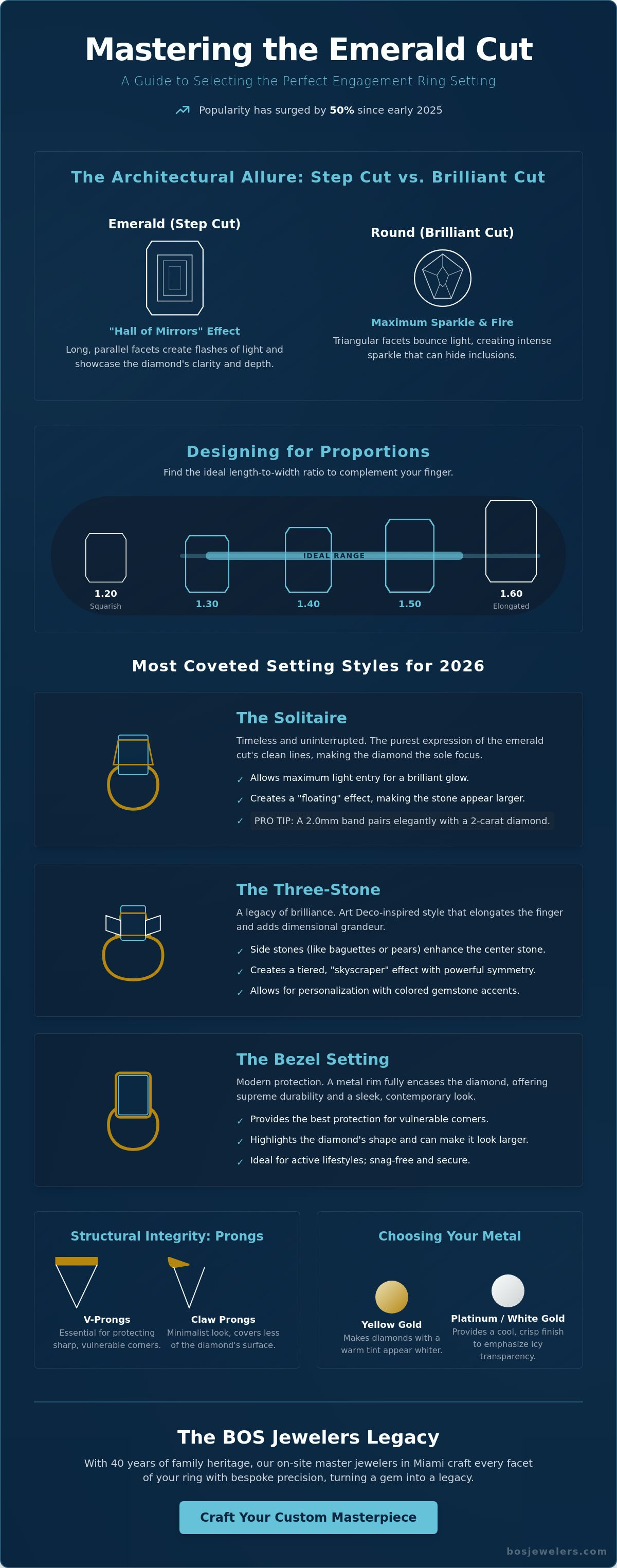
The fundamental difference between these styles lies in their geometry. While a round brilliant cut uses triangular facets to maximize "fire," the emerald cut utilizes long, rectangular "steps." These parallel facets draw the eye deep into the stone rather than bouncing light off the surface. For a deeper understanding of these technical variations, you can explore this Diamond Cut Overview which details how step-cuts differ from their brilliant counterparts. Because these stones feature a large, open table, the setting must allow light to enter from the sides to prevent the diamond from looking "flat." Our on-site master jewelers often recommend open-basket designs to ensure those clean lines of light remain uninterrupted.
Why Setting Choice Matters More for Emerald Cuts
Emerald cuts are the fourth most popular diamond shape, and their popularity has grown by 50% over the last year. However, their clarity is a double-edged sword. Because the facets are so large and open, they show color and inclusions more easily than a princess or cushion cut. The metal you choose for your setting acts as a backdrop that can either highlight or mask these traits. For example, setting a stone with a slight warm tint in 14K yellow gold can make the diamond appear whiter by comparison. Conversely, a platinum or white gold setting provides a cool, crisp finish that emphasizes the stone’s icy transparency. You also have to consider the balance between vintage charm and modern minimalism. A sleek, thin band can make the diamond appear larger, while a heavy, ornate setting might overwhelm the stone's sophisticated geometry.
A superior emerald cut setting must prioritize the precise alignment of the stone's parallel facets to ensure the hall of mirrors effect remains undistorted and structurally sound.
Comparing the Most Coveted Emerald Cut Setting Styles
Selecting the right frame for your diamond is a deeply personal journey. While the stone provides the soul, the setting provides the personality. In 2026, we're seeing a beautiful shift toward both ultra-minimalist and highly architectural styles. Understanding how different emerald cut engagement ring settings interact with light will help you choose a piece that feels like a true extension of your story. Whether you crave the quiet strength of a solitaire or the intricate detail of a multi-stone design, your choice should celebrate the diamond's unique geometry.
The Solitaire: Timeless and Uninterrupted
A solitaire is the purest expression of the emerald cut's clean lines. We typically recommend a four-prong configuration to allow maximum light entry through the stone's sides, though six prongs offer a bit more security for larger stones. For those seeking a "floating" effect, a high-set peg head allows the diamond to sit proudly above the band. When designing these, we carefully match the band width to the stone's carat weight. A 2-carat diamond often pairs beautifully with a 2.0mm band to ensure the proportions feel balanced and elegant without distracting from the main event.
The Three-Stone: A Legacy of Brilliance
For a look steeped in history, the three-stone setting is unrivaled. This style often draws inspiration from Art Deco Jewelry History, where geometric symmetry was the gold standard. Pairing your center stone with tapered baguettes creates a tiered, skyscraper effect that elongates the finger. If you prefer a softer silhouette, pear-shaped side stones or even colored gemstones, which have seen a 111% increase in popularity over the last 12 months, can round out the sharp corners. This approach is a hallmark of our custom work at BOS Jewelers, where we help you navigate The Ultimate Guide to Diamond Engagement Rings to find your signature style.
The Halo: Enhancing the Emerald's Footprint
The halo setting is a masterclass in light play. For an emerald cut, a traditional halo adds significant surface area, making the diamond appear larger than its actual carat weight. It's also a clever way to mask slight color tints in stones. If you want a more subtle glow, a hidden halo sits tucked beneath the center stone, visible only from the side. This adds a secret sparkle that only you and your partner know is there. We recommend choosing delicate pavé for the halo to avoid overwhelming the sophisticated, quiet nature of the center piece.
The bezel setting has also emerged as a top choice for the modern woman in 2026. By encircling the diamond in a thin rim of 14K gold, you gain the ultimate level of security for an active lifestyle. It's sleek, snag-free, and highlights the rectangular shape with bold, metallic lines. If you're ready to start your journey, our team would love to show you our latest custom designs in our Miami showroom.
Structural Integrity: Prongs, Metals, and Protecting the Step-Cut
The emerald cut is celebrated for its hall-of-mirrors effect, yet its structural vulnerability is a detail often overlooked by less experienced retailers. Unlike rounded shapes that distribute impact, the clipped corners of a step-cut diamond are its most delicate points. Without the right emerald cut engagement ring settings, these corners are susceptible to chipping if they strike a hard surface. Protecting your investment requires a balance of expert metalwork and a deep understanding of diamond geometry.
V-prongs offer the most robust protection by literally hugging the corners of the stone in a protective metal "V." This style is particularly effective for larger stones where the corner surface area is more pronounced. If you prefer a more minimalist aesthetic, claw prongs provide a sharp, elegant look that mimics the diamond's own facets. However, claw prongs leave the extreme edges of the stone slightly more exposed. Our on-site master jewelers in Miami always evaluate the specific depth and girdle thickness of your diamond before recommending the prong style that best secures your legacy.
At BOS Jewelers, we believe your heirloom deserves a foundation that matches its brilliance. We work exclusively with 14K and 18K gold because of their superior durability and lasting value. You won't find silver in our showroom; it simply lacks the structural integrity required to secure a high-value diamond for a lifetime. This commitment to quality ensures that your ring remains as secure today as it will be for the next generation.
Choosing the Right Metal for Your Legacy
14K gold is the standard for a reason. It offers a perfect blend of 58.3% pure gold and alloy metals that provide the hardness necessary for everyday wear. While 14K white gold provides a crisp, modern finish, 14K yellow gold is currently the top-selling choice for 2026, offering a warm glow that complements the vintage Art Deco roots of the emerald cut. For more insight into how we select our materials, you can explore The Essential Guide to 14K Gold Bangles, which details our standards for metal quality and artistry.
Prong Security and Maintenance
Securing a rectangular stone requires a precisely carved "seat" within the prong. This is a small groove where the diamond's girdle rests perfectly. If this seat is too shallow, the stone may wobble; if it's too deep, the prong becomes weak. We recommend having your prongs checked by a professional every six months to ensure they haven't thinned or shifted. If you ever notice a snag on your clothing or hear a slight rattle, it is time for a professional evaluation. You can learn more about our restoration services in our guide to Ring Resizing and Prong Repair, where we explain how we maintain the integrity of your most precious pieces.
Designing for Proportions: Finding Your Ideal Ratio
An emerald cut diamond is a study in geometry. While its clarity is paramount, its silhouette is what defines its character on your hand. The "perfect" length-to-width ratio typically falls between 1.30 and 1.50, though the best choice is often a matter of personal aesthetic. A ratio closer to 1.30 offers a fuller, more substantial look, while a 1.50 ratio creates a slender, elongated appearance. Your choice of emerald cut engagement ring settings should act as a partner to these proportions, either accentuating the length or adding much-needed width to a narrower stone.
The specific length-to-width ratio of your diamond dictates the precise placement of the prongs to ensure the stone's structural balance and visual symmetry remain flawless.
The East-West Setting: A Modern Twist
In 2026, we've seen a bold departure from tradition with the rise of the East-West orientation. By setting the diamond horizontally across the finger, you create a look that is both avant-garde and remarkably practical. This orientation naturally lowers the stone's profile, making it an ideal choice for those with active lifestyles who want to avoid snags. It's a particularly flattering choice for those with longer fingers, as the horizontal line breaks up the vertical plane of the hand. Our Miami workshop has seen a surge in requests for this style, often crafted in 14K yellow gold to bridge the gap between modern design and vintage warmth.
Balancing the Band and the Stone
The band is the foundation of your ring's visual weight. For a larger, deep-set emerald cut, a thin 1.5mm band might feel physically and visually precarious. We're seeing a resurgence of the "cigar band" style, with widths reaching 4mm to 6mm, providing a bold, sculptural base for the diamond. Conversely, a tapered band that narrows as it approaches the stone can create an optical illusion, making the diamond appear significantly larger than its actual carat weight. When we design these custom pieces, we ensure the wedding band will sit flush against the engagement setting, preventing unnecessary friction and wear on the gold prongs. If you're ready to find the silhouette that speaks to you, schedule a consultation with our on-site master jewelers to begin your custom design.
Whether you prefer a sleek, straight band or a more ornate, sculptural design, the goal is always to create a harmonious balance. A well-proportioned setting doesn't just hold the diamond; it elevates it. By considering both the ratio of the stone and the width of the band, we help you create a bespoke heirloom that feels as though it was made specifically for your hand. We take pride in this meticulous approach, ensuring that every 14K gold creation leaving our workshop is a testament to your unique legacy.
The BOS Jewelers Legacy: Crafting Your Custom Emerald Cut Masterpiece
For over 40 years, BOS Jewelers has stood as a pillar of the Miami community, transforming raw 14K gold and loose diamonds into symbols of enduring love. When you choose an emerald cut, you're choosing a stone that reveals everything. It's only fitting that its frame be just as transparent in its quality. Mass-market retailers often rely on pre-fabricated, high-volume molds that fail to account for the subtle depth or unique length-to-width ratio of your specific diamond. Our emerald cut engagement ring settings are different. They are masterfully crafted on-site by jewelers who understand that a fraction of a millimeter can be the difference between a secure stone and a lost heirloom.
The quiet confidence of a BOS Jewelers piece comes from our identity as a family-owned heritage brand. We don't just sell jewelry; we create it. By maintaining an on-site workshop, we eliminate the risks associated with shipping your precious materials to third-party factories. This proximity allows our master jewelers to hand-set every stone, ensuring the prongs are perfectly aligned with the diamond's step-cut facets. This level of precision is why our custom settings are superior to mass-produced alternatives, offering a bespoke fit that celebrates the sophisticated architecture of your chosen diamond.
The Custom Design Journey
Your journey begins with a personal conversation rather than a generic catalog. We start with a conceptual sketch, ensuring the architecture of the ring complements the specific proportions of your diamond. Because we're a family-owned establishment with on-site master jewelers, your ring never leaves our care. From the initial 14K gold casting to the final hand-polishing, every step happens right here in Miami. This level of oversight ensures the "seat" for your diamond is carved with absolute precision, providing a home for your stone that is as safe as it is beautiful. You'll work directly with our experts to select a diamond that meets our rigorous standards for clarity and brilliance.
Celebrate Your Milestone with Confidence
An engagement ring is more than a piece of jewelry; it's the first chapter of your family's legacy. We take that responsibility seriously, offering the warmth of a family business alongside the prestige of high-end luxury. When you work with us, you aren't just a customer; you're part of a multi-generational tradition of craftsmanship. Our commitment doesn't end when you walk out the door. We invite you back for regular cleanings and prong inspections to ensure your masterpiece remains pristine for decades to come. Let us help you create a piece that reflects the depth of your commitment and the brilliance of your future together. Explore our custom engagement ring gallery and discover the BOS difference today. Welcome to the family.
Your Journey Toward a Timeless Legacy
Your engagement ring is the silent narrator of your love story. We've seen how the most exquisite emerald cut engagement ring settings do more than just hold a stone; they protect its soul. By prioritizing structural integrity through V-prongs and selecting 14K gold for its lifelong durability, you're ensuring your diamond's hall-of-mirrors effect remains clear and brilliant. Remember that the ideal 1.30 to 1.50 ratio is only part of the equation. The true magic happens when a master jeweler aligns those facets with a bespoke frame.
Since 1983, our family-owned business has focused on the artistry that mass-market retailers often overlook. With our on-site master jewelers, your ring receives the individual attention it deserves, from the first sketch to the final hand-polish. We invite you to Design Your Custom Emerald Cut Legacy with BOS Jewelers and experience the sincerity of a heritage brand. Let's create something timeless together. Welcome to the family.
Frequently Asked Questions
Is an emerald cut diamond more likely to chip in certain settings?
Emerald cuts are more prone to chipping at their clipped corners due to the vulnerable nature of step-cut geometry. Standard four-prong emerald cut engagement ring settings leave these edges more exposed to accidental impact. We recommend V-prongs or bezel frames to provide a protective metallic shield around these delicate points, ensuring your stone remains pristine for a lifetime.
What is the best metal for an emerald cut engagement ring?
14K gold is the premier choice for durability and longevity in 2026. While platinum remains a classic option, 14K yellow gold is currently our top-selling metal because it provides a warm contrast to the diamond's icy transparency. It's a robust material that holds prongs securely; we don't use silver because it lacks the structural integrity required for high-value diamonds.
Do emerald cut diamonds look smaller than round diamonds of the same carat weight?
Emerald cuts often appear smaller than round diamonds because they are cut deeper to achieve that hall-of-mirrors effect. A 1-carat round brilliant typically has a 6.4mm diameter, whereas a 1-carat emerald cut might have a narrower face. You can maximize the perceived size by choosing a halo setting or a thinner band to enhance the stone's footprint on the finger.
What is the most secure setting for an emerald cut diamond?
The bezel setting is the most secure option for an active lifestyle. By encircling the entire perimeter of the stone in 14K gold, you eliminate the risk of snagging or corner damage. If you prefer a more traditional look, a V-prong design provides superior corner protection compared to standard round prongs, balancing safety with sophisticated elegance.
Can I customize a vintage-style setting for a modern emerald cut?
You can easily blend Art Deco aesthetics with modern emerald cut engagement ring settings. Our on-site master jewelers specialize in taking vintage inspirations, such as milgrain edges or tapered baguettes, and adapting them to the precise measurements of a modern diamond. This bespoke approach ensures a perfect fit that mass-market rings simply can't achieve.
How do I choose the right length-to-width ratio for my setting?
Your choice should depend on whether you want a "stout" or "elongated" look on your hand. A 1.30 ratio appears more square and substantial, while a 1.50 ratio creates a slender, lengthening effect. Since emerald cut popularity has increased by 50% since early 2025, many are opting for the more elongated 1.45 to 1.50 range to flatter the hand's natural lines.
Why should I choose a custom setting over a pre-made one?
Custom settings offer a level of precision that protects your investment from becoming a lost heirloom. Because every emerald cut has a unique depth and girdle thickness, a pre-made "one size fits all" head can result in a loose stone or thinned prongs. At BOS Jewelers, our 40 years of expertise ensures your setting is built specifically for your diamond's unique architectural requirements.
What is a 'hidden halo' and does it work with emerald cuts?
A hidden halo is a circle of small diamonds tucked just below the girdle of the center stone. It works exceptionally well with emerald cuts because it adds a subtle, modern sparkle without distracting from the diamond's clean, geometric lines. It's a perfect way to add a "secret" brilliance that's only visible from the side profile, keeping the top view crisp and classic.