

Signs Your Diamond is Loose in Its Setting: A Master Guide to Jewelry Security (2026)
You're reaching for your keys when you hear a faint, metallic click coming from your hand. That tiny sound can send a wave of panic through anyone, as it's often one of the first signs your diamond is loose in its setting. We understand that your jewelry represents more than just 14K gold and precious stone; it's a vessel for your most cherished memories and a significant financial investment. It's natural to feel a sense of dread when you suspect your heirloom might be at risk, especially with the 2026 trend toward larger center stones and intricate vintage metalwork.
You don't have to live with that anxiety or wait for a catastrophe to happen. We'll show you how to perform professional sensory tests and identify specific visual cues at home to ensure your stone remains exactly where it belongs. This guide provides the clarity you need to distinguish between minor wear and a critical emergency. We'll help you gain the confidence to inspect your pieces like an artisan, ensuring your most beloved rings and pendants are secure for generations to come.
Key Takeaways
- Discover how daily activities and environmental changes subtly affect your jewelry's architecture through metal fatigue and prong wear.
- Master the professional "Fingernail Tap" and other tactile methods to identify the subtle signs your diamond is loose in its setting before a minor wiggle becomes a heartbreaking loss.
- Learn why certain designs, from classic solitaires to intricate pavé settings, require specific inspection techniques to ensure every stone is secure.
- Understand the essential immediate steps to take if you detect movement, including proper storage to prevent further damage or loss.
- Distinguish between professional repair techniques like retipping and reheading to make informed decisions about preserving your jewelry’s legacy and structural grace.
Why Fine Diamond Settings Lose Their Security Over Time
A diamond is the hardest natural substance on earth, yet the precious metal that cradles it is surprisingly delicate. We often view our jewelry as static, unchanging objects. In reality, your 14K gold rings and pendants are dynamic. They respond to the world around them. Over years of devoted wear, the gold prongs that secure your stone undergo subtle physical changes. Metals expand and contract with temperature shifts; they react to the pressure of your grip and the friction of your daily life. This constant interaction eventually leads to the structural shifts that create the first signs your diamond is loose in its setting.
Daily life presents a series of invisible challenges to jewelry security. Friction is perhaps the most persistent thief of metal. Every time your ring brushes against a silk scarf, a wool sweater, or even the inside of a pocket, a microscopic amount of gold wears away. We call this metal fatigue. Over a decade, those sturdy prongs can thin into fragile wires. Beyond gradual wear, impact trauma remains a leading cause of stone displacement. A single sharp "clink" against a granite countertop or a heavy door handle can be enough to shift a prong or knock a stone out of its carefully carved seat. You might not see the damage immediately, but the structural integrity has been compromised.
Interestingly, your daily beauty routine can actually hide these vulnerabilities. Lotions, soaps, and natural skin oils often collect behind the diamond. This buildup acts as a temporary, grimy "glue" that holds a loose stone in place. You might believe your stone is secure simply because it isn't rattling, but you are looking at a false sense of security. This is why a professional cleaning is often the moment of truth for many of our clients.
The Metallurgy of Setting Failure
In our workshop, we frequently see how 14K gold behaves over multi-generational timelines. While gold is prized for its balance of beauty and durability, it can become brittle if it is not cared for properly. There is a profound difference between a prong that has simply bent out of shape and a "bead" in a pavé setting that has worn down to nothing. A bent prong can often be gently realigned by an expert artisan; however, a worn-down setting requires more intensive restoration. When we perform a professional cleaning and polishing, we strip away the accumulated debris that masks these issues, often revealing movement that was previously undetectable to the eye.
Manufacturing vs. Environmental Factors
Not all loose stones are the result of wear. Sometimes, environmental factors intersect with the original craftsmanship. For instance, when we perform a ring resizing, the physical manipulation of the band can occasionally put tension on the side stones of a multi-stone design. It's a delicate balance that requires the steady hand of a seasoned jeweler. Additionally, modern tools like ultrasonic cleaners are wonderful for restoring brilliance, but their high-frequency vibrations can actually finish the job of shaking a stone loose if the setting was already compromised by a hard knock or a poorly cut seat. Understanding these nuances helps you stay vigilant about the signs your diamond is loose in its setting.
- 14K Gold Expansion: Metal reacts to heat and pressure, shifting the "seat" of the stone.
- Thinning Prongs: Constant friction against fabrics slowly removes metal over time.
- Hidden Looseness: Dirt and oils can temporarily stabilize a stone that is actually at risk.
- Impact Displacement: Hard surfaces can instantly knock a diamond out of alignment.
The Sensory Inspection: Three Ways to Test Your Diamond’s Security
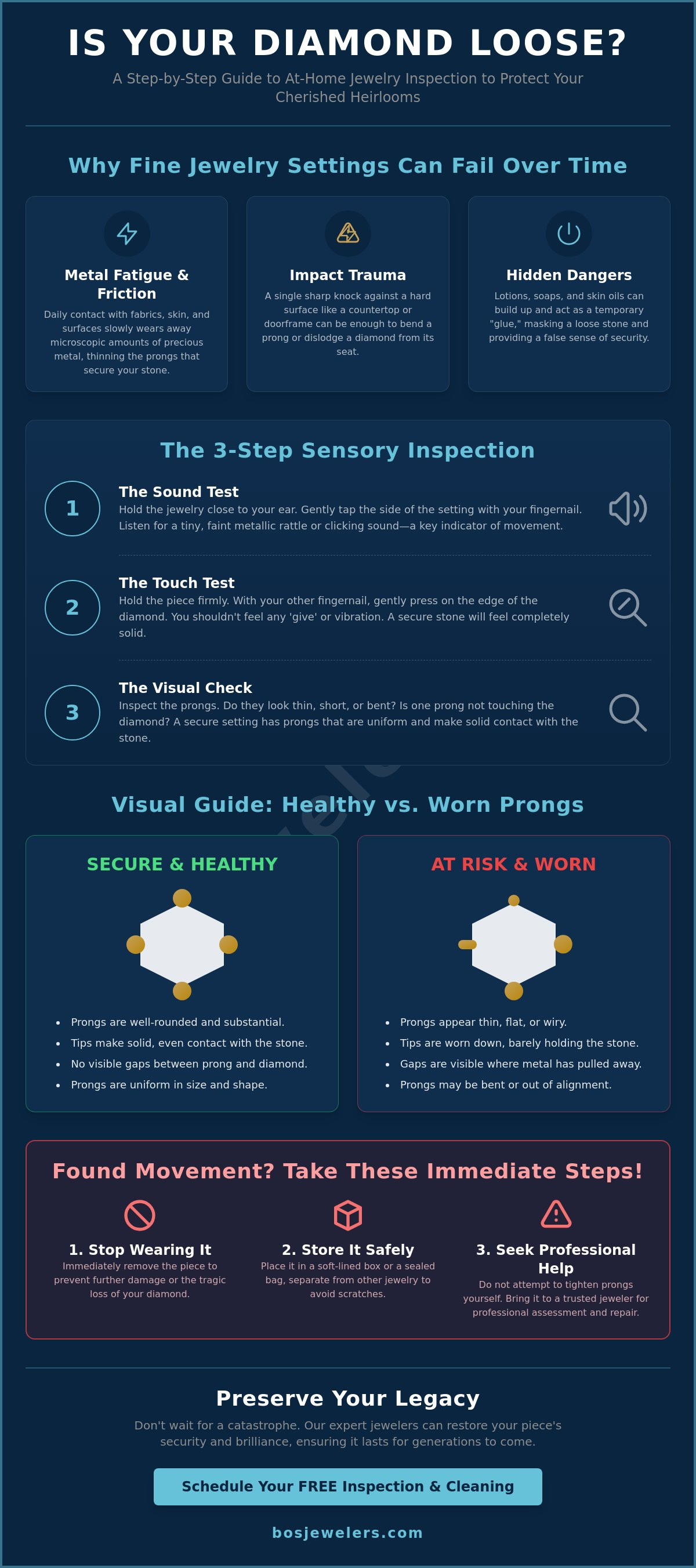
Before you begin your inspection, ensure your piece is pristine. As we discussed earlier, accumulated oils and lotions act as a stabilizer, masking the very movement you're trying to find. A quick soak in warm water with mild dish soap clears the path for an accurate assessment. Once the piece is dry, you can begin the process of identifying the subtle signs your diamond is loose in its setting. We believe that every owner should possess the confidence to perform these basic checks at home, bridging the gap between admiring your jewelry and truly understanding its structural health.
The most effective method is the Fingernail Tap. Hold your ring firmly by the band between your thumb and forefinger. Use the tip of your fingernail to gently press against the table, which is the flat top of the diamond, or the girdle, the thin outer edge. You aren't looking for the stone to wobble visibly. Instead, you're feeling for a minute vibration or a "give" that shouldn't exist in a well crafted piece. If the stone shifts even a fraction of a millimeter, it's a clear signal that the prongs have lost their tension. While some suggest using metal tweezers for this, we advise against it. Metal tools can easily scratch 14K gold or chip the diamond's edge. Your own touch is a far more sensitive and safe instrument.
The Sound of Insecurity: The Shake and Tap Tests
Listen for a distinctive metallic click. Hold the jewelry close to your ear and tap the side of the band with your index finger. Be careful to distinguish between the sound of a loose center stone and the movement of a decorative charm or the hinges of a specialized Euro-shank. A secure diamond is perfectly silent. If you hear a faint rattling, the stone's seat has likely been compromised. This is a moment for caution; stop wearing the piece immediately and consider a professional prong repair to prevent further displacement.
Visual Cues Under Magnification
Modern technology offers a window into the artisan's world. Open your smartphone camera and use the macro setting or a 2x zoom to inspect the "seat" where the diamond rests against the metal. Look for "daylight," which are tiny gaps of air between the prong tip and the surface of the stone. A properly set diamond should have no visible space between the metal and the crown. Additionally, look for snagged fabric fibers. If you notice a thread from a sweater caught under a prong, it's a definitive warning that the metal has lifted and the stone is no longer secure.
- The Fingernail Tap: Feel for vibrations by applying light pressure to the girdle.
- The Sound Check: A metallic rattle indicates the stone is bouncing in its seat.
- The "Daylight" Test: Use magnification to spot gaps between the metal and the diamond.
- Fiber Snags: Lifted prongs often catch on clothing, signaling a structural failure.
Vulnerabilities by Setting Style: What to Look For
Every setting style is a unique feat of jewelry engineering, and each possesses its own specific failure points. While the sensory tests we discussed earlier provide a strong foundation, identifying the specific signs your diamond is loose in its setting requires an eye for the unique architecture of your piece. A solitaire ring faces entirely different stresses than a pavé halo or a modern bezel. By understanding these structural nuances, you can spot potential issues long before they lead to a devastating loss.
Solitaire Prongs and Tension Settings
Solitaire settings rely on the focused tension of gold prongs to cradle your center stone. Because the diamond is so exposed, these prongs bear the brunt of every accidental knock. You should perform the "Spin Test" by gently attempting to rotate the diamond within its prongs using your fingertip. If the stone moves even slightly, the tension has been compromised. Additionally, inspect the tips of the prongs for "flat spots." This visual cue suggests the metal has worn down significantly from years of friction against clothing. Choosing a diamond engagement ring with six prongs offers a higher safety margin than four, as the extra points of contact provide essential redundancy if one prong is damaged.
The Complexity of Pavé and Side Stones
Pavé and halo designs utilize dozens of tiny "melee" diamonds, each held by microscopic gold beads. These are the most common stones to lose because the metal involved is so minimal. We recommend the "Fingernail Drag," where you lighty run your nail across the surface of the stones. If one diamond sits slightly higher than its neighbors, it has likely shifted from its seat. In shared prong systems, where one prong secures two adjacent diamonds, the risk is even higher. A single loose stone can create a domino effect, weakening the security of the stones on either side and potentially leading to multiple losses in a short period.
Bezel and channel settings offer a different set of challenges. Bezel settings encircle the entire diamond in a protective rim of 14K gold. You should look for any visible gaps or "daylight" where the metal rim should be flush against the stone. In channel settings, stones are held in place by the pressure of the metal walls. If you've had a ring resized or if the band has "stretched" due to heavy daily wear, that tension can dissipate. This architectural shift often causes stones to pop out of the channel without any direct impact. Keep a close watch on these specific signs your diamond is loose in its setting to ensure your jewelry remains as secure as the day it was crafted.
- Solitaire: Check for prongs that have worn flat or stones that spin in place.
- Pavé: Watch for stones that sit unevenly or beads that have thinned.
- Bezel: Look for gaps between the diamond's edge and the surrounding metal rim.
- Channel: Be wary of "stretched" bands that might have lost their internal tension.
Immediate Steps: What to Do If Your Diamond Moves
Discovering movement in a cherished heirloom can be a jarring experience. Whether you've noticed the subtle rattle of a stone or seen the visual signs your diamond is loose in its setting, your immediate actions determine the future of that piece. The absolute golden rule of jewelry security is simple: stop wearing the item immediately. While it's tempting to keep a significant ring on your finger for one last evening, the risk of a total and permanent loss far outweighs any temporary sentiment. A diamond that moves in its seat is already in a state of structural failure, and the simple act of reaching into a pocket or clapping your hands could be the final catalyst that sends the stone tumbling away.
Once you've removed the piece, your choice of storage is vital. We recommend placing the jewelry inside a small, transparent, zip-top plastic bag rather than a traditional velvet-lined box. Jewelry boxes have hidden crevices and fabric folds where a small diamond can easily become lost if it happens to fall out while in transit. A sealed bag ensures that even if the stone detaches, it remains safely contained with the setting. Before you seal the bag, take a clear, high-resolution photograph of the piece. This documentation serves as a vital record for your insurance provider and gives your jeweler a baseline for the repair process.
It is equally important to avoid the "DIY trap." You might feel inclined to use a pair of household pliers to gently nudge a prong back into place, but we urge you to resist this impulse. Fine 14K gold is a malleable material that requires specialized, smooth-jawed tools and a calibrated touch. Household tools can leave permanent "tool marks" on the metal or, worse, apply uneven pressure that chips the diamond's delicate girdle. If you suspect your jewelry is at risk, the safest path is to schedule a professional prong repair with an expert artisan who understands the nuances of gemstone security.
First Aid for Your Fine Jewelry
When removing a compromised ring, always grasp the band, or shank, rather than pulling from the center stone or the head of the setting. This minimizes additional stress on the already weakened prongs. Never attempt to secure a loose stone with tape, wax, or household adhesives. These substances leave behind a stubborn residue that can be difficult to remove and may even react with the metal or trap moisture against the diamond, complicating the professional restoration process. Instead, focus on gathering any original laboratory reports or previous appraisal documents to bring to your consultation.
The Professional Inspection Framework
When you bring your piece to a master jeweler, they will perform an assessment far more rigorous than a home check. Using a 10x power loupe, the artisan will inspect the "seat" of each stone for microscopic cracks in the gold. They often perform a "Prong Push" test, using a specialized probe to check the individual tension of every point of contact. This expert evaluation isn't limited to the prongs alone; the jeweler will also examine the entire shank for signs of thinning or warping that could be contributing to the instability of the setting. This comprehensive approach ensures that the eventual repair restores the piece to its original, brilliant security.
- Cease Wear: Remove the jewelry immediately to prevent accidental loss.
- Sealed Storage: Use a plastic bag to ensure any detached stones are captured.
- No DIY Repairs: Avoid household tools that can scratch gold or chip diamonds.
- Expert Assessment: A professional loupe inspection identifies hidden structural cracks.
Restoration and Preservation: Ensuring a Lifetime of Security
Preserving the structural integrity of your jewelry is a lifelong commitment to the memories those pieces represent. By the time you identify the signs your diamond is loose in its setting, the journey toward restoration has already begun. We believe that fine jewelry shouldn't just be repaired; it should be meticulously restored to its original brilliance. This process requires a blend of modern technology and the steady hand of an artisan who understands that a ring is more than just metal and stone. It is a legacy in the making, and we treat every repair with the reverence it deserves.
Professional Repair Techniques
When a setting is compromised, we evaluate the best path forward based on the extent of the wear. Retipping is a common and effective solution for prongs that have thinned at the very top. Our artisans add a fresh bead of 14K gold to the tip, reinforcing the grip on the diamond without altering the ring's design. However, if the entire "basket" or head of the setting has become brittle or warped, we may recommend reheading. This involves replacing the entire structural component that holds the stone. In our workshop, we often utilize laser welding for these precision tasks. Unlike traditional torches, lasers allow for pinpoint accuracy, ensuring that the heat doesn't affect the surrounding stones or the delicate patterns of a vintage design.
A Heritage of Care
A proactive approach is the best defense against loss. We recommend a professional inspection every six months to catch microscopic issues before they become emergencies. Often, a routine ring resizing serves as the perfect opportunity for a full structural audit. During this process, we don't just adjust the fit; we examine every prong and solder joint under high magnification. This level of scrutiny ensures that your piece remains as secure as it is beautiful, allowing you to wear it with the quiet confidence of a seasoned collector.
Beyond the technical repairs, maintaining your jewelry's security is about building a relationship with a trusted, multi-generational jeweler. There is a profound peace of mind that comes from a professional jewelry cleaning and security check. It allows us to clear away the debris that might hide the signs your diamond is loose in its setting while celebrating the milestones your jewelry represents. We invite you to visit our gallery and let our expert artisans inspect your cherished pieces. Together, we can ensure that your collection remains a secure and radiant part of your family history for generations to come.
- Retipping: Precision application of fresh gold to worn prong tips to restore tension.
- Reheading: Full replacement of the stone's support structure when the base is compromised.
- Bi-Annual Audits: Regular professional checks to identify wear before it leads to stone loss.
- Structural Integrity: Using maintenance appointments as opportunities for expert evaluation of the entire piece.
Protecting the Brilliance of Your Shared History
Your jewelry tells a story that spans generations, and its security is the foundation of that legacy. We've explored the subtle sensory cues and architectural vulnerabilities that every collector should know to maintain their collection. By remaining vigilant for the signs your diamond is loose in its setting, you take the first step in ensuring your most precious milestones remain intact. Whether it's a cherished heirloom solitaire or a custom 14K gold pendant, these pieces deserve the patient, meticulous care of a seasoned expert.
With over 40 years of expert craftsmanship and a family-owned heritage of jewelry preservation, we're here to be your partners in this journey. Our on-site technical repairs and specialized prong restoration services ensure your treasures receive the highest level of artistry without ever leaving our care. We invite you to Schedule a Professional Inspection with Our Master Artisans today. Let us help you protect the brilliance and the history you wear every day. Your peace of mind is as valuable as the stones you cherish, and we look forward to welcoming you into our community of craft and tradition.
Frequently Asked Questions
Can I hear a loose diamond rattle?
Yes, you can often hear a distinct metallic rattle if the stone has shifted from its seat. By holding the piece close to your ear and gently tapping the side of the band, you might detect a faint clicking sound. This is one of the most common signs your diamond is loose in its setting. If you hear anything other than silence, it's time to have the piece professionally evaluated by an artisan.
Is it normal for a diamond to move slightly in its setting?
No, any movement in a diamond setting is a cause for concern. A properly set stone should be held with precise tension and should not rotate, wobble, or vibrate. Even a microscopic shift indicates that the metal has worn down or the prongs have been knocked out of alignment. Ignoring a minor wiggle often leads to the eventual loss of the stone.
How much does it cost to tighten a loose diamond?
While costs vary based on the complexity of the design, industry standards for tightening a single stone typically range from $25 to $75. For multi-stone rings, such as tennis bracelets or pavé designs, a full security check and tightening may range from $45 to $120. These professional adjustments are a small investment compared to the emotional and financial cost of replacing a lost diamond.
Can I tighten the prongs on my ring myself?
We strongly advise against attempting any do-it-yourself repairs on your fine jewelry. Household tools lack the refined, smooth-jawed precision required to manipulate 14K gold without leaving permanent scars. Applying uneven pressure can also cause the diamond to chip or crack along its girdle. Trusting an expert ensures the structural integrity of your piece is restored without compromising its beauty or value.
Why does my diamond feel loose after a professional cleaning?
Professional cleaning often reveals a looseness that was previously hidden by accumulated debris. Over time, lotions, soaps, and oils can build up behind the stone, acting as a temporary adhesive. When our artisans remove this grime to restore the diamond's brilliance, the stone may begin to rattle. This doesn't mean the cleaning caused the damage; it simply exposed a pre-existing security issue.
How often should I have my diamond setting checked?
You should have your jewelry professionally inspected at least once every six months. Regular bi-annual checks allow a jeweler to identify microscopic signs your diamond is loose in its setting before they escalate into a critical failure. These routine visits are essential for high-wear items like engagement rings and bangles that encounter daily friction and occasional impact.
What is prong retipping and when is it necessary?
Prong retipping is the process of adding fresh 14K gold to the top of a worn or flattened prong. It becomes necessary when the metal has thinned to the point where it no longer provides adequate coverage over the diamond's crown. This precision technique reinforces the setting's grip, ensuring the stone remains secure for many more years of daily wear.
What should I do if a small side stone falls out but the center stone is fine?
Stop wearing the piece immediately and place it in a sealed bag. Even if the center stone feels secure, the loss of a side stone often indicates a broader failure in the setting's architecture. In shared-prong or pavé designs, one missing stone can weaken the security of those adjacent to it. A professional inspection will determine if a simple replacement or a more comprehensive repair is needed.