

Prong Retipping Cost for Diamond Rings: A Guide to Safeguarding Your Legacy
Imagine the sudden, sharp intake of breath when you feel a prong snagging against your silk scarf or notice a tiny gap where solid gold should meet your diamond. It's a moment of vulnerability for a piece that represents your family's history. You aren't just worried about the prong retipping cost for diamond ring repairs; you're worried about the safety of a gemstone that's truly irreplaceable. We've walked alongside many families through this exact concern, providing the steady hand and expert eye needed to restore security to their most cherished treasures.
Understanding the nuances of jewelry maintenance shouldn't be a source of stress or confusion. Whether you're curious about the technical difference between retipping and a full rebuild or simply want to ensure your setting remains snag-free, clarity is essential for your peace of mind. In this guide, we'll explain the factors that influence repair costs and how professional craftsmanship preserves the brilliance of your jewelry. You'll gain the confidence to make informed decisions, ensuring your heirloom remains as secure and beautiful as the day it was first worn.
Key Takeaways
- Learn how retipping acts as the structural guardian of your gemstone, reinforcing the delicate gold prongs that naturally wear down through daily wear.
- Master simple at-home checks like the "Tapping Test" to identify thinning metal before your diamond's security is compromised.
- Gain clarity on how labor and metal complexity shape the prong retipping cost for diamond ring maintenance, allowing you to plan for your jewelry's long-term care.
- Discover why professional cleaning and precise alloy matching are essential steps in a seamless restoration that preserves your ring's original beauty.
- Understand the value of partnering with expert artisans who perform on-site repairs to provide the highest level of security for your sentimental pieces.
What is Prong Retipping and Why is it Vital for Your Diamond?
Your diamond ring is more than a simple accessory; it's a sparkling archive of your most significant life milestones. While the diamond itself is legendary for its hardness, the precious metal that holds it in place is surprisingly supple. Over years of constant wear, the tiny metal claws, known as a prong setting, begin to thin. This natural erosion happens through daily friction. Rubbing against sweaters, bedsheets, or even your own skin slowly wears away the gold. Retipping is the delicate process of adding new metal to these worn tips to restore their strength. It's the most essential form of preventative maintenance we perform, ensuring your gemstone stays exactly where it belongs.
When you ignore the thinning of these metal guardians, you're essentially allowing your ring to transition from a secure treasure into a high-risk liability. We often see clients who are surprised to learn that gold isn't permanent. Every time you reach into a pocket or grip a steering wheel, you're participating in a microscopic sanding process. Eventually, the metal becomes so thin it can no longer grip the diamond's crown. Retipping addresses this before the metal snaps, providing a fresh layer of 14K gold to reinforce the structure.
The Anatomy of a Diamond Setting
To understand why maintenance is vital, you must understand the architecture of the ring. A prong consists of the tip, which curves over the stone; the body, which provides height; and the seat, where the diamond's edge rests. These components make up the "head" of the ring. Different styles, like the sharp elegance of a claw or the protective embrace of a V-prong, experience wear patterns uniquely. A V-prong on a marquise cut, for instance, protects a vulnerable point but can flatten over time if not inspected regularly.
The Risks of Neglecting Your Setting
If you've ever felt your ring snag on a favorite cashmere scarf, you've received a warning from your jewelry. That tiny catch often means a prong has lifted or thinned to a sharp, paper-thin edge. When one prong fails, the balance of the entire setting is lost. While many owners worry about the prong retipping cost for diamond ring repairs, the emotional and financial cost of replacing a lost center stone is far greater. A secure setting isn't just about aesthetics; it's about the peace of mind that comes from knowing your legacy is protected. When considering the prong retipping cost for diamond ring restoration, think of it as an investment in the stone's future and your family's history.
The Technical Process: How Jewelers Restore Your Prongs
Restoring a ring requires more than just a steady hand; it demands an intimate understanding of metallurgy and light. Before any work begins, our artisans perform a deep professional cleaning. This step is non-negotiable. Removing microscopic debris, oils, and lotions allows us to see the true state of the metal. It reveals hidden fractures or thinning that could compromise the final result. Following these essential jewelry care tips ensures that the foundation of the repair is pristine and the new metal bonds perfectly to the old.
Matching the specific alloy of your ring is where the artistry truly shines. We don't just use generic gold; we match the specific hue and karat of your piece for a seamless finish. When discussing the prong retipping cost for diamond ring services, you're investing in this high level of technical precision. The jeweler must also manage heat with extreme care. While diamonds are resilient, sudden temperature shifts can cause internal stress. Every step is a delicate dance between fire and stone. Once the metal is added, a final meticulous polishing restores the metal's mirror-like finish, making the repair invisible to the naked eye.
Retipping vs. Re-pronging vs. New Head
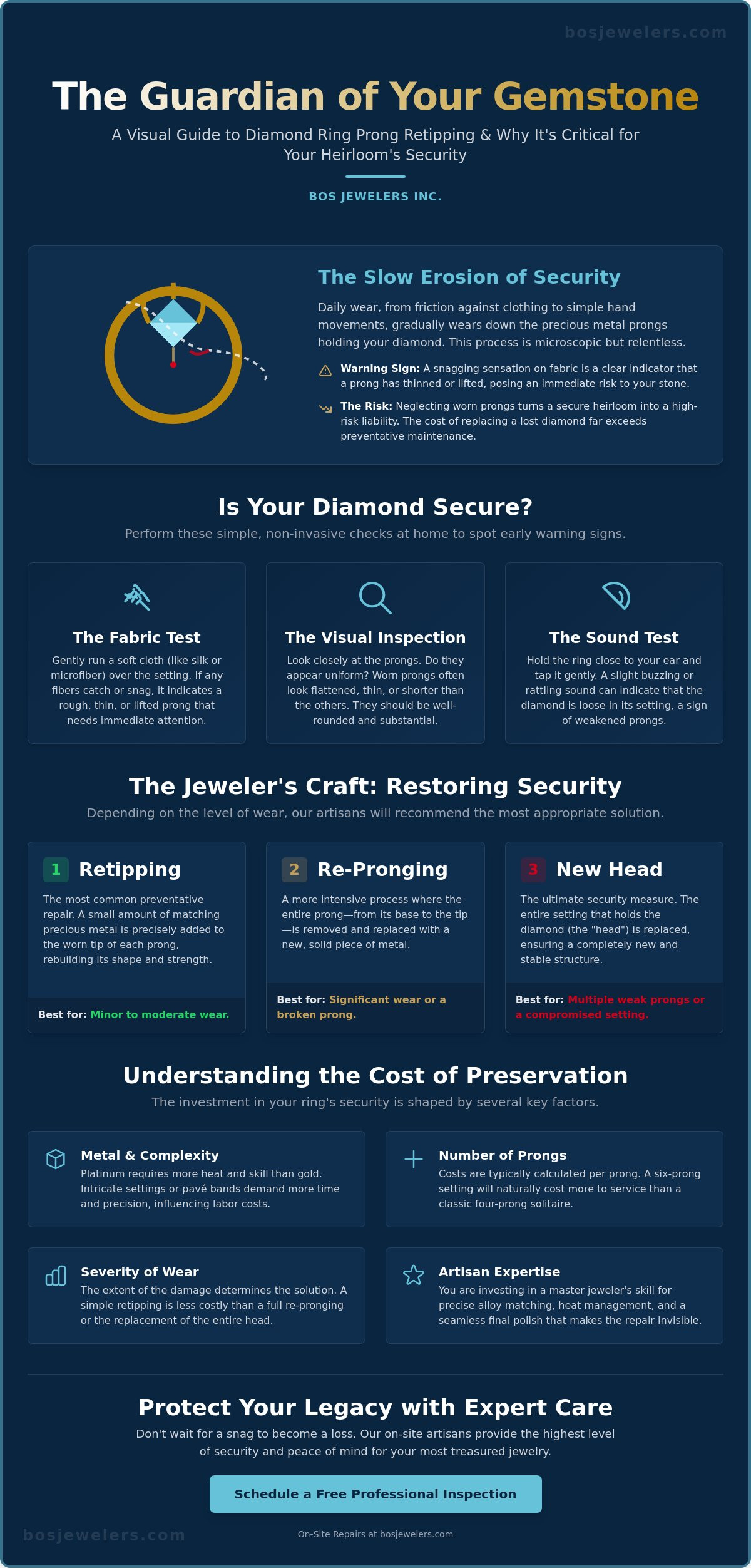
Retipping involves adding a small bead of gold to the worn tip. It's ideal for minor wear. Re-pronging is more intensive; we replace the entire vertical post from the base. When the entire structure is compromised, we may recommend a new head. This involves replacing the entire unit that holds the stone to ensure the highest level of security for your heirloom. If you've noticed your setting looks dull or uneven, our experts can provide professional jewelry cleaning and polishing to reveal the true condition of your prongs.
Modern Innovations: Laser Welding vs. Traditional Torch
Laser welding has revolutionized our craft. It uses a concentrated beam of light to melt metal in a tiny, precise area. This allows us to work mere millimeters from a diamond without heating the entire band. This technology is particularly beneficial for heat-sensitive gemstones and intricate designs. Traditional torch soldering still has its place for major structural bonds, but it requires master-level heat management. Using both tools allows us to provide the safest, most durable repair possible for your most cherished pieces.
Understanding the Factors Behind Prong Retipping Cost
When you seek a restoration for your jewelry, the quote you receive reflects far more than a tiny bead of gold. It's a valuation of time, precision, and the artisan's years of dedicated experience. The prong retipping cost for diamond ring repairs is primarily driven by the complexity of the labor involved rather than the raw weight of the metal added. Every ring tells a different story; some require a simple touch-up, while others demand a master jeweler's full attention to navigate intricate galleries or delicate filigree.
Most experts utilize a "per prong" pricing model for minor wear. However, if multiple prongs show signs of thinning, a "full head" restoration often proves more cost-effective. Addressing all four or six prongs simultaneously ensures a uniform appearance and perfect structural symmetry. It also saves you the anxiety of returning a few months later when the next prong inevitably fails. Intricate designs, such as diamond engagement rings featuring hidden halos or pave-set stones, require extra caution. The jeweler must protect every tiny accent diamond while reinforcing the main setting, a process that demands a higher level of technical mastery.
The Metal Factor: Gold vs. Platinum
The type of precious metal in your setting significantly impacts the repair process. Gold is a classic choice that balances durability with a manageable melting point for the craftsman. Platinum is a different matter entirely. This noble metal has a much higher melting point and requires specialized oxygen-rich torches and dedicated tools to prevent contamination. While platinum repairs are more intensive, the metal's legendary density provides superior longevity. It doesn't wear away as quickly as gold, meaning your investment in a platinum repair often lasts much longer.
Diamond Size and Sensitivity
The size and variety of your gemstone also play a critical role in determining the complexity of the work. A large center stone requires more substantial prongs and a steadier hand to ensure the seat is perfectly aligned. If your ring features heat-sensitive stones like emeralds or opals, the jeweler must use advanced laser technology to avoid damaging the gem. The inherent value of your stone dictates the level of security and expertise required. When finding a trusted jeweler, always ask about their specific experience with your gemstone's unique physical properties to ensure it remains safe throughout the restoration.
Signs Your Ring Needs Immediate Professional Attention
Your jewelry is a constant companion through the rhythms of daily life. Because these pieces are so familiar, it's easy to overlook the subtle signs of wear that occur over time. A diamond engagement ring, worn every day, experiences thousands of microscopic impacts and constant friction. Developing a routine for home inspection is the first step in acting as a steward for your jewelry. By identifying issues early, you'll manage the prong retipping cost for diamond ring maintenance before it escalates into a more complex, structural repair.
One of the most effective methods for checking your setting is the Tapping Test. Hold your ring securely between two fingers near your ear and gently tap the side of the band with your other hand. If you hear a faint, metallic clicking or rattling sound, your stone is loose. This indicates the seat has widened or the prongs have shifted. Another vital check is the Fingernail Test. Carefully try to slide your fingernail under the edge of a prong where it meets the diamond. There should be no gap. If your nail can slip beneath the metal, the prong is no longer providing the necessary tension to hold your gemstone safely.
Visual cues are equally revealing. Examine your prongs in bright, natural light. They should appear as healthy, rounded beads or elegant points. If they look flattened, paper-thin, or resemble tiny pancakes, the metal has been worn down significantly. Recognizing these signs early ensures that the prong retipping cost for diamond ring restoration remains a simple preventative measure rather than a frantic emergency. When you catch these visual changes quickly, you preserve the original silhouette of your design.
The 6-Month Professional Check-up
While home tests are helpful, they can't replace the trained eye of a master jeweler. During a semi-annual visit, we examine your setting under 10x magnification to spot hairline fractures invisible to the naked eye. We always begin with professional jewelry cleaning, as built-up lotions and debris can actually "glue" a loose stone in place, masking a dangerous setting. At BOS Jewelers Inc, we believe preventative care is always more graceful and affordable than the heartbreak of a lost center stone.
When to Stop Wearing Your Ring Immediately
If your ring begins to snag on your hair or clothing, it's a definitive sign that a prong has lifted or sharpened. Stop wearing the piece immediately to prevent the metal from catching further and snapping off. If you notice a prong is missing entirely, place the ring in a soft pouch or a lined jewelry box right away. Avoid carrying it loose in a pocket or purse where the stone could easily fall out. When your setting is compromised, our artisans at BOS Jewelers Inc are here to provide expert ring resizing and prong repair to restore your piece to its original, secure glory.
Choosing a Trusted Artisan for Your Jewelry Restoration
Entrusting a sentimental heirloom to a jeweler is a deeply personal decision that requires a level of trust beyond a simple transaction. When you're researching the prong retipping cost for diamond ring maintenance, it's easy to get lost in the numbers. However, the true value lies in the specific hands that will perform the work. At BOS Jewelers Inc, we view ourselves as creators and guardians of your family's history. We've spent 40 years fostering multi-generational relationships within our community, ensuring that every piece of jewelry we touch receives the same dedication to quality that defined our very first day.
A heritage business offers a unique perspective on technical repair that a standard retail chain cannot replicate. We understand the nuances of how a setting ages and how to restore it without losing its original character. While the prong retipping cost for diamond ring services is an investment in safety, it's also an investment in artistry. Our portfolio of diamond engagement rings and intricate restorations showcases our commitment to high-end luxury and familial warmth. We treat every repair as a work of art, balancing the technical specifications of the metal with the romantic allure of the object itself. You aren't just getting a repair; you're securing the longevity of your legacy.
The Value of On-Site Master Goldsmiths
One of the most significant advantages we offer is the presence of expert artisans directly on our premises. When your jewelry stays in-house at BOS Jewelers Inc, you eliminate the risks associated with shipping sentimental items to a third-party facility. This allows for direct communication between you and the goldsmith performing the restoration. Because our workshop is right here, we can offer a more efficient turnaround for ring resizing and prong repairs. You'll have the peace of mind that comes from knowing exactly where your ring is at every moment of the process.
Preserving Your Jewelry’s Legacy
Our goal is to maintain the original aesthetic intent of the designer, ensuring the repair is invisible to the naked eye. A successful retipping should blend seamlessly with the existing metal to create a unified, brilliant finish. We conclude every repair with a professional polishing that restores a like-new luster to the entire piece. We invite you to experience the patient, meticulous nature of our craft firsthand. Whether you need a simple inspection or a complex restoration, we welcome you to join our family of clients and let BOS Jewelers Inc help you build a lasting personal history. We believe that your jewelry deserves the quiet confidence of a seasoned expert.
Ensuring Your Gemstone Remains a Timeless Legacy
Your diamond ring is a vessel for your most beautiful memories. Protecting its structural integrity isn't just a technical necessity; it's an act of deep stewardship. We've explored how identifying thinning metal early can prevent the quiet heartbreak of a lost stone. While understanding the prong retipping cost for diamond ring maintenance is a practical step, the true reward is the enduring security of a professional setting that allows your diamond to shine safely.
At BOS Jewelers Inc, we bring over 40 years of master goldsmith experience to every piece that enters our heritage workshop. We are specialists in 14K gold and diamond preservation, ensuring that your restorations are performed with the highest level of artistry. Our expert artisans handle all repairs on-site, providing the transparency and care your heirlooms deserve. We invite you to Schedule Your Professional Setting Inspection at BOS Jewelers Inc to ensure your ring remains as radiant as your history. Let us help you safeguard the brilliance of your jewelry for the generations still to come.
Frequently Asked Questions
How much does it typically cost to retip a single prong on a diamond ring?
The cost for this specialized restoration varies depending on the metal type and the complexity of the setting's design. While industry averages provide a general baseline, a personalized inspection is the only way to determine the specific requirements for your heirloom. Factors such as the stone's heat sensitivity and the metal's alloy composition will influence the final prong retipping cost for diamond ring maintenance. We focus on providing a transparent evaluation that reflects the artisan's time and the precision required for a seamless repair.
Is it better to retip prongs or replace the entire head of the ring?
Retipping is the preferred choice for minor thinning where the prong's body remains structurally sound and upright. If several prongs are severely worn or if the base of the setting shows signs of fatigue, replacing the entire head is often the more secure and cost-effective solution. Our master jewelers examine the architecture of your ring to ensure your diamond has the most stable and enduring home possible. We prioritize the long-term safety of your gemstone over a temporary fix.
How long does the prong retipping process usually take?
Most professional retipping repairs are completed within a few business days, though the exact timeline depends on the intricacy of your setting. Because we perform these restorations in our on-site heritage workshop, we can manage the process with meticulous care without the delays of shipping to a third-party facility. We believe in a steady, unhurried rhythm that mirrors the patient nature of the design process itself. This ensures every bead of gold is perfectly placed and polished to our high standards.
Will retipping my prongs change the appearance of my engagement ring?
A successful retipping should be virtually invisible, blending seamlessly with the original metal to restore the ring's initial silhouette. Our artisans carefully match the specific 14K gold alloy of your piece and finish the work with a professional polish. This process actually enhances the appearance of your jewelry by removing the "flat" look of worn metal and restoring the mirror-like brilliance of the setting. Your ring will return to you looking refreshed and as secure as the day it was first crafted.
Can you retip prongs on platinum rings, or is it only for gold?
Platinum prongs can absolutely be retipped, though the process requires specialized oxygen-rich torches and a higher level of technical expertise. Platinum is a noble metal with a much higher melting point than gold, demanding a master's touch to ensure the new metal bonds perfectly. While the repair process for platinum is more intensive, the metal's legendary density provides superior longevity. We utilize advanced laser technology to perform these precise repairs, protecting your diamond from unnecessary heat stress.
Is prong retipping covered by jewelry insurance or warranties?
Coverage for retipping depends entirely on the specific terms of your insurance policy or the original manufacturer's warranty. Most standard insurance policies cover sudden accidental damage but often categorize prong wear as "maintenance" rather than a covered loss. It's a good idea to consult with your provider to see if they assist with the prong retipping cost for diamond ring upkeep. Many owners find that the small investment in preventative maintenance is far more affordable than the deductibles required for a lost stone claim.
What happens if a prong breaks off completely?
If a prong is missing entirely, the repair transitions from a simple retip to a more complex "re-pronging" or a full head replacement. You should stop wearing the ring immediately and place it in a soft pouch to prevent the center stone from shifting or falling out. Our artisans will rebuild the vertical metal post from the base of the setting to restore the structural guardian of your diamond. This level of restoration ensures that the stone is once again held with the correct tension and security.
How can I tell if my diamond is loose before a prong actually breaks?
You can often detect a loose stone by performing the "Tapping Test" near your ear or checking for gaps with the "Fingernail Test." If you hear a subtle metallic rattle when you tap the band, or if a prong catches on your favorite silk scarf, the setting's integrity has been compromised. These early warning signs are your ring's way of asking for professional attention. Identifying these issues before a prong snaps allows for a more graceful and less urgent restoration process.