

Jewelry Prong Repair: Protect the Gemstone You Treasure
You reach for a cherished ring and notice a thread caught on its setting. A snag, a shifting stone, or a prong that looks unusually thin can raise an unsettling question: is the gemstone still secure? Jewelry prong repair can help protect the stone and the memories held in a meaningful piece. The right repair depends on how much of the setting has worn.
A careful assessment can show whether a worn prong needs added metal or more extensive repair. Until then, avoid wearing the piece or trying to adjust the setting yourself.
In this guide, we’ll explain signs of prong wear, how retipping differs from replacing a prong, and how gemstone type can affect care. With more than 40 years of family-owned jewelry experience, BOS Jewelers Inc provides professional prong repair for gold and diamond pieces. We’ll also share practical ways to care for a repaired setting.
Key Takeaways
- Watch for snagging, uneven prong tips, or a gemstone that moves. Don’t try to adjust the setting yourself.
- Jewelry prong repair may involve tightening a stone, retipping worn metal, or replacing a damaged prong.
- Birthstones vary in their properties, so care should account for the individual gemstone and setting.
- A professional assessment can identify the repair needed to help secure a cherished piece.
- Gentle handling and suitable storage can help limit avoidable wear after repair.
Jewelry Prong Repair: Signs Your Gemstone Setting Needs Attention
A small change in a setting can put a gemstone at risk. If a stone looks different or you notice a snag as you dress, pause before wearing the piece again. Jewelry prong repair may be needed when the metal holding a gemstone shows wear. Visible clues are a reason to seek an assessment, not a way to diagnose the setting yourself.
Prongs are the small metal tips that hold a gemstone in place. This overview of gemstones explains more about the stones they secure, but assessing a setting requires examining the jewelry itself.
What does a worn or damaged prong look like?
Look at the setting in good light without pressing or pulling at it. A prong may need attention if it appears flattened, bent, broken, unusually thin, or uneven beside the others. A visible gap between a prong and the stone, or a gemstone that sits differently than before, is another warning sign.
Fabric snagging can point to a rough or raised tip, but it doesn’t confirm the cause. Don’t push, bend, or test a prong. Doing so can disturb an already weakened setting.
- Watch for: uneven or misshapen tips, a visible gap, or a stone that moves.
- Take seriously: repeated snagging or any visible looseness.
Quick rule: If a gemstone visibly moves or its setting looks damaged, stop wearing the jewelry and arrange a professional assessment.
What should you do if a gemstone feels loose?
Set the piece aside and handle it gently until it can be assessed. Continued wear can expose the setting to knocks and friction, which may worsen the problem or allow the stone to come free. Don’t shake the jewelry or repeatedly test whether the stone moves.
If a gemstone has detached, keep it in a small, secure container with the jewelry so both can be examined together. A visual check can alert you to a concern, but it can’t show how much the prongs or surrounding setting have worn. A jeweler can assess the piece and determine the repair it needs.
Retipping or Prong Replacement: How Jewelry Prong Repair Works
A prong is the small metal element that holds a gemstone in its setting. The right repair depends on how much sound metal remains and whether the surrounding setting can continue to support the stone. A jeweler assesses both the setting and gemstone before recommending work.
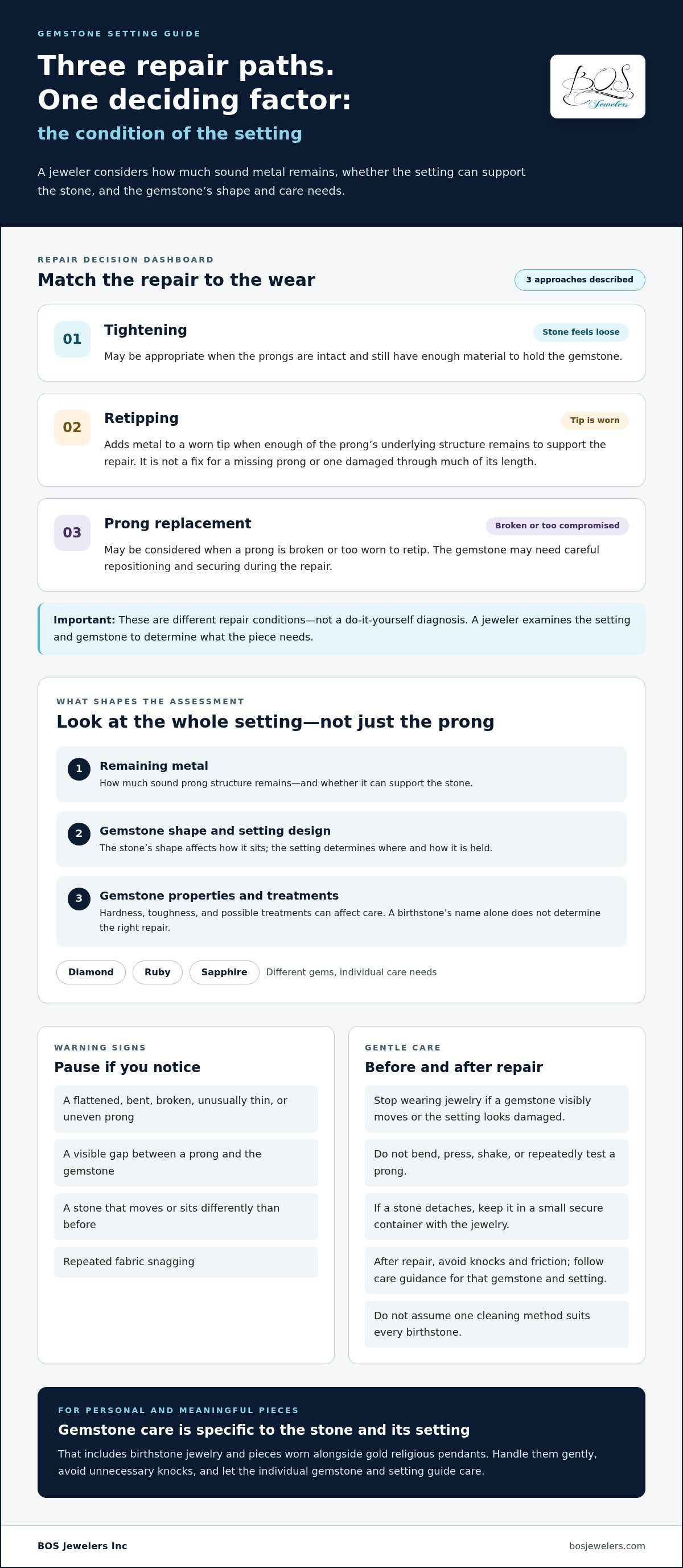
The repair choice depends on the prong’s condition and the setting’s needs. A loose stone may need tightening if the prongs are intact. A worn tip may be suitable for retipping, while a broken or substantially damaged prong may need replacement. The American Gem Society offers general jewelry education, but only an assessment of the piece can determine what its setting requires.
When is prong retipping used?
Retipping adds metal to a worn prong’s tip when enough of its underlying structure remains to support the repair. It can address a thin or worn-down end, but it isn’t a solution for a missing prong or one damaged through much of its length. The jeweler examines how the prong meets the gemstone and fits into the setting before deciding whether retipping is appropriate.
When might a prong need replacement?
If a prong is broken or too worn to retip, replacement may be considered. The gemstone may need to be carefully repositioned and secured during the repair. The work depends on the setting’s design and the gemstone’s shape, since the stone must be held securely while preserving the setting’s fit and appearance.
These approaches address different conditions:
- Tightening: The stone feels loose, but the prongs may still have enough material to hold it.
- Retipping: A prong tip is worn, while its remaining structure can support added metal.
- Replacement: A prong is broken or too compromised for retipping.
Thoughtful jewelry prong repair starts with examining the setting as a whole. BOS Jewelers Inc provides professional prong repair for gold and diamond pieces. Explore professional prong repair at BOS Jewelers Inc.
Gemstones, Birthstones, and Safe Care Before and After Prong Repair
A birthstone can make a piece feel especially personal, but birthstones don’t all have the same properties or care needs. Diamond, ruby, and sapphire are examples of different gemstones, not a reason to treat every stone or setting alike. Prong repair should account for the individual gem and how its setting holds it.
Why gemstone type and setting design matter
A jeweler considers the gemstone, its shape, and the surrounding metal when assessing a setting. The shape affects how the stone sits, while the setting determines where and how it is held. Gemstones also differ in properties such as hardness and toughness, and some may have treatments that affect care. A birthstone’s name alone doesn’t determine the right repair. The Gemological Institute of America (GIA) offers broader gemstone education, while advice for a particular piece depends on examining its stone and setting together.
General care guidance has limits. You can avoid unnecessary knocks and watch for changes, but a jeweler’s assessment is needed to determine suitable work for a specific setting. This matters for jewelry with personal or spiritual meaning, including a gemstone piece worn alongside gold religious pendants.
How to care for jewelry after a prong repair
After professional repair, handle the piece gently and follow the care instructions for that gemstone and setting. Remove jewelry before activities that could catch, knock, or press against it, such as hands-on chores or exercise. These habits can limit avoidable friction without assuming every gemstone needs the same routine.
Keep cleaning simple until you know what’s suitable for the stone. Don’t apply one cleaning method to every birthstone, since individual gems can have different care requirements. For broader jewelry maintenance, including attention to a ring’s fit, BOS Jewelers Inc offers professional jewelry care and repair. For a cherished gold or diamond piece that needs assessment, book jewelry prong repair with BOS Jewelers Inc.
Professional Jewelry Prong Repair for Cherished Gold and Diamond Pieces
A professional assessment looks beyond the visible prong. The jeweler examines the gemstone’s security, the prongs, and the surrounding setting to understand how the piece is holding together. This helps determine whether the setting needs tightening, retipping, or replacement. The recommendation should reflect the jewelry’s condition and design.
What to expect from a professional prong assessment
The jewelry’s construction guides the assessment. A jeweler considers how the gemstone sits, whether the setting shows wear, and what repair addresses the findings. You can ask how the recommendation relates to the condition of your piece before work begins. This helps clarify the next step while keeping the jewelry’s original character in mind.
BOS Jewelers Inc provides professional jewelry repair, including prong repair for gold and diamond pieces. Each item receives careful consideration, whether it’s worn often or reserved for meaningful occasions.
Care for jewelry with personal meaning
A religious pendant passed down through a family, an engagement ring, or a diamond piece marking a milestone can carry meaning beyond its materials. Thoughtful repair attends to the setting while respecting the memories connected to the jewelry. For readers drawn to meaningful gold jewelry, our guide to 14K gold religious pendants offers another perspective on pieces that become part of a personal story.
After repair, follow the jeweler’s care guidance for your specific piece. If you notice a change in the setting, set the jewelry aside until it can be assessed. Small, considered steps can help protect both the gemstone and the memories attached to it.
BOS Jewelers Inc provides attentive repair for gold and diamond jewelry. Explore our jewelry repair services to care for a piece that matters to you.
Keep Your Cherished Jewelry Ready for What Comes Next
A treasured piece deserves care that honors both its craftsmanship and the moments it represents. Acting when a setting needs attention can help you feel more confident wearing that ring, pendant, or bracelet again. Jewelry prong repair is a practical way to care for the gemstone and preserve the meaning you’ve given it.
A professional assessment can clarify the condition of your piece and the repair it needs. BOS Jewelers Inc brings a personal touch to jewelry repair, with more than 40 years of experience caring for meaningful gold and diamond pieces.
Whether your jewelry marks a milestone or carries a family story, attentive care can help you continue wearing it with confidence. Explore professional jewelry repair at BOS Jewelers Inc and take the next step toward caring for a piece you treasure.
Frequently Asked Questions
What are the signs that a ring needs prong repair?
A ring may need assessment if a prong looks bent, flattened, broken, or uneven, or if the gemstone seems to shift. Snagging on fabric can be another clue, though it doesn’t confirm the cause. Look at the ring in good light, but remember that a visual check can’t show the full condition of the setting. If you notice a change, leave diagnosis and any adjustment to a jeweler.
Can I wear a ring if one prong is loose?
It’s best to leave the ring off until it’s assessed. Place it in a small, secure container rather than loose in a jewelry box where it could rub against other pieces. If a stone comes free, keep it with the ring in that container. This helps prevent the loose stone from being misplaced and keeps both parts together for examination.
What is the difference between prong retipping and prong replacement?
Retipping adds metal to a worn prong tip, while replacement addresses a prong that can’t be repaired that way. During an assessment, ask the jeweler to explain what condition they observed and whether the recommendation applies to one prong or more of the setting. That conversation helps you understand the proposed work without having to diagnose the ring yourself.
Can prongs be repaired on birthstone jewelry?
A jeweler can assess a birthstone piece, but the recommendation should be specific to the gemstone and setting. If you know the stone’s name or have documentation that came with the jewelry, share that information during the assessment. It can provide useful context, though it doesn’t replace examining the piece. Until you have guidance for that gemstone, don’t assume a cleaning or care method is suitable.
How can I help prevent prong damage?
Store rings and other fine jewelry separately so they aren’t jostled together in a drawer or jewelry box. Choose a consistent, secure place for pieces you remove, which can also help prevent loss. As part of regular jewelry care, notice changes in how a piece looks or feels. If something seems different, pause wearing it and have the setting assessed rather than trying to correct it yourself.
Does prong repair mean the gemstone has to be replaced?
No, prong repair doesn’t automatically mean the gemstone needs replacement. A jeweler can discuss the condition of the stone separately from the condition of its setting, so you understand whether the concern is with the mount, the gemstone, or both. Ask for the assessment to distinguish those findings. That clarity helps you consider the recommended work without assuming the gemstone must be removed or replaced.