

How to Untangle a Delicate Gold Necklace: The Expert’s Guide to Rescuing Fine Chains
Last evening, you reached into your jewelry box for a cherished 14K gold religious pendant, only to find a stubborn, microscopic knot mocking your plans. It's a heart-sinking moment that every collector of fine jewelry eventually faces, often at the very moment you're preparing for a special celebration. We understand the sudden wave of anxiety that comes with seeing those delicate links twisted together. You likely worry that one wrong move might snap the fine artistry of your favorite chain or permanently mar the finish of a piece meant to last for generations.
Our guide will teach you how to untangle a delicate gold necklace using the same patient, meticulous techniques our own artisans use at the jeweler's bench. You'll discover how to safely restore your fine chains to their original, fluid grace without risking a trip for professional repair. We will walk you through the essential tools found in your own home and the professional lubricants that make even the tightest knots surrender. By the time you finish reading, you'll have the confidence to maintain your entire collection with the steady hand of a seasoned expert.
Key Takeaways
- Learn why the natural malleability of 14K gold makes patience your most valuable tool when fine links begin to stretch or bind.
- Master the art of how to untangle a delicate gold necklace by using specialized friction reducers that allow chains to glide apart effortlessly.
- Discover the essential household tools that mimic a professional jeweler's bench to safely loosen even the most stubborn microscopic knots.
- Implement simple storage secrets like the clasp-first rule to ensure your cherished pendants and nameplates remain ready for your next milestone.
- Understand the delicate balance between a home rescue and when it's time to seek professional jewelry cleaning and polishing to restore your piece's brilliance.
The Delicate Nature of 14K Gold: Why Fine Necklaces Tangle
Fine jewelry is a marvel of engineering and art. When you hold a thin 14K gold chain, you're feeling the result of centuries of refined craftsmanship. However, that same delicacy makes it prone to the frustration of knots. The relationship between chain gauge and knot complexity is simple yet punishing. The finer the gauge, the more links exist within a single inch, providing more surface area for neighboring links to catch, twist, and bind. This creates a microscopic puzzle that can seem impossible to solve without the right approach.
Unlike base metals or lower-karat options, 14K gold possesses a specific level of malleability. While this allows us to craft intricate designs, it also means the metal can "give" under stress. If you attempt to force a knot apart by pulling the ends of the chain, you risk stretching the individual links permanently. This doesn't just ruin the aesthetic; it weakens the structural integrity of the entire piece. Our "Golden Rule" for anyone learning how to untangle a delicate gold necklace is absolute: never apply tension to a closed knot. Force is the enemy of fine gold. Most tangles occur during sleep, improper storage in a crowded jewelry box, or during an active lifestyle where the chain is constantly shifting against your skin.
Understanding Chain Geometry and Link Strength
Different styles of construction react uniquely to being tangled. A classic cable chain, with its simple oval links, might be easier to loosen than a box chain, where square links can nestle into one another like a puzzle. Wikipedia explains the properties of different chain types, illustrating how the interlocking patterns affect both strength and flexibility. Curb chains, with their flat, interlocking links, often create denser knots that require a more surgical approach. Each link represents a potential stress point where the metal is thinnest. Understanding these geometries helps you visualize how to reverse the tangle rather than fighting against it.
The Emotional Value of Jewelry Preservation
We recognize that your jewelry is rarely just an accessory. Many of these delicate pieces, like cherished gold religious pendants or custom nameplates, carry deep personal significance and represent major life milestones. They are often intended to become multi-generational heirlooms, passed down through families as tokens of love and legacy. This heritage-first mindset is essential. When you approach a knot with patience and respect for the artistry involved, you aren't just fixing a necklace. You're preserving a story. Taking the time to learn how to untangle a delicate gold necklace properly ensures that these symbols of faith and family remain as brilliant and strong as the day they were first worn.
Essential Preparation and Tools for Jewelry Rescue
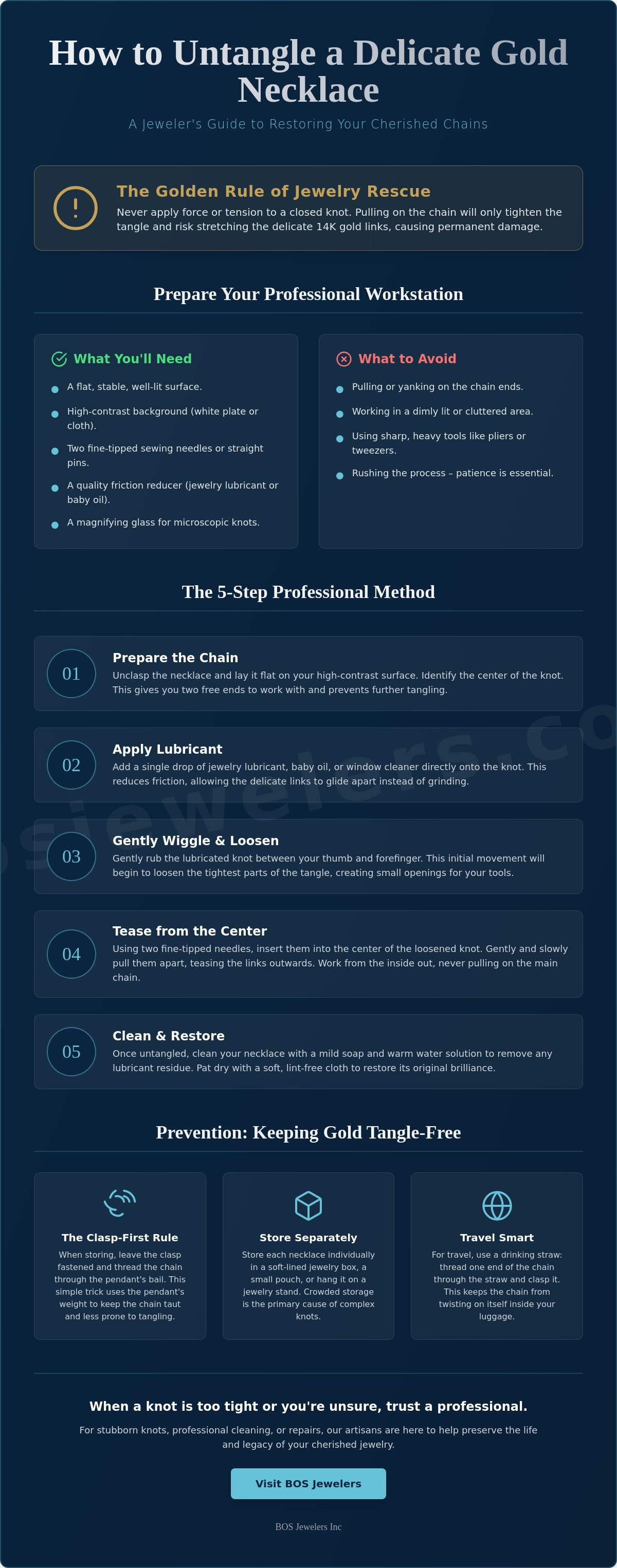
Before you begin the delicate work of separation, you must prepare your environment with the same care an artisan uses at the bench. Success in learning how to untangle a delicate gold necklace often depends more on your setup than your speed. A cluttered or dimly lit space invites frustration and accidental damage. Instead, find a flat, stable surface where you can rest your elbows to stabilize your hands. High-contrast backgrounds are non-negotiable for this type of work. A simple white porcelain plate or a clean, lint-free microfiber cloth allows the warm brilliance of the 14K gold to stand out sharply. This visual clarity ensures you can see exactly where one link ends and the next begins, preventing you from accidentally pulling the wrong section.
Your "Professional's Kit" doesn't require expensive machinery, but it does require precision. You will need two fine-tip sewing needles, a magnifying glass, and, most importantly, a steady hand. Using two needles allows you to tease the knot from the center outward, rather than pulling from the outside in. Always maintain a soft touch. Gold is a precious, soft metal, and using heavy tools like pliers or coarse tweezers can leave permanent crimps or scratches on the high-polish finish. If you find that the links are too small to see clearly, GIA's jewelry care guide suggests using proper magnification to avoid eye strain and ensure the structural integrity of the piece remains intact.
Creating a Professional Workstation at Home
Your chosen workstation should be entirely draft-free. Even a gentle breeze from a ceiling fan or an air conditioning vent can shift a fine chain, undoing minutes of meticulous progress in a heartbeat. If a traditional magnifying glass feels cumbersome, use your smartphone camera as a makeshift macro lens. By zooming in on the knot through your screen, you can identify the "heart" of the tangle with incredible detail. This setup mirrors the focused environment of a master jeweler, allowing you to work with the quiet confidence that your heritage pieces deserve.
Why You Must Always Unclasp the Chain First
The most frequent mistake made during a jewelry rescue is attempting to work on a closed loop. When the necklace is fastened, every movement you make creates internal tension that inevitably pulls the knot tighter. By unfastening the clasp, you provide a vital "exit path" for the chain ends to slide through the tangle. This step is particularly crucial for pieces with incredibly fine gauges, such as the chains often paired with children’s 14K gold earrings or minimalist nameplates. If the knot proves too complex for a home remedy, our team offers specialized jewelry cleaning and polishing to safely restore your most delicate items. Mastering how to untangle a delicate gold necklace starts with this simple act of releasing tension, giving the gold the room it needs to breathe and move.
Choosing Your Method: Lubricants and Friction Reducers
When needles alone aren't enough to release a stubborn knot, the secret to success lies in the physics of friction. Friction is the invisible force that binds gold links together, turning a loose loop into a frustratingly tight bind. By introducing a lubricant, you create a microscopic barrier that allows the metal to slide past itself with minimal resistance. This is a critical step in learning how to untangle a delicate gold necklace without causing the structural stretching that can occur when you rely on force alone. We view this process as a gentle negotiation with the metal, requiring a soft touch and the right medium.
We generally recommend three primary approaches: the Oil Method, the Powder Method, or the Dry Method. While the Dry Method relies purely on patience and precision with needles, the other two use external agents to ease the process. However, safety must remain your priority. Never reach for harsh household chemicals, vinegar, or abrasive cleaners. These substances can react with the alloys in 14K gold, potentially dulling the finish or causing long-term damage to the metal's brilliance. Our goal is to rescue the piece, not just the chain, ensuring it remains a beautiful part of your personal history.
The Oil Method: Best for Stubborn, Tight Knots
For those knots that feel as hard as a bead, high-quality olive oil or mineral oil is the safest choice for your 14K gold. These oils are gentle on the metal and provide superior glide for the links. Rather than submerging the entire piece, apply a single drop precisely to the center of the knot using a toothpick. Once applied, use your fingertips to gently "massage" the knot. This subtle movement encourages the oil to penetrate deep into the interlocking links, loosening the grip of the tangle from the inside out and making it much easier to tease apart with your needles.
The Powder Method: Best for Multi-Chain Tangles
If you're dealing with a complex cluster where multiple chains have intertwined, baby powder or cornstarch can be more effective than liquid lubricants. Powder works by breaking the surface tension between the metal links, allowing them to shift independently without sticking together. It's a cleaner alternative for complex clusters, though you must be careful not to let the powder "clog" the tiny crevices of intricate designs. A light dusting is often all that's required to see immediate progress in even the most daunting tangles.
Professional Cleaning After the Rescue
Once the knot is finally vanquished, your work isn't quite finished. Leaving oil or powder residue on your jewelry can attract dirt and eventually dull the gold's natural luster. Clean the piece immediately using lukewarm water and a drop of mild, lotion-free dish soap. Rinse the chain thoroughly and dry it with a soft, lint-free cloth to prevent water spots on the 14K gold. This restoration step is vital for maintaining the longevity of your collection. For a deeper, more thorough refresh, we recommend scheduling professional jewelry cleaning to ensure every microscopic crevice is free of debris and your gold shines with its original, celebratory brilliance.
Step-by-Step: The Professional Way to Untangle Gold
With your tools ready and your workspace prepared, it's time to begin the actual rescue. This process requires the patience of an artisan; rushing will only result in a tighter knot or a damaged link. Follow these steps precisely to master how to untangle a delicate gold necklace while preserving the intricate craftsmanship of your 14K gold jewelry.
- Step 1: Lay the necklace completely flat on your high-contrast surface. Use your magnifying glass to identify the "heart" of the knot, which is the tightest point where the links converge.
- Step 2: Apply a single drop of mineral oil or a light dusting of powder directly to the tangle. Allow it to sit for at least 30 seconds to ensure the lubricant penetrates the microscopic gaps between the links.
- Step 3: Insert the tips of your two needles into the center of the tangle. Gently tease the links outward in opposite directions, working from the inside out to avoid adding tension.
- Step 4: As the knot begins to loosen, you'll see small loops forming. Use one needle to hold the knot steady while the other gradually expands these loops until the chain can be safely threaded through.
- Step 5: Once free, clean the necklace to remove all residue. Inspect the links closely for any signs of stretching, discoloration, or structural fatigue.
The 'Teasing' Technique: Using Needles Like a Pro
Professional jewelers often use a "vibration method" to settle the metal links. By gently tapping the needles against the work surface or the knot itself, you create tiny vibrations that help the lubricant settle and encourage the gold to shift naturally. Always direct your movement from the tightest point of the tangle toward the loose ends. This ensures you aren't accidentally pushing more of the chain into the knot, which is the most common mistake made during a home rescue. Keep your touch light and your movements rhythmic to maintain control over the fine gauge of the chain.
When to Stop: Recognizing a 'Deadly' Knot
There is a point where a knot becomes a "kink." A kink occurs when the 14K gold has been folded so sharply that the metal begins to fatigue. If you see a sharp, fixed angle in a link that does not move with gentle teasing, stop immediately. Applying more pressure could snap the chain. Never use pliers or metal tweezers, as these tools lack the precision required for fine jewelry and will likely crush the delicate links. If the knot is too stubborn or you notice structural damage, it's best to seek professional jewelry cleaning and polishing to safely assess the condition of your piece and restore its original fluid grace.
Prevention and Protection: Keeping Your 14K Gold Tangle-Free
Once you have successfully rescued your piece, the focus shifts from recovery to preservation. Preventing future knots is the ultimate expression of respect for the artistry of your collection. The most effective preventative measure is also the simplest: always fasten the clasp before putting your necklace away. A fastened chain behaves predictably, while an open one allows the two loose ends to weave through the links, creating the very knots we've discussed. For travel, we recommend the "Straw Trick." Simply thread one end of the chain through a standard drinking straw and fasten the clasp. The rigid structure of the straw prevents the chain from folding back on itself, making it impossible for a knot to form. It's a humble yet brilliant solution for keeping your finest gold pieces safe in a carry-on or evening bag.
Dedicated storage is an investment in the longevity of your jewelry. Fine chains should never be tossed into a shared tray where they can intertwine with other pieces. Sturdy 14K gold bangles, for instance, can easily snag a delicate necklace if they're allowed to shift together in a drawer. We recommend using a jewelry box with individual hooks that allow necklaces to hang freely. Gravity acts as a natural straightener, keeping the links perfectly aligned and tension-free. When you're on the move, individual velvet pouches provide a soft environment that prevents the metal from "grabbing" onto itself. We suggest a quick weekly ritual: take a moment to inspect your chains under a bright light. Identifying a tiny loop before it tightens into a knot is the most effective way to avoid the stress of a complex rescue.
Smart Storage Solutions for Fine Jewelry
Using individual pouches or hanging racks isn't just about organization; it's about physics. Friction knots occur when two chains rub together, creating microscopic snags that quickly escalate into tight binds. By keeping each piece in its own dedicated space, you eliminate the primary cause of jewelry damage. If you prefer a horizontal layout, ensure that each necklace is laid out in a straight line on a soft, padded surface. This prevents the chain from settling into a pile, which is how most "spontaneous" knots begin their life in your jewelry box.
Building a Relationship with Your Jeweler
We view jewelry care as a lifelong partnership between the owner and the artisan. Just as you might visit us for ring resizing to ensure a perfect fit, your necklaces benefit from regular professional check-ups. During these visits, our experts check for thinning links, clasp fatigue, and microscopic tangles that haven't yet become problematic. Catching these issues early prevents the heartbreak of a snapped chain or a lost pendant. While you now know how to untangle a delicate gold necklace, some knots are simply too risky to handle alone. We invite you to bring your most precious heirlooms to our workshop, where we treat every piece with the same reverence we give our own family's history. Our expert artisans are always here to serve as your guides, ensuring your jewelry remains as radiant as the milestones it celebrates.
Preserving the Brilliance of Your Jewelry Collection
Your jewelry reflects your most precious moments, and protecting its integrity is a commitment we share. By mastering the art of how to untangle a delicate gold necklace, you've gained the skills to handle your fine chains with the same meticulous care used at our jeweler’s bench. Remember that patience is your most effective tool. Using gentle lubricants like mineral oil or a light dusting of powder will always yield better results than applying force. Establishing a routine of proper storage, such as fastening your clasps and hanging chains individually, ensures your 14K gold remains ready for your next life milestone.
With over 40 years of family-owned expertise, we specialize in the artistry of high-quality 14K gold and diamonds. If a knot ever feels beyond your reach or a link appears compromised, our expert on-site technical repairs and maintenance services are here to restore your pieces to their original splendor. We invite you to explore our collection of expertly crafted 14K gold jewelry and discover new treasures built to last for generations. Your collection deserves a legacy of brilliance, and we're honored to help you maintain it.
Frequently Asked Questions
Can I use Windex to untangle my gold necklace?
Windex is not recommended for fine gold jewelry because the ammonia content can be too aggressive for certain alloys. While it's a common household suggestion, it may dull the luster of your 14K gold over time. Instead, stick to a gentle drop of mineral oil or a mild solution of lukewarm water and lotion-free dish soap to provide the necessary glide without risking the metal's radiance.
Will baby powder damage the finish of my 14K gold chain?
Baby powder is perfectly safe for 14K gold and won't scratch or chemically alter the surface of your jewelry. It's an excellent friction reducer that helps links slide apart, especially when you're learning how to untangle a delicate gold necklace at home. Just ensure you perform a thorough cleaning afterward to remove any residue that might settle into the intricate links of your pendants or nameplates.
What should I do if my necklace snaps while I'm trying to untangle it?
If your chain breaks, stop immediately and place all the pieces in a secure pouch. Don't attempt a home repair with adhesives or household tools, as this can cause permanent damage. Bring the piece to an expert artisan for professional repair. Our team specializes in delicate link restoration, ensuring your multi-generational heirlooms are returned to their original, seamless beauty.
How do I untangle multiple necklaces that are knotted together?
Untangling a cluster of chains requires you to lay the entire mass flat and unclasp every single necklace first. This releases the tension and provides multiple exit paths for the ends to slide through. Use a light dusting of baby powder and work from the outside of the cluster inward. Patience is essential here; focus on freeing one chain at a time rather than trying to solve the entire puzzle at once.
Is it safe to sleep in a delicate gold necklace?
Sleeping in fine jewelry is the leading cause of stubborn knots and structural fatigue. As you move during the night, the fine links are subjected to tossing and turning, which can create tight tangles or even snap the chain. We always recommend removing your 14K gold pieces before bed and hanging them separately to ensure they remain as fluid and strong as the day you received them.
Can an ultrasonic cleaner help remove knots in jewelry?
An ultrasonic cleaner should not be used to remove knots, as the high-frequency vibrations can actually settle the links deeper into the tangle. While these machines are wonderful for removing dirt and oils, they aren't designed to solve mechanical tangles. It's always best to manually loosen the knot using needles and lubricants before using any cleaning equipment to restore the piece's brilliance.
How much does it typically cost for a jeweler to untangle a necklace?
The cost for professional untangling depends entirely on the complexity of the knot and the time required for an artisan to safely resolve it. Some simple tangles might be addressed during a standard cleaning, while intricate knots may require more technical attention. We suggest bringing your piece in for an individual assessment so we can provide a personalized recommendation based on the specific needs of your jewelry.
Why does my necklace keep tangling even when I'm wearing it?
Fine necklaces often tangle while being worn due to a combination of body heat, natural movement, and the lightweight nature of the chain. These factors allow the links to shift and catch on one another, especially if the chain is very fine. Regular inspections and ensuring your piece is properly cleaned can help, as dirt and oils can make the metal stickier and more prone to catching.