

How to Tell If a Diamond Is Real: A Connoisseur’s Guide to At-Home Testing (2026)
Imagine holding a cherished ring passed down through generations, its brilliance catching the light just as it did for your grandmother. You feel a deep connection to its history, yet a small, quiet doubt lingers about its true composition. You aren't alone in wondering how to tell if a diamond is real at home, especially as sophisticated simulants like Moissanite and Cubic Zirconia become increasingly difficult to distinguish from the real thing. We understand that the value of your jewelry isn't just financial; it's a vessel for your most precious memories. The fear of being misled or accidentally damaging a delicate setting is a burden no collector should carry.
We're here to provide you with professional-grade insights and reliable methods to evaluate your stones with the same care we use in our own workshop. You'll discover how to perform safe, non-destructive tests that offer peace of mind without risking the integrity of your 14K gold settings. We'll also explore the latest 2026 industry shifts, including the new GIA quality assessments, to help you understand exactly when a stone requires the discerning eye of an expert artisan. By the end of this guide, you'll possess the knowledge to protect your collection and honor the legacy of your most brilliant investments.
Key Takeaways
- Learn how to tell if a diamond is real at home using simple, non-destructive methods like the fog and water tests to gauge thermal conductivity and density.
- Understand the science of light and refractive indices to distinguish a genuine diamond’s sparkle from the deceptive glow of common simulants.
- Explore safe ways to assess a stone’s legendary durability and heat resistance without compromising the integrity of your precious heirloom.
- Gain clarity on the evolving 2026 standards for natural and lab-grown stones to ensure you're making informed decisions for your collection.
- Identify when to transition from personal inspection to professional verification to confirm your diamond's true value and heritage.
The Essence of a Diamond: Why Authenticity Defines Your Legacy
A diamond is far more than a mere arrangement of carbon atoms. It acts as a silent witness to your most profound milestones, from the quiet promise of a proposal to the celebration of a multi-generational legacy. When you hold a piece of fine jewelry, you aren't just holding an object; you're holding a story. This is why understanding how to tell if a diamond is real at home is such a vital skill for any connoisseur. Authenticity ensures that the brilliance you admire today will endure for decades, maintaining both its emotional resonance and its intrinsic value.
Before you seek out professional services like jewelry cleaning and polishing or ring resizing and prong repair, you must understand what you own. Different materials require vastly different care. A genuine diamond's legendary hardness allows it to withstand heat and pressure that would shatter or cloud a lesser stone. By learning how to tell if a diamond is real at home, you take the first step in preserving the integrity of your 14K gold settings and ensuring that your treasures receive the specialized treatment they deserve from expert artisans.
The Emotional Significance of Real Gemstones
Real diamonds serve as the cornerstone of family heirlooms, bridging the gap between the past and the future. There is a deep, personal connection between the meticulous craftsmanship of a master jeweler and the raw, natural beauty of a stone formed over eons. Choosing a genuine stone for a diamond engagement ring ensures that the narrative of your love is built on something as enduring as the promise it represents. A simulant might mimic the look, but it cannot replicate the timeless weight and prestige of a natural or high-quality lab-grown stone.
Common Diamond Look-Alikes You Might Encounter
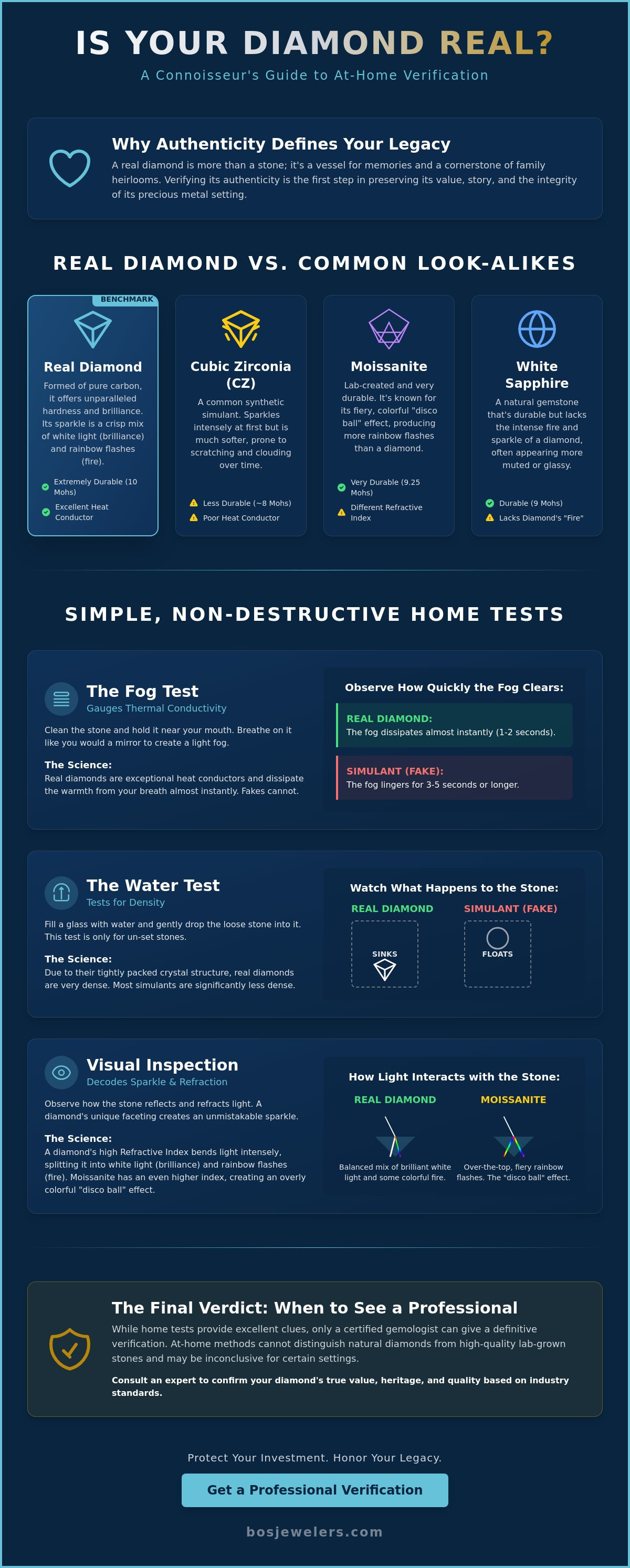
In your journey to verify your collection, you will likely encounter various stones that appear identical to the untrained eye. These are often categorized as a Diamond simulant. While beautiful in their own right, they possess different physical and optical properties that set them apart from the real thing. Understanding these differences is the key to appreciating your jewelry's true composition.
- Cubic Zirconia: This is the most prevalent synthetic simulant. It offers significant sparkle initially but is prone to scratching and clouding over time, unlike the eternal clarity of a diamond.
- Moissanite: Originally discovered in a meteor crater, most moissanite today is lab-created. It rivals diamond brilliance but produces a distinct "disco ball" effect with colorful flashes that differ from a diamond’s classic white sparkle.
- White Topaz and Sapphire: These natural gemstones are frequently used in fine 14K gold jewelry. While they are durable and lovely, they lack the intense fire and refractive power that make a diamond truly exceptional.
The Fog and Water Tests: Gauging Density and Thermal Conductivity
Nature has gifted diamonds with extraordinary physical properties that go beyond their visual brilliance. These unique characteristics allow you to begin understanding how to tell if a diamond is real at home without needing specialized laboratory equipment. Two of the most reliable, non-destructive methods involve simple elements you already have: your breath and a glass of water. These tests are incredibly gentle. They won't harm your 14K gold settings or the stones themselves, making them perfect first steps for any concerned collector who values the integrity of their heirlooms.
Preparation is the foundation of accuracy in any assessment. Over time, your jewelry collects natural oils from your skin, perfumes, and everyday wear. These microscopic layers can act as unexpected insulators, potentially skewing the results of a thermal conductivity test. Before you start, we recommend a gentle wipe with a soft, lint-free cloth. Ensuring the stone is pristine allows its true nature to interact with the elements during your assessment. It's a small but vital step that honors the craftsmanship of the piece.
Performing the Fog Test Correctly
Diamonds are exceptional conductors of heat, a property that stems from their rigid, tightly bonded crystal structure. They dissipate warmth almost instantly. To perform this test, hold your jewelry close and breathe a puff of air directly onto the stone, just as you would to fog a mirror. A real diamond won't hold that moisture for long.
- Clean the stone thoroughly with a lint-free cloth first to remove any debris.
- Breathe a puff of air directly onto the diamond as if you were fogging a window.
- Count the seconds. A genuine diamond clears the fog in 1-2 seconds. A simulant, such as glass or quartz, will stay cloudy for several seconds longer because it lacks the diamond's thermal efficiency.
The Water Drop and Submersion Method
A diamond’s high density is another signature of its authenticity, often referred to by experts as specific gravity. This test requires nothing more than a clear glass of room-temperature water. It's an elegant way to observe the stone's physical weight relative to its size, which is much higher than most common look-alikes.
- Fill a glass with regular water; no special chemicals or additives are required.
- Drop the loose stone into the glass. Real diamonds are incredibly dense and will always sink straight to the bottom of the vessel.
- Observe the reaction closely. If the stone floats, hovers in the middle, or sinks with a slow, drifting motion, it's likely a lighter material like glass or quartz.
While these tests provide a wonderful starting point for your at-home journey, they're most effective when the jewelry is in top condition. If you notice your stone isn't reacting as expected, it might simply be due to deep-seated grime or a worn setting. Our artisans are always here to help with professional jewelry cleaning and polishing to restore that original luster and ensure your tests are as accurate as possible. We believe every piece of history deserves to be seen in its best light.
Visual Inspection: Decoding Sparkle and Refractive Index
The visual allure of a diamond is its most captivating feature, yet it is also a complex language of light. When you observe a stone’s dance, you are witnessing its refractive index, the specific way the gem bends and bounces light. This is a primary indicator for anyone exploring how to tell if a diamond is real at home. A genuine diamond possesses an extraordinary ability to refract light, creating a signature glow that simulants struggle to replicate. While many believe a diamond should sparkle with every color of the rainbow, a true connoisseur looks for the delicate balance between brilliance and fire.
Brilliance refers to the bright white light reflected from the interior of the stone, while fire describes the scattered flashes of spectral colors. A real diamond typically displays more white brilliance than rainbow fire. If you see a stone that looks like a disco ball with excessive colorful flashes, you might be looking at moissanite. To look even deeper, we recommend using a 10x jeweler’s loupe to search for nature’s fingerprints. Nearly all diamonds contain tiny natural imperfections known as inclusions. If a stone appears absolutely flawless under magnification, it's likely a high-quality synthetic or a common simulant.
The Dot and Read-Through Test
Because diamonds are so effective at bending light, you cannot easily see through them. This physical reality allows for the "Dot Test." Place your loose stone flat-side down on a piece of white paper marked with a single ink dot. Attempt to look through the pointed end of the stone. If you can see the dot or any circular reflection, it is not a diamond. A diamond’s complex crystal lattice scatters the light so thoroughly that the view of the paper below is completely blocked. It's a simple yet profound way to witness the stone's internal architecture.
Inspecting the Setting and Hallmarks
A diamond’s story is often told by the vessel that holds it. Real diamonds of significant value are rarely set in inexpensive metals. When inspecting your jewelry, look closely at the interior of the band or the back of a piece like one of our 14K Gold Religious Pendants. Look for stamps such as "14K" or "18K," which indicate high-quality gold. If you see markings like "C.Z." for Cubic Zirconia or "GP" for Gold Plated, the center stone is almost certainly not a diamond.
The craftsmanship of the setting itself is another hallmark of authenticity. Expert artisans take immense pride in their work, ensuring that the prongs holding a stone in a Diamond Tennis Bracelet or a Diamond Engagement Ring are symmetrical and secure. High-value stones deserve high-value labor. If the setting looks flimsy or mass-produced with uneven prongs, it's a strong signal to have the piece verified by a professional who understands the heritage of fine jewelry.
Durability Testing: Assessing the Resilience of Carbon
A diamond is the ultimate testament to nature's endurance. Sitting at a perfect ten on the Mohs Scale of Mineral Hardness, it is the hardest natural substance on Earth. This legendary resilience isn't just a technical specification; it's the reason why your most precious pieces can be worn daily and still passed down through generations. When you're exploring how to tell if a diamond is real at home, testing this physical strength is a powerful way to separate a true gem from fragile imitations. While a simulant might mimic the light of a diamond, it cannot replicate its structural defiance.
One of the most immediate ways to judge quality is the "Sharp Edges" rule. Because diamonds are incredibly hard, they can be cut with razor-sharp precision. If you look at the stone's facets under magnification, the lines where they meet should be crisp and pointed. In contrast, many fakes are made from molded materials like glass or certain resins. These often have rounded, soft edges that look blurred upon closer inspection. A diamond's facets are a display of masterful artistry and the stone's own stubborn strength.
The Thermal Shock Test (Loose Stones Only)
This test is a dramatic demonstration of a diamond's unique ability to handle extreme stress. Diamonds are highly efficient at conducting heat, allowing them to remain stable even during rapid temperature shifts. To perform this, heat a loose stone with a lighter for approximately 30 seconds and then immediately drop it into a glass of cold water. A real diamond will emerge completely unscathed. Weaker materials like glass or quartz cannot handle the sudden contraction and will shatter instantly. A diamond’s structural integrity is forged in extreme heat, and it remains indifferent to the shock of the cold.
Why the Sandpaper Test is a Risk Not Worth Taking
You may have heard that you can use sandpaper to check for scratches. While it's true that a diamond won't be harmed by standard sandpaper, we strongly advise against this method for mounted jewelry. Sandpaper is an abrasive that can easily ruin the polished finish of your 14K gold bangles or delicate ring settings. Even if the stone survives, the metal around it may become dull or scratched, and fine grit can become trapped in the intricate prongs.
Preserving the beauty of your jewelry is just as important as verifying the stone itself. If you've attempted these tests and feel concerned about the security of your setting or the stone’s placement, our master jewelers are here to help. We invite you to trust us with your professional prong repair needs to ensure your diamond remains safely cradled in its gold home for years to come. Protecting your legacy requires a balance of curiosity and careful stewardship.
The Final Verdict: Why Professional Verification is Essential
The methods we have explored offer a wonderful foundation for understanding how to tell if a diamond is real at home. They provide the immediate reassurance every collector seeks when handling a cherished heirloom or a new acquisition. However, these tests remain the first steps in a much longer journey of jewelry stewardship. While home testing provides the clues you need to build confidence, true certainty requires the specialized equipment and the seasoned eye of a master gemologist. A professional doesn't just look at the stone; they interpret its history and verify its pedigree through respected institutions like the GIA or EGL.
The diamond industry is currently undergoing significant shifts that make expert insight more valuable than ever. As of February 2026, the GIA has moved away from the traditional 4Cs for laboratory-grown diamonds, opting instead for a simplified two-tier Quality Assessment. This change reinforces the distinct separation between natural and lab-created markets. While you may be able to identify a simulant on your own, distinguishing between a natural diamond and a high-quality lab-grown stone requires sophisticated laboratory analysis. Seeking a professional opinion from the experts at BOS Jewelers Inc ensures you understand the exact nature of your investment.
The Tools of the Trade: Beyond the Kitchen Table
Professional artisans utilize electronic diamond testers that measure both thermal and electrical conductivity with incredible precision. These advanced devices can distinguish between diamonds, moissanites, and white sapphires in ways that simpler tests cannot. Beyond electronic probes, microscopic analysis allows us to identify specific inclusion types. These internal "birthmarks" are essential for proving a stone's natural origin. A formal appraisal serves a vital practical purpose; it provides the documented valuation required for insurance, ensuring your legacy is protected against the unforeseen.
Maintaining Your Diamond’s Brilliance
A diamond's fire is only as brilliant as its cleanliness. Over months of wear, even the most exceptional stone can lose its luster as it collects microscopic debris. Routine professional jewelry cleaning and polishing can reveal the hidden character of a neglected piece, restoring the light performance you first fell in love with. During these sessions, we also perform meticulous prong inspections. Ensuring that the 14K gold remains robust and secure is vital for the longevity of your jewelry. It prevents the heartbreak of a loose stone and maintains the structural integrity of the design.
Whether you are verifying a legacy engagement ring or looking to pair your stones with gold religious pendants, we invite you to join a tradition of trust. True luxury is found in the quiet confidence that every piece in your collection is authentic and expertly maintained. Our workshop at BOS Jewelers Inc serves as a sanctuary for those who value the intersection of tradition, artistry, and the enduring beauty of a genuine diamond. We are here to guide you through every milestone, ensuring your jewelry remains as brilliant as the memories it represents.
Protecting Your Legacy with Confidence and Brilliance
Your journey into the heart of your jewelry collection begins with a simple, respectful curiosity. By mastering how to tell if a diamond is real at home, you've taken an important step in honoring the history and value of your most cherished pieces. Whether you've observed the rapid clearing of a fog test or analyzed the sharp facets of a brilliant cut, these insights empower you as a knowledgeable steward of your own collection. However, the true peace of mind that comes with a multi-generational heirloom is found in the absolute certainty of professional verification.
At BOS Jewelers Inc, we bring over 40 years of family-owned expertise to every consultation. Our artisans specialize in 14K gold and high-quality diamonds, offering expert on-site jewelry cleaning and maintenance to ensure your treasures remain as secure as they are beautiful. We invite you to experience the brilliance of a verified masterpiece at BOS Jewelers Inc and let our team help you preserve your unique story. Your legacy deserves the meticulous care and quiet confidence that only four decades of dedicated craftsmanship can provide.
Frequently Asked Questions
Can a fake diamond pass the fog test?
Most common simulants like glass or quartz will fail the fog test because they don't dissipate heat with the same efficiency as a diamond. However, moissanite is an exceptional conductor of heat and can often pass this specific test. This is why learning how to tell if a diamond is real at home requires a combination of visual and physical assessments rather than relying on a single result to confirm authenticity.
Is the sandpaper test safe for my engagement ring?
We strongly advise against using sandpaper on your jewelry. While a genuine diamond sits at a ten on the Mohs scale and won't scratch, the abrasive grit will permanently mar the polished surface of your 14K gold band or religious pendants. It's also possible for fine dust to become lodged in the prongs, which makes it difficult to clean and could potentially loosen the stone over time.
How can I tell the difference between a diamond and Moissanite at home?
Moissanite is known for its intense "disco ball" effect, reflecting far more colorful light than a diamond's classic white brilliance. If you look through the side of the stone with a loupe, you might also see "doubling," where the facets appear to have two lines instead of one. Diamonds are singly refractive, meaning they won't show this specific optical doubling, providing a key visual clue for your home inspection.
Does a real diamond glow under UV or black light?
Some natural diamonds exhibit blue fluorescence under UV light, but it isn't a universal trait. Roughly 25% to 35% of natural diamonds show some degree of fluorescence, which can range from faint to very strong. Because many real diamonds don't glow at all and some simulants can be engineered to fluoresce, this shouldn't be your only method for verification when testing your collection.
What should I do if my diamond fails one of the home tests?
If a stone fails a test, it's often due to environmental factors like surface oils or a heavy setting interfering with the results. You shouldn't panic; instead, consider having the piece professionally inspected by a trusted artisan. We often find that a thorough jewelry cleaning and polishing is all that's needed to reveal a stone's true brilliance and allow for a more accurate reading of its physical properties.
Are lab-grown diamonds considered "real" diamonds in these tests?
Yes, lab-grown diamonds are chemically, physically, and optically identical to natural diamonds. Because they share the same carbon structure, they will pass every test for how to tell if a diamond is real at home exactly like a mined stone. Distinguishing between the two requires advanced laboratory equipment and a deep understanding of the 2026 GIA Quality Assessment standards that now categorize lab-grown stones as either Premium or Standard.
Why does my diamond look cloudy even if it is real?
Diamonds are naturally "lipophilic," meaning they attract grease and oils from your hands, soaps, and lotions. This creates a film that blocks light from entering and reflecting, making the stone appear dull or milky. Regular maintenance and professional care can strip away these layers, restoring the fire and clarity that define a high-quality diamond engagement ring or a set of children's 14K gold earrings.
How much does it cost to have a diamond professionally verified?
Verification costs depend on the depth of the analysis and whether you require a formal document for insurance purposes. While we recommend checking with your local expert for their specific fees, industry averages for professional appraisals typically fall between $50 and $200 per item as of early 2026. This investment provides a certified pedigree and the peace of mind that your family's history is accurately documented.