

How to Layer Gold Necklaces: The 2026 Stylist’s Guide to Effortless Elegance
Your jewelry box isn't just a collection of metal; it's a curated gallery of your life's most precious milestones. We understand the frustration when those cherished pieces become a knotted, uncoordinated mess by midday. You want a look that feels intentional and stays in place, yet you often find yourself untangling delicate chains instead of enjoying their brilliance. Learning how to layer gold necklaces shouldn't feel like a chore or a compromise on quality.
As a family-owned establishment with a deep respect for artistry, we've developed a stylist's framework to help you master the art of the stack. We'll show you how to ensure your 14K gold chains and meaningful religious pendants sit perfectly while remaining tangle-free. This guide explores the golden rules of spacing, the beauty of mixing textures, and practical ways to protect your fine 14K gold from damage. You'll gain the confidence to wear your personal history with the effortless elegance it deserves.
Key Takeaways
- Understand why 14K gold offers the perfect harmony of rich color and structural durability for a stack that stands the test of time.
- Master the professional framework for how to layer gold necklaces by selecting a meaningful "anchor" piece and building dimension with varied textures.
- Learn the "weight distribution" secret and the benefits of multi-strand clasps to maintain a sophisticated, tangle-free look throughout the day.
- Discover how to weave your personal history into your jewelry by centering your layers around 14K gold religious pendants or bespoke diamond nameplates.
- Identify early signs of wear from metal-on-metal friction to ensure your cherished links and clasps remain secure and beautiful for years to come.
The Foundation of the Stack: Why 14K Gold is the Gold Standard
Layering is more than a simple styling choice; it's a way to weave your personal history into a visible, wearable narrative. Throughout the history of necklaces, these adornments have served as profound symbols of identity, faith, and heritage. When we speak about how to layer gold necklaces, we're discussing the intentional arrangement of your most cherished pieces to create a look that feels both effortless and deeply personal. Every successful stack begins with a "Foundational Piece." This anchor is typically your most significant or heaviest chain, serving as the steady heart of your entire arrangement.
We believe in the enduring brilliance of 14K gold for these curated looks. It offers the perfect harmony between resilient strength and that iconic, sun-drenched hue. While pure 24K gold is undeniably beautiful, it's often too soft to withstand the constant movement and contact inherent in layering. We maintain a strict focus on gold because a luxury stack requires uniform brilliance across every level. You won't find silver in our collections; silver's tendency to tarnish can disrupt the warm, celebratory glow of a fine gold ensemble. By sticking to a consistent metal, you ensure your jewelry remains as radiant decades from now as it is today.
Understanding 14K Gold Durability for Daily Wear
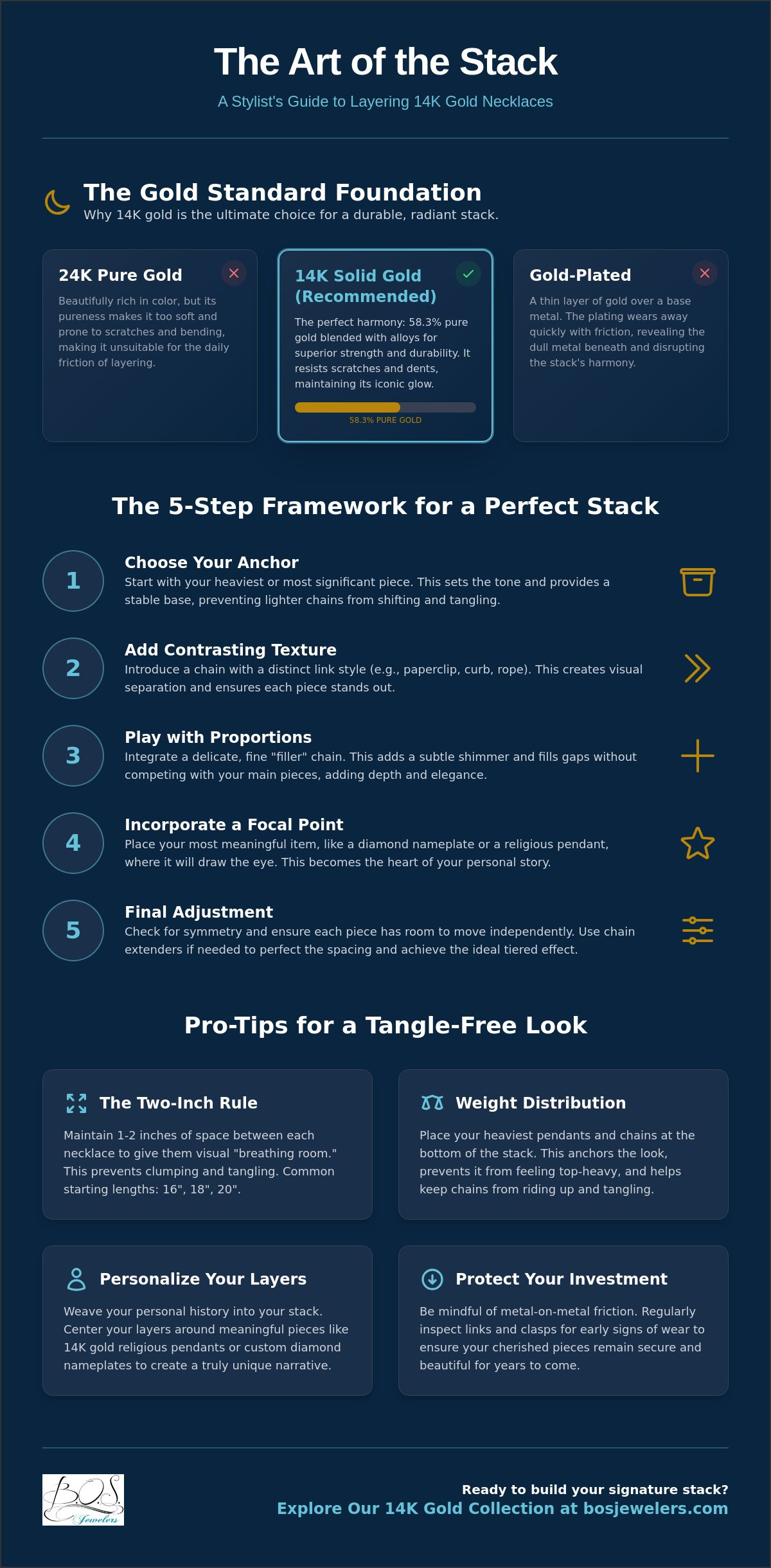
The secret to the longevity of 14K gold lies in its composition. By blending 58.3% pure gold with carefully selected alloys, artisans create a metal that resists the scratches and dents of daily life. This is vital because layered chains naturally rub against one another as you move. 14K gold is the industry standard for fine jewelry that withstands the friction of layering. We always advocate for solid gold over plated alternatives. Plated jewelry eventually wears thin, revealing a dull base metal that can irritate the skin and ruin the visual harmony of your curated stack.
Setting the Spacing: The Two-Inch Rule
Visual breathing room is the difference between a tangled mess and a professional-looking display. We recommend the "Two-Inch Rule" to keep your pieces distinct and readable. Aim for approximately one to two inches of space between each chain to prevent them from overlapping or clumping together. You can easily map your neckline by selecting standard lengths, such as a 16-inch choker followed by 18-inch and 20-inch chains. If a specific pendant doesn't sit exactly where you'd like, don't hesitate to use a chain extender. These small tools are invaluable for achieving that perfect, tiered effect that characterizes a masterfully layered look.
The 5-Step Framework for a Stylist-Level Necklace Stack
Creating a sophisticated stack is an exercise in composition. It requires more than just varying lengths; it's about balancing visual weight, texture, and personal meaning. While many stylists suggest starting with your shortest piece, we've found that building from your strongest element ensures a look that remains anchored and intentional throughout your day. This framework will help you master how to layer gold necklaces with the quiet confidence of a professional curator.
- Step 1: Choose your Anchor. Select your heaviest chain or most significant pendant first. This piece sets the tone for the entire stack and prevents lighter chains from shifting too easily.
- Step 2: Add Texture. Introduce a plain gold chain with a distinct link, such as a bold paperclip or a classic curb link. This creates a visual break between your pendants.
- Step 3: Play with Proportions. Integrate a delicate "filler" chain. These fine links add a touch of shimmer without competing for attention, filling the space between your bolder pieces.
- Step 4: Incorporate a Focal Point. Place a meaningful item, like a custom diamond nameplate or a religious cross, at the center. This serves as the eye-catching heart of your arrangement.
- Step 5: Final Adjustment. Check for symmetry and movement. Ensure each piece has enough space to breathe and move independently without overlapping into a single clump.
Mixing Textures and Weights
Visual interest thrives on contrast. We often recommend pairing a smooth, liquid-like snake chain with a deeply textured rope chain. This juxtaposition ensures that each layer remains distinct. Managing "visual weight" is equally important; placing your most substantial pieces toward the bottom of the stack prevents the look from feeling top-heavy or cluttered near the neck. To complete the ensemble, consider how your 14K gold bangles can mirror the textures in your necklace stack, creating a cohesive story from your neckline to your wrist.
Choosing Your Focal Point
A successful stack always has a clear destination for the eye. Centering your look around a significant piece ensures the arrangement feels like a curated collection rather than a random assortment. Diamonds are an exquisite choice for these focal points, as they provide a brilliant "sparkle" layer that catches the light without adding unnecessary bulk. When choosing your materials, understanding the meaning of the karat mark helps you appreciate why 14K gold is the ideal canvas for these precious stones. For a truly personalized touch, you might design a custom nameplate at BOS Jewelers Inc with our artisans to serve as the timeless centerpiece of your daily attire.
Solving the Tangle Struggle: Pro Tips for All-Day Wear
Nothing disrupts the allure of a curated look quite like a cluster of knotted gold at the base of your neck. We've all experienced that moment in front of the mirror, patiently teasing apart delicate links that have decided to become one. Mastering how to layer gold necklaces effectively requires more than just an eye for style; it involves understanding the physics of movement. To keep your chains physically separated, we often recommend using a necklace detangler or a multi-strand clasp. These clever devices attach to your existing necklaces and hold the ends at fixed intervals, ensuring they stay perfectly spaced from morning until evening.
The "Weight Distribution" trick is another essential stylist's secret for maintaining a clean stack. By placing your heaviest 14K gold pendants on your longest chains, you use gravity to your advantage. The weight of the lower pendant creates constant tension on the longest chain, which keeps it from floating upward and intertwining with shorter, lighter pieces. Additionally, try mixing your chain geometries. Pairing a square-linked box chain with a rounded cable chain is highly effective because their different shapes don't "nest" into one another, making them far less likely to catch and twist.
We also understand the annoyance of "clasp creep," where your closures slowly rotate from the back of your neck to the front, overshadowing your pendants. This usually happens when the weight of the front of the necklace doesn't sufficiently outweigh the clasp. Ensuring your pendants have enough substance or choosing chains with a slightly textured finish can provide the necessary friction to keep everything in its proper place. If a clasp continues to migrate, it's a sign that the balance of that specific layer needs a small adjustment.
The Science of Friction in Jewelry
Link shapes play a significant role in how your jewelry behaves throughout the day. Smooth, liquid-like links glide past one another, while intricate, textured links are more prone to catching on adjacent chains. The refined, smooth finish of high-quality 14K gold is particularly beneficial here, as it helps reduce micro-abrasions that can occur when metal rubs against metal. Mixing chain weights is the most effective DIY method to prevent tangling.
Daily Habits to Prevent Knots
Preserving the integrity of your jewelry starts with a simple "last on, first off" rule. Your gold should be the final touch after you've applied perfumes and hairsprays, and the first thing you remove before changing your attire. This prevents chains from snagging on fabrics or becoming coated in residues that cause them to stick together. Proper storage is equally vital; hanging your sets individually overnight prevents the dreaded "morning knot." Occasionally, you may notice your chains clumping more than usual due to the buildup of skin oils and lotions. In these instances, seeking professional jewelry cleaning can restore the effortless glide and brilliant luster of your favorite pieces.
Personalizing Your Layers with Meaningful Pendants
Jewelry serves as a mirror to our deepest values and most cherished memories. While the technical aspects of spacing and weight distribution are vital, the true soul of a stack lies in the pieces that carry personal significance. Learning how to layer gold necklaces provides you with a canvas to express your identity, whether through a symbol of faith or a bespoke nameplate. By thoughtfully integrating these elements, you transform a beautiful accessory into a profound statement of who you are.
Many of our clients choose gold religious pendants as the spiritual heart of their collection. These pieces often carry multi-generational history, making them the perfect anchor for your daily attire. We recommend centering your stack around these significant symbols, ensuring they sit at the most prominent point of your décolletage. To transition your look for an evening event, consider layering solid gold pendants with subtle diamond accents. The interplay between the warm glow of 14K gold and the sharp brilliance of a diamond adds a sophisticated dimension without overwhelming the sacred nature of the central piece.
Integrating Religious Crosses and Medals
A crucifix or a saint's medal carries a weight of tradition that deserves careful placement. We suggest pairing these detailed pendants with simpler gold links, such as a delicate cable or a polished curb chain, to keep the focus on the artistry of the medal itself. You might also experiment with different finishes; a matte-finish pendant against a high-polish chain creates a subtle contrast that highlights the intricate engravings. Always ensure the bail of your religious pendant is wide enough to glide freely over your chosen layering chains to prevent snagging or restricted movement.
The Custom Nameplate: The Ultimate Personal Layer
A custom diamond nameplate is a modern classic that bridges the gap between contemporary style and personal legacy. Because of its horizontal orientation, a nameplate often serves as the ideal middle layer in a three-piece stack, sitting comfortably between a shorter choker and a longer pendant. This arrangement provides a balanced visual rhythm that feels both curated and current. For a truly coordinated family aesthetic, you can pair your personalized nameplate with children’s 14K gold earrings, creating a subtle, elegant connection between your own style and the pieces you choose for your little ones.
If you're ready to begin your own narrative, we invite you to explore our collection of custom nameplates and religious pendants at BOS Jewelers Inc to find the piece that speaks to your history.
Protecting Your Investment: Maintenance for Layered Jewelry
Layering 14K gold is a beautiful celebration of personal style, but it introduces constant physical interaction between your most cherished pieces. Over time, the very friction that allows chains to glide against each other can lead to subtle thinning of the links. Understanding how to layer gold necklaces includes recognizing when your collection needs professional attention to preserve its structural integrity. We often see thinning jump rings or weakened clasps in pieces worn daily; these small components bear the tension of your entire stack and deserve a watchful eye to prevent accidental loss.
If your stack includes a custom diamond nameplate or a detailed religious pendant, the security of those stones is paramount. Professional prong repair ensures that the delicate gold fingers holding your diamonds remain thick and secure against the movement of layering. It's also a perfect time to evaluate your entire jewelry wardrobe. A polished look extends beyond the neckline. If you find your rings are no longer sitting comfortably, considering ring resizing can ensure your total ensemble feels as refined and intentional as your necklace layers.
Professional Cleaning vs. Home Care
Maintaining that iconic mirror finish requires a balance of routine home care and professional restoration. At home, a gentle soak in warm water with mild soap will remove surface dust and light residues. However, tightly layered chains often trap skin oils, perfumes, and lotions in hard to reach crevices. This is where professional ultrasonic cleaning becomes essential. Our master artisans use these specialized tools to vibrate away deep seated buildup, restoring the effortless movement and brilliance that makes 14K gold pop against your skin.
Technical Inspections for Frequent Wearers
We recommend scheduling a jewelry check-up at least once a year if you wear your layers frequently. Our experts look for thinning bails and weakened clasps that might go unnoticed. We take great pride in our role as creators and guardians of your personal history. Whether you need a simple polish or want to reinforce an heirloom piece for modern layering, our on-site artisans possess the quiet confidence of decades of experience. We invite you to visit us at BOS Jewelers Inc for a bespoke consultation, where we can ensure your 14K gold collection remains a radiant testament to your milestones for generations to come.
Craft Your Timeless Personal Narrative
You now possess the framework to transform a collection of chains into a sophisticated, tangle-free expression of your unique journey. By choosing the enduring brilliance of 14K gold and applying the stylist's "Anchor" method, you ensure each piece sits with intentionality and grace. Mastering how to layer gold necklaces is an evolving art. It's a practice that allows your faith, your name, and your history to shine through every carefully placed link and shimmering pendant.
At BOS Jewelers, we've spent over 40 years in the historic Seybold Building helping families celebrate life's most precious moments. Our on-site master jewelers specialize in crafting custom diamond nameplates and 14K gold religious pendants that serve as the perfect heart for any curated stack. Whether you require technical repairs or a bespoke new addition, we're here to guide you with the expertise of a multi-generational heritage establishment. Discover the perfect 14K gold foundation for your stack at BOS Jewelers and begin building a collection that mirrors the brilliance of your own story. We look forward to welcoming you into our family tradition.
Frequently Asked Questions
How many necklaces are too many for a layered look?
Three to four necklaces are typically the ideal limit for a balanced stack. This number allows for enough variety in texture and length without overwhelming your frame or risking excessive knots. If you're new to learning how to layer gold necklaces, start with a simple duo of a 16-inch and 18-inch chain. You can always add a third "anchor" piece once you're comfortable with the movement.
Can I layer 14K gold with different gold colors like white or rose gold?
Yes, mixing different gold colors is a sophisticated way to add depth to your ensemble. While we often recommend a consistent 14K gold base for its durability, blending yellow, white, and rose gold creates a modern, tri-tone effect. To keep the look intentional, try to repeat each color at least twice in your total jewelry look, perhaps matching a white gold layer with your diamond engagement ring.
What is the best necklace length for a standard V-neck top?
A tiered arrangement of 16, 18, and 20 inches works beautifully with the natural lines of a V-neck. The goal is to have the necklaces follow the shape of the neckline without disappearing beneath the fabric. Ensure your longest piece, perhaps a meaningful religious pendant, sits at least an inch above the point of the V to maintain a clean, framed appearance that draws the eye upward.
How do I stop my necklaces from spinning and the clasps moving to the front?
Necklace spinning is usually caused by an imbalance in weight between the front and the back of the chain. To solve this, ensure your pendants have enough physical weight to act as a counterweight to the clasp. You can also use a multi-strand detangler, which keeps the ends of your necklaces fixed in place at the back of your neck, preventing them from rotating during the day.
Is it safe to sleep with layered gold necklaces on?
We strongly advise removing your layered sets before you go to sleep. Sleeping in multiple chains significantly increases the risk of kinking the links or creating tight knots that are difficult to undo. The tossing and turning of sleep puts unnecessary stress on delicate 14K gold bails and clasps. Taking a moment to hang them separately ensures your investment remains pristine and ready for the morning.
What should I do if my necklaces are already tangled in a knot?
Lay the tangled necklaces on a flat, well-lit surface and use two fine sewing needles to gently tease the knot apart. Avoid pulling the chains, as this only tightens the knot and may stretch the links. If the tangle is particularly stubborn, a tiny drop of mineral oil can help the links slide past one another. If you're worried about damaging a delicate piece, our on-site master jewelers are always here to help.
How do I choose the right chain thickness for layering?
Variety is the secret to a professional-looking stack, so aim for a mix of thicknesses. Start with a medium-weight chain as your base, then add a very thin "filler" chain and a bolder, textured link like a paperclip style. This contrast prevents the necklaces from blending into one another. When learning how to layer gold necklaces, remember that different thicknesses also help reduce the chances of the chains intertwining.
Can I layer a heavy religious pendant with a very thin chain?
We don't recommend pairing a heavy pendant with a very fine chain because it creates a point of significant stress. Over time, the weight of a substantial 14K gold religious pendant can stretch or even snap a delicate link. It's best to match the scale of your pendant to the strength of the chain. A sturdy wheat or box chain provides the security needed for heavier heirloom pieces while still looking elegant.