

How to Choose an Engagement Ring Setting: A Master Jeweler’s Guide (2026)
Last Tuesday, a couple visited our Miami workshop with a beautiful heirloom diamond and a common fear; they loved the brilliance of a high-profile mount but worried it would snag on every silk blouse or lose its grip during a busy workday. You likely share this hesitation. It's natural to feel torn between a delicate aesthetic and the practical need for a ring that won't feel bulky or fragile. You want a piece that feels like a natural extension of your hand, not a constant source of worry. Understanding how to choose an engagement ring setting is the first step in protecting your investment and your peace of mind.
We've spent decades as a family-owned business perfecting the balance between luxury and longevity. We promise to help you master the art of selecting a secure, stunning, and timeless setting that perfectly complements your diamond and your unique lifestyle. We'll walk through the technical differences between prongs and bezels, explain why some styles require more care than others, and show you how to pick a design that looks as exquisite in 2040 as it does today. Welcome to the family; let's begin building your legacy together.
Key Takeaways
-
Understand the vital distinction between aesthetic style and technical mounting to ensure your diamond is held with both elegance and masterfully crafted security.
-
Discover how to choose an engagement ring setting that harmonizes with your lifestyle, balancing the allure of a high-profile mount with the practical needs of your daily life.
-
Learn how prong selection influences both light performance and safety, allowing you to choose a configuration that protects your investment without compromising its brilliance.
-
Gain expert insights into the long-term care and structural integrity of 14K gold to ensure your ring transitions from a modern treasure to a timeless family legacy.
-
Explore the bespoke process of working with master jewelers to finalize a custom selection that perfectly captures the significance of your milestone.
Table of Contents
-
The Foundation of Brilliance: Defining the Engagement Ring Setting
-
Practicality Meets Elegance: Choosing a Setting Based on Your Lifestyle
-
A Visual Guide to Setting Styles: Balancing Security and Sparkle
The Foundation of Brilliance: Defining the Engagement Ring Setting
When you begin the journey of how to choose an engagement ring setting, you aren't just selecting a decorative frame. You're choosing the architectural foundation that protects your investment and defines its brilliance. A setting is the functional metalwork that anchors your gemstone to the band. It dictates how high the stone sits on the finger and how much light enters the facets from below. At BOS Jewelers, we've spent over 40 years perfecting these delicate structures in our Miami workshop. We prioritize the technical integrity of every piece because the mounting is what transforms a loose stone into a wearable heirloom.
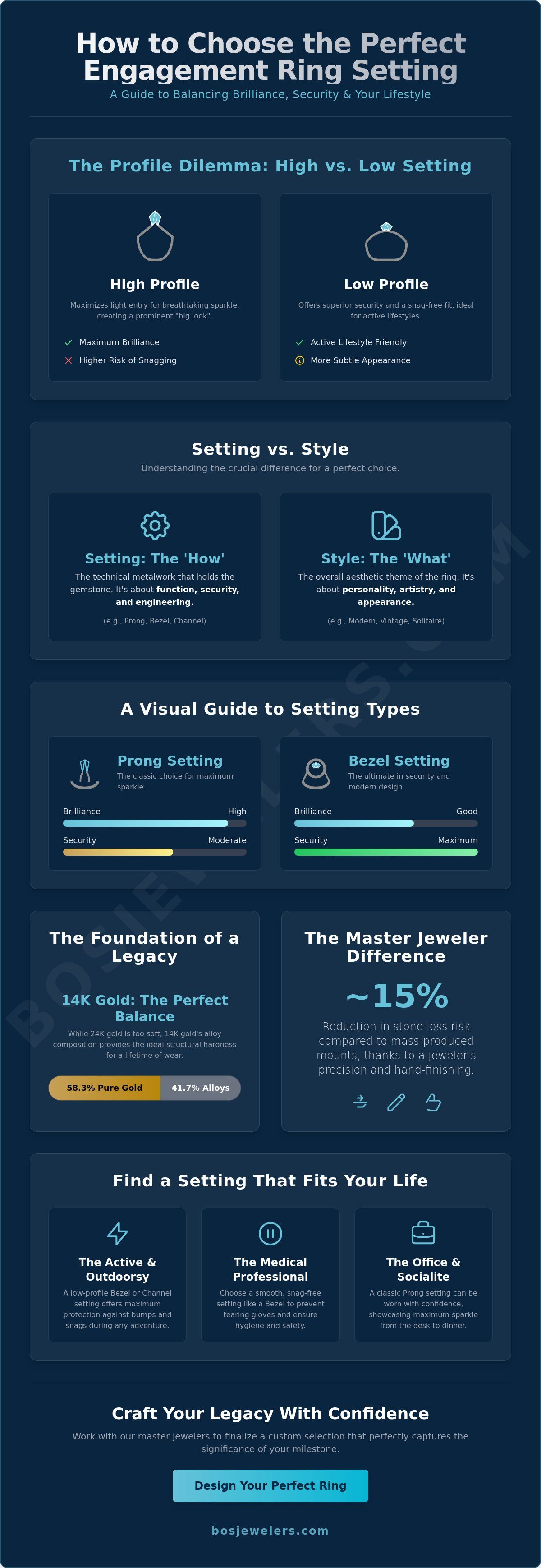
The material you choose for this foundation is just as vital as the design. We often recommend 14K gold for its ideal balance of beauty and structural hardness. While 24K gold is too soft for daily wear, 14K gold contains 58.3% pure gold mixed with durable alloy metals. This composition ensures the prongs remain stiff and secure over decades of use. Understanding the history and cultural significance of engagement rings helps you appreciate why this mounting is so vital; it's the bridge between ancient tradition and modern craftsmanship. A well-chosen setting ensures your diamond performs at its peak while staying safe during your daily adventures.
Setting vs. Style: Why the Difference Matters
An engagement ring setting is the physical structure that anchors the center stone to the band. While many people use the terms interchangeably, "style" refers to the aesthetic theme, such as vintage, modern, or bohemian. The setting is the technical method of attachment. This choice influences the ring's personality without altering the diamond itself. For instance, a 1.00-carat round brilliant diamond takes on a classic, airy appearance in a traditional four-prong mount. That same stone looks bold, contemporary, and incredibly protected when placed in a sleek bezel setting. Recognizing this distinction is the first step in how to choose an engagement ring setting that aligns with both your visual taste and your practical needs.
The Role of the Master Jeweler in Setting Selection
Precision is everything in the world of fine jewelry. A master jeweler ensures that every prong is perfectly symmetrical and spaced to within a fraction of a millimeter. Off-the-shelf, mass-produced settings often lack the durability of a custom-fitted mount created for a specific stone. We believe in the value of a family-owned jeweler who sees your ring as a legacy piece rather than a transaction. Our on-site experts hand-finish every seat to ensure the diamond doesn't just sit on the metal; it belongs there. This level of care prevents the microscopic shifting that causes approximately 15% of stone loss in poorly constructed commercial mounts. When you work with a heritage brand, you're gaining a partner who understands the nuances of multi-generational wear and the meticulous nature of true artistry.
Practicality Meets Elegance: Choosing a Setting Based on Your Lifestyle
Selecting a ring isn't just about the brilliance of the stone; it's about how that piece lives with you every day. At BOS Jewelers, our master jewelers believe a ring should be a seamless extension of your identity. Understanding how to choose an engagement ring setting requires a deep look at your daily rhythm. Do you spend your days in a clinical environment, or perhaps you're often active outdoors? Your setting must balance the desire for a "big look" with the reality of your movement. We've spent over 30 years in Miami helping couples find this equilibrium, ensuring their jewelry remains as resilient as their commitment.
Before finalizing a design, we encourage you to perform the "Snag Test." This involves assessing how the metalwork interacts with delicate fabrics like silk or cashmere. A prong that sits too high can catch on a favorite sweater or tear through a medical glove. We often recommend expert advice on choosing a ring setting to ensure your choice aligns with your wardrobe and professional requirements. Our on-site master jewelers often adjust the height of a setting by just a fraction of a millimeter to provide that perfect, snag-free fit.
Low-Profile Settings for Active Lifestyles
Low-profile settings, such as bezel or flush mounts, are the preferred choice for those with high-intensity careers. These masterfully crafted designs hold the diamond securely within a metal rim, which significantly reduces the risk of the stone chipping during a sudden impact. For the 22 million healthcare professionals in the United States who must frequently change gloves, a low-profile ring prevents the frustration of constant snagging. These settings sit closer to the skin, typically less than 4 millimeters above the finger, making them incredibly comfortable for athletes and those who work with their hands. Maintenance is often simpler, as the recessed stone is less likely to collect debris.
High-Profile Settings for Maximum Sparkle
High-profile settings are designed for the person who wants their diamond to command attention. By elevating the stone 6 to 8 millimeters above the band, more light enters through the pavilion, maximizing the fire and brilliance of the cut. The Cathedral setting is a timeless favorite; it uses elegant arches of precious metal to provide height while maintaining structural integrity. While these styles are exquisite, they require a bit more mindfulness. During the winter months, high prongs are more likely to catch on knitwear or heavy scarves. If you're ready to see these styles in person, we invite you to explore our custom creations at our Miami showroom. Learning how to choose an engagement ring setting is a journey we are honored to take with you, ensuring your legacy is both beautiful and practical.
A Visual Guide to Setting Styles: Balancing Security and Sparkle
Selecting the right mounting is about more than just aesthetics; it is an architectural decision that dictates how your center stone interacts with light and how well it stands up to your daily life. Our master jewelers have spent decades refining these designs in our Miami workshop, ensuring every piece reflects the legacy you are building. To truly master how to choose an engagement ring setting, you must weigh the brilliance of exposed facets against the structural integrity of the metal work.
The Classic Prong and Solitaire
The prong setting remains the most sought-after choice for diamond engagement rings because it allows the maximum amount of light to enter the stone from all angles. By lifting the diamond above the band with minimal metal coverage, the stone often appears larger and more radiant than it would in a more enclosed mount. A four-prong setting offers a modern, square look while a six-prong setting provides a classic, rounded appearance with extra security.
While the four-prong style is excellent for showing off the diamond's profile, our team often recommends the six-prong configuration for active lifestyles. Since its inception in 1886, the six-prong "Tiffany" style has been the gold standard for security. If one prong is accidentally damaged, the remaining five continue to hold the stone in place, whereas a four-prong setting offers less room for error.
The Bezel and Halo: Modern Security and Vintage Allure
For those who prioritize protection, the bezel setting is an exquisite solution. It wraps the diamond in a continuous collar of precious metal, shielding the entire perimeter of the stone. This style is the ultimate safeguard for the diamond’s girdle, which is the most vulnerable part of the gem. It creates a sleek, snag-free surface that won't catch on clothing, making it a favorite for healthcare professionals and athletes.
If you desire more presence on the finger, the halo setting uses a perimeter of smaller diamonds to create the illusion of a much larger center stone. This can increase the perceived size of the center diamond by as much as 0.5 carats. Many couples consult an expert guide to engagement ring settings to compare how a halo adds vintage flair versus the clean lines of a bezel. While halos offer immense sparkle, they do require more frequent cleaning to maintain the "fire" of the smaller accent stones.
The Rise of "Side-Fire" and Hidden Details
Contemporary trends for 2026 emphasize "hidden halos" and side-stone brilliance. A hidden halo sits just beneath the center stone's girdle, visible only from the side profile, adding a secret sparkle that only you and your partner might notice. This reflects the bespoke nature of our work, where every angle is masterfully crafted.
-
Pavé Settings: These use tiny beads of metal to hold small diamonds closely together, creating a "paved" surface of light along the band.
-
Channel Settings: Diamonds are set between two parallel walls of metal, providing a smooth finish and excellent protection for side stones.
-
Hidden Accents: Adding a small sapphire or a custom engraving under the head of the ring personalizes the piece without cluttering the main design.
Understanding how to choose an engagement ring setting requires looking at the ring as a 360-degree piece of art. Whether you prefer the airy brilliance of a solitaire or the reinforced elegance of a bezel, we invite you to explore these textures in person. Let us help you find the balance that secures your diamond and your legacy for generations to come.
The Longevity Factor: Maintenance and Structural Integrity
An engagement ring is more than a purchase; it's a legacy that will likely stay on your hand for decades. Understanding how to choose an engagement ring setting involves looking past the initial sparkle to the structural reality of the piece. Every design choice you make today dictates the maintenance schedule you'll follow for the next 50 years. While platinum is celebrated for its density, 14K gold is often the master jeweler's choice for daily longevity. Because 14K gold contains 58.3% pure gold mixed with durable alloys, it resists scratches and holds diamonds more firmly than softer 18K or 24K alternatives.
Prong Repair and Stone Security
Prongs are the unsung heroes of your ring, but they aren't invincible. Over time, the metal wears down through friction wear against clothing and hard surfaces. We recommend a professional inspection every six months to ensure your stone remains secure. You can perform a simple "rattle test" at home: hold the ring between two fingers near your ear and tap the band. If you hear a faint clicking sound, the stone is loose. In these cases, our master jewelers perform re-tipping, a process where we add fresh metal to the top of the prongs to restore their original strength and grip. It's a vital step for preservation.
Settings and Future Resizing
Life changes, and your ring size might change too. When you're deciding how to choose an engagement ring setting, you must consider future flexibility. Certain styles, like full eternity bands or intricate pavé designs that wrap entirely around the finger, are nearly impossible to resize without compromising the stones. If you love the look of side stones, we suggest choosing a setting with a sizing bar. This is a small, solid section of metal at the base of the band that allows for seamless adjustments. For a deeper look at the technical side of these adjustments, see our master guide to ring resizing.
-
14K Gold: The optimal choice for high-activity lifestyles and maximum stone security.
-
Six-Month Inspections: These are non-negotiable for identifying thin prongs before they break.
-
Sizing Bars: A critical design feature for any band featuring side stones or pavé work.
Maintenance shouldn't be a burden; it's an act of preservation for your most cherished symbol. Our family has spent years perfecting these structural nuances to ensure your ring remains as breathtaking as the day you proposed. We treat every inspection with the same care we used to create the piece originally.
Ready to find a piece built for a lifetime? Explore our collection of masterfully crafted engagement rings and let us help you start your legacy today.
Crafting Your Legacy: How to Finalize Your Custom Selection
Your journey through the technical details of prongs and metals leads to this final, most rewarding stage. Deciding how to choose an engagement ring setting is a blend of practical logic and raw emotion. You aren't just buying jewelry; you're commissioning a piece of history that will be worn for 30, 50, or 70 years before being handed down to the next generation. We recommend 14K gold for this purpose. Its 58.3 percent gold content provides the perfect structural integrity for daily wear. While 18K gold offers a richer yellow hue, 14K remains the heritage standard for diamond bridal jewelry because it resists scratches and holds stones with an unwavering grip.
Before you sign off on the design, run through this four point checklist to ensure the ring stands the test of time:
-
Aesthetic: Does the setting amplify the diamond's natural fire and match her personal style?
-
Lifestyle: If she's active or works with her hands, is the setting profile low enough to avoid snagging?
-
Security: Are the prongs or bezels robust enough to withstand decades of friction?
-
Budget: Have you balanced the metal weight and design complexity with your diamond's requirements?
The Custom Design Consultation
The best way to start is by bringing inspiration photos and notes about her daily lifestyle to your jeweler. We use these details to build a profile of the perfect piece. At BOS Jewelers, we've spent 40 years refining this collaborative process. We help you visualize the final masterpiece using detailed sketches or 3D CAD models. This ensures every millimeter is perfect before the metal is even cast. Our family-owned expertise is baked into every prong, offering a level of precision that mass-produced rings simply can't replicate.
Finalizing the Perfect Match
Choosing the right setting is the final piece of the puzzle in your proposal story. It's the framework that protects your investment and showcases your commitment. We invite you to visit our Miami showroom to begin the journey of creating a bespoke masterpiece. Our on-site master jewelers are ready to guide you through every choice, from the first sketch to the final polish. We don't just sell rings; we welcome you to the family. As we often say, a masterfully crafted piece of jewelry is more than an accessory; it's a "timeless legacy of love."
Begin Your Legacy With a Masterpiece
Selecting the perfect ring is more than a simple purchase; it's the foundation of your family's future legacy. You now understand the vital balance between daily practicality and the structural integrity of 14K gold. Whether you prioritize the maximum brilliance of a high-prong setting or the sleek security of a bezel, knowing how to choose an engagement ring setting ensures your diamond remains safe for a lifetime. Our team has served the Miami community as a family-owned establishment since 1980, bringing over 40 years of jewelry industry heritage to every consultation. We don't just sell rings; we craft them on-site with the precision that only master jewelers can provide.
Every custom creation we produce reflects our commitment to artistry and longevity. We're ready to guide you through the technical nuances of metal strength and stone security while keeping your personal style at the forefront. It's time to move beyond the screen and feel the weight of quality craftsmanship in your own hands. Begin your journey toward a masterfully crafted custom engagement ring today. We look forward to welcoming you into our family and helping you celebrate this magnificent milestone.
Frequently Asked Questions
Which engagement ring setting is the most secure?
A bezel setting is the most secure option because it wraps a continuous rim of precious metal entirely around the diamond’s girdle. This 360-degree protection shields the edges from chips and prevents the stone from falling out. It's a favorite for active lifestyles in Miami, where we prioritize both elegance and longevity. Our master jewelers recommend this style for 100% peace of mind during daily wear.
Does a halo setting make the center diamond look bigger?
A halo setting can make your center diamond appear up to 50% larger than its actual carat weight. This design surrounds the main stone with a frame of smaller diamonds, typically adding 2 to 3 millimeters to the overall diameter. Understanding how to choose an engagement ring setting like this allows you to maximize visual impact. It’s an exquisite way to enhance brilliance while celebrating your unique love story.
What is the difference between a high-profile and low-profile setting?
High-profile settings sit 6 to 8 millimeters above the finger, while low-profile settings rest only 3 to 4 millimeters high. High-profile designs allow more light to enter the diamond’s pavilion, though they may snag on clothing more frequently. Low-profile options offer a more flush fit that’s ideal for healthcare professionals or those who wear gloves. We ensure every custom piece balances these functional needs with timeless beauty.
Can any engagement ring setting be resized?
Most settings can be resized, but full eternity bands and tension settings are the 2 primary exceptions. Since eternity bands feature diamonds covering 100% of the shank, there's no bare metal for a jeweler to cut and rejoin. If you're unsure about a size, we recommend choosing a setting with a sizing bar at the base. Our on-site experts can then adjust the fit to ensure your ring remains comfortable forever.
Is a 4-prong or 6-prong setting better for a round diamond?
A 6-prong setting is generally better for a round diamond because it offers 33% more contact points than a 4-prong alternative. This extra security ensures the stone stays put even if one prong is damaged. While a 4-prong style shows more of the diamond's surface, the 6-prong layout maintains the stone’s circular silhouette more effectively. We often suggest 6 prongs for stones larger than 1.5 carats to provide maximum stability.
How often should I have my ring setting inspected by a jeweler?
You should visit a professional jeweler every 180 days for a comprehensive inspection and cleaning. During these 6-month checkups, we examine the prongs under 10x magnification to identify any thinning metal or loose stones. Regular maintenance prevents the loss of precious gems and keeps your exquisite piece looking as radiant as the day you first saw it. It’s a simple step to protect your family’s growing legacy.
Do bezel settings hide the diamond’s brilliance?
Bezel settings don't hide brilliance, but they do change how light interacts with the stone. While a 0.5mm metal rim covers the sides, a well-cut diamond still reflects light through the top table with immense fire. Modern bezel designs are masterfully crafted to sit slightly lower, allowing for a sleek, contemporary look. They offer a sophisticated aesthetic that doesn't compromise the sparkle our Miami clients have come to expect.
What is a "cathedral" setting and is it durable?
A cathedral setting features 2 metal arches that rise from the shank to support the center stone's mounting. This design is incredibly durable because the arches provide structural reinforcement that protects the head from side impacts. When you're learning how to choose an engagement ring setting, the cathedral style stands out for its architectural grace. It creates a majestic profile that highlights the craftsmanship of your bespoke jewelry piece.