
Hollow Gold vs. Solid Gold Jewelry: Pros, Cons, and the Pursuit of Lasting Quality
Would you still choose that beautiful gold pendant if you knew it could never be repaired after its first accidental dent? It's natural to feel a sense of hesitation when you see two seemingly identical 14K gold crosses with vastly different price tags. You want to celebrate a milestone or honor your faith with something lasting, yet the fear of damaging an expensive investment often creates more stress than joy. Understanding the nuances of hollow gold vs solid gold jewelry pros and cons is the essential first step toward finding a piece that matches your lifestyle and your legacy.
We've spent over forty years guiding families through these choices, and we believe your jewelry should offer both brilliance and peace of mind. You'll learn exactly how construction impacts the security of a precious birthstone and why certain designs are better suited for daily wear. We'll explore the technical realities of durability and value, ensuring you have the confidence to choose a handcrafted piece that will truly stand the test of time.
Key Takeaways
- Master the fundamental structural differences between solid alloys and hollow shells to make an informed investment in your personal jewelry collection.
- Weigh the hollow gold vs solid gold jewelry pros and cons to see why solid construction remains the gold standard for pieces intended to endure as multi-generational legacies.
- Learn why the intricate details of a 14K gold religious pendant require the density of solid gold to resist the wear and tear of a lifetime of devotion.
- Discover why solid construction is a technical necessity for birthstone settings, providing the essential strength required to keep your precious gems securely in place.
- Understand how to match jewelry construction to your specific lifestyle, ensuring safety and durability for everything from children's earrings to daily-wear bracelets.
Defining the Craft: What is the Real Difference Between Hollow and Solid Gold?
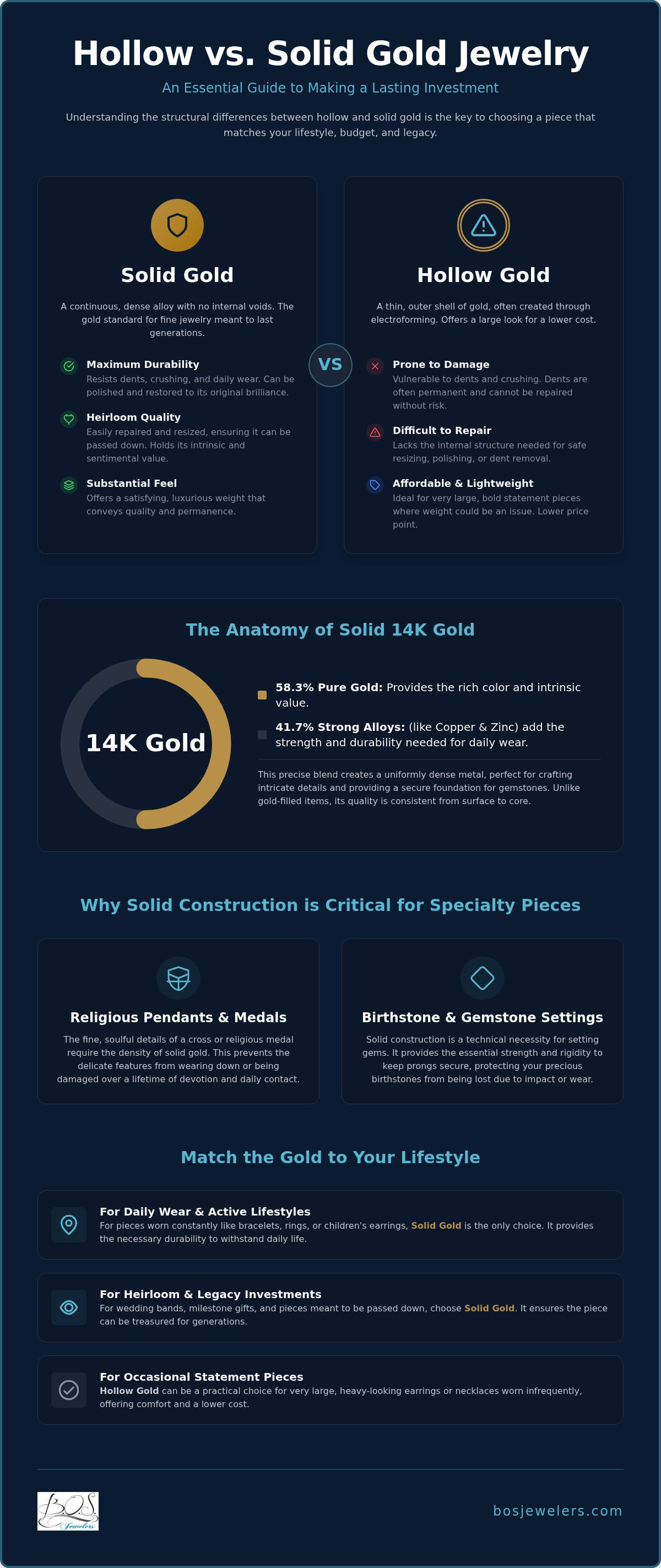
The term "solid gold" often carries an air of mystery. To some, it implies a piece of pure 24K gold, but in the world of fine craftsmanship, this is rarely the case. Pure gold is far too malleable for the demands of daily life. Instead, we look to 14K gold as the definitive standard for excellence. When we discuss hollow gold vs solid gold jewelry pros and cons, the conversation begins with what lies beneath the polished surface. Solid gold jewelry is cast or forged as a continuous, dense alloy. It contains no air pockets, hidden chambers, or structural voids. In contrast, hollow gold is an architectural illusion. It's a gold shell that offers the grand visual presence of a heavy chain or thick bangle without the associated weight or cost.
The distinction is vital because the construction dictates how a piece will age. A solid piece feels substantial against the skin, offering a tactile reminder of its quality. A hollow piece might look identical on a velvet display, but it lacks the internal reinforcement needed to survive a lifetime of wear. Understanding these differences ensures that your next purchase isn't just a temporary adornment, but a lasting part of your personal history.
The Anatomy of Solid 14K Gold
Solid 14K gold is composed of 58.3% pure gold, precisely balanced with durable alloys like copper and zinc. This consistency creates a metal with uniform density throughout the entire piece. Unlike gold-filled jewelry, which relies on a base metal core, solid gold maintains its integrity from the surface to the center. This structural stability provides a reliable foundation for repair and resizing. 14K solid gold is the ideal medium for the intricate, soulful details required in religious artistry.
Understanding Hollow Gold Construction
Hollow gold is often created through a process called electroforming. This sophisticated technique allows artisans to layer gold over a pre-formed shape, which is later removed or left as a lightweight core. It's a method that maximizes visual volume while minimizing the actual amount of gold used. While these pieces can be stunning for occasional statement wear, they lack the "meat" of solid pieces. Some hollow designs even incorporate lightweight fillers to help the thin exterior shell resist pressure, though these don't offer the same permanence as a solid casting.
Performance and Longevity: Weighing the Pros and Cons for Your Collection
When you weigh the hollow gold vs solid gold jewelry pros and cons, the true test occurs during your daily routine. A piece of jewelry isn't just a static object in a box. It moves with you, encounters hard surfaces, and experiences the constant friction of life. While both styles have their place in a curated collection, their performance over time varies significantly. Choosing between them requires a balance of aesthetic desire and practical expectation.
The FTC guidelines on precious metals ensure that jewelers provide clear disclosures about gold content and construction. This transparency is vital because, while hollow gold offers an accessible entry point for voluminous designs, the long-term value often leans toward solid construction. Solid gold doesn't just hold its shape; it holds its history. It's a choice that prioritizes the future as much as the present.
Durability and the Risk of Dents
Hollow gold is essentially a delicate shell. If you accidentally strike a hollow bangle or pendant against a hard surface, the metal can "crush" or cave in. Because there's no metal behind that surface to provide support, these dents are usually permanent. They cannot be easily buffed or hammered out without risking further damage. Solid gold possesses the density to withstand significant impact. While it may acquire surface scratches over decades of wear, these can be professionally polished away to restore the piece to its original brilliance. This resilience is why we recommend solid construction for anyone with an active lifestyle.
Weight, Comfort, and Price Points
There's an undeniable psychological comfort in the "heft" of a solid gold cross or chain. It feels intentional and prestigious against the skin. However, we recognize that for exceptionally large statement pieces, hollow construction serves a practical purpose by preventing neck or ear fatigue. 14K solid gold provides the perfect middle ground, offering that luxurious weight without becoming cumbersome. If you're looking to maintain the luster of your current favorites, our professional jewelry cleaning and polishing services can help restore that signature glow to both solid and hollow pieces in your collection.
Beyond immediate comfort, consider the legacy of your purchase. Solid gold retains its intrinsic value far more effectively than hollow alternatives. It remains a tangible asset that you can pass down through generations, confident that it won't lose its form or structural integrity over time. It represents a commitment to quality that transcends temporary trends.
The Role of Structure in Specialty Pieces: Religious Pendants and Gemstone Settings
When you select a piece that carries deep spiritual or personal significance, the choice isn't just about the immediate aesthetic. It's about the preservation of a story. Evaluating hollow gold vs solid gold jewelry pros and cons becomes a technical necessity when we look at intricate designs like religious icons or gemstone-set heirlooms. These pieces require a structural integrity that a thin shell simply cannot provide. For an object intended to be worn for decades, the interior composition is just as vital as the exterior shine.
We believe that a milestone gift should never be a source of anxiety. Whether it's a birthstone pendant or a devotional cross, the construction dictates whether the piece remains a cherished heirloom or becomes a candidate for the scrap pile. Choosing solid construction ensures that the fine details and precious stones you've carefully selected stay exactly where they belong.
Why Solid Gold is Essential for Religious Pendants
Detailed religious imagery, such as the fine features of a crucifix or the delicate etching of a saint, requires the depth of high-relief casting. Hollow construction often results in a "stamped" look that lacks crispness and soul. Over years of wear, the bale, which is the small loop connecting the pendant to the chain, experiences constant friction. In a hollow piece, this loop can wear thin and eventually break through. A solid 14K gold cross is the preferred choice for baptismal and lifelong gifts because it remains as steadfast as the faith it represents. You can explore the artistry behind these designs in our guide to gold religious pendants.
Securing Gemstones and Birthstones in Solid Settings
Gemstone security relies entirely on the "meat" of the metal. Prongs and bezels need a solid foundation to grip a stone like a July ruby or a September sapphire securely. In a hollow setting, there's no internal thickness for the prongs to anchor into, which makes them prone to pulling away or snapping off entirely. Solid 14K gold provides the necessary density to keep your birthstones safe during daily movement. This foundation also makes future maintenance possible. Professional prong repair is only truly effective on solid gold, as an artisan can weld new metal to the existing base without the risk of melting a delicate hollow shell.
Making the Investment: How to Choose the Right Construction for Your Lifestyle
Choosing the right piece of jewelry is a deeply personal process that balances your aesthetic desires with the realities of your daily routine. We understand that every purchase is a chapter in your family's history. Reflecting on the hollow gold vs solid gold jewelry pros and cons helps you decide which construction will serve you best over the coming decades. While the allure of a larger piece at a lower price point is tempting, your lifestyle should be the ultimate guide for your investment.
We've seen how the right choice today prevents heartache tomorrow. Whether you're selecting a gift for a loved one or a treat for yourself, the construction you choose dictates how much care the piece will require. It's about finding that perfect harmony between the brilliance of the design and the endurance of the metal.
Matching Jewelry Construction to Wear Frequency
For your daily essentials, such as wedding bands or bracelets that rest against your wrist, solid gold is the only choice that truly makes sense. These items are subject to constant movement and impact. Solid construction ensures they won't lose their shape or cave in under pressure. Occasional statement pieces, like oversized earrings or dramatic necklaces worn for special events, are where hollow gold finds its purpose. It allows for bold, voluminous styles, such as the premium Indian fashion pieces from Dayaa Jewels, that remain comfortable for an evening out. However, if you're selecting a legacy item like a devotional pendant or a birthstone ring, solid gold remains the gold standard for items meant to be cherished by future generations.
Professional Maintenance and Repair Considerations
Longevity is closely tied to repairability. When it comes to ring resizing, hollow bands present significant challenges. Because the interior is empty, traditional cutting and welding techniques can cause the thin walls to collapse or warp. Solid gold bands allow for seamless adjustments that maintain the ring's structural integrity. Similarly, professional polishing can restore a solid gold piece to its original luster time and again. With hollow items, a jeweler must be exceptionally careful not to "polish through" the thin exterior shell.
Safety is another vital consideration, particularly for the youngest members of your family. We always recommend solid construction for children’s 14K gold earrings. Solid gold is less likely to break or trap bacteria in hidden cavities, providing a safer and more durable option for active children. To ensure you're receiving the quality you expect, always look for registered hallmarks and seek professional appraisals for high-value items. This diligence protects both your sentiment and your investment.
Choose a Legacy That Never Fades
Your jewelry should be more than a fleeting adornment. It's a testament to your milestones and a vessel for your most cherished memories. By carefully weighing the hollow gold vs solid gold jewelry pros and cons, you've gained the clarity needed to choose a piece that aligns with your lifestyle and your values. You now understand that while hollow designs offer impressive volume, only solid 14K gold provides the structural foundation required for secure gemstone settings and lifelong repairability.
Since 1983, our family-owned heritage brand has focused on the meticulous artistry of 14K gold and diamonds. We take pride in being creators who understand the technical soul of every pendant and ring we offer. With our expert on-site jewelry repair and polishing services, we ensure that your investment remains as brilliant as the day you first wore it. We invite you to explore our collection of solid 14K gold religious pendants and fine jewelry to find a piece that truly stands the test of time. Your story deserves the enduring strength of quality craftsmanship.
Answers to Your Most Pressing Jewelry Questions
Can you fix a dent in a hollow gold chain?
Dents in hollow gold are usually permanent because the piece lacks an internal foundation. When a hollow shell collapses, there's no metal to push back against the pressure. Attempting to "pop" a dent out often results in cracking the thin gold walls. While solid gold can be buffed or reshaped by an artisan, a damaged hollow piece typically requires replacement rather than repair.
Is solid gold better for people with sensitive skin?
Solid 14K gold is the superior choice for those with metal sensitivities. Hollow jewelry sometimes uses base-metal solders or chemical fillers to maintain its shape during the manufacturing process. If the exterior shell wears down or develops a microscopic crack, these internal materials can irritate the skin. Solid construction ensures that only the high-quality 14K alloy touches your skin, providing a much more consistent and hypoallergenic experience.
How can I tell if my jewelry is hollow or solid gold?
The most reliable indicators are weight and sound. A solid 14K gold cross will feel surprisingly heavy for its size, whereas a hollow version will feel light, almost like plastic. You can also gently tap the piece with a fingernail. Solid gold produces a dull, satisfying "thud," while hollow gold often gives off a higher-pitched, tinny ring. When weighing the hollow gold vs solid gold jewelry pros and cons, this tactile "heft" is often the first sign of a lasting investment.
Why does hollow gold cost so much less than solid gold?
Hollow gold is priced lower because it contains significantly less precious metal by weight. Since gold is traded as a commodity based on its weight in ounces or grams, a piece that's mostly air will always be more affordable than a dense, solid casting. You're essentially paying for the visual volume rather than the metal's intrinsic value. While this makes statement pieces more accessible, it's important to remember that the lower price reflects a sacrifice in durability and long-term metal retention.
Does hollow gold tarnish or change color over time?
Genuine 14K gold doesn't tarnish like silver, but hollow pieces can lose their luster differently than solid ones. Dust, skin oils, and moisture can sometimes become trapped inside the hollow cavity. This internal buildup can eventually seep through tiny seams, causing the piece to look dull or discolored. Solid gold is much easier to maintain because it lacks these hidden chambers, allowing for a thorough, professional cleaning that restores the entire surface to its original brilliance.
Is 14K solid gold actually "solid" or is it an alloy?
It's a solid alloy, meaning the metal is consistent throughout the entire piece. The term "solid" refers to the construction of the item, not the purity of the gold itself. 14K gold is composed of 58.3% pure gold mixed with other metals like copper and zinc to provide necessary strength. This blend is essential for creating a durable medium that can securely hold a diamond or a birthstone. It's the standard we use for our handcrafted religious pendants to ensure they survive the rigors of daily devotion.