

Common Engagement Ring Buying Mistakes to Avoid: A Guide to Lasting Brilliance
What if the most expensive diamond in the gallery isn't actually the one that will shine the brightest on her hand? Selecting a symbol of your forever is one of the most significant milestones you'll ever cross, yet it's often clouded by a fog of technical jargon and high-pressure sales. We understand that you want more than just a piece of jewelry; you're looking for a legacy. However, many couples find themselves overwhelmed by the 4Cs or paralyzed by the fear of overpaying for a stone that lacks true fire. Learning the common engagement ring buying mistakes to avoid is the first step toward ensuring your investment matches the depth of your commitment.
You deserve a purchasing process that feels as elegant and seamless as the ring itself. We've crafted this guide to help you bypass the typical pitfalls, from miscalculating the impact of a cut to overlooking the practicalities of a partner's daily lifestyle. We'll explore how to balance the technical specifications of a diamond with the emotional resonance of its design, especially as current trends shift toward prioritizing a stone's light performance over its simple carat weight. By the end of this journey, you'll have the quiet confidence of a seasoned collector, ready to select a handcrafted masterpiece that offers both peace of mind and breathtaking brilliance for generations to come.
Key Takeaways
- Understand why viewing your purchase as a structural legacy rather than a mere transaction is the first step to identifying common engagement ring buying mistakes to avoid.
- Learn to escape the "Carat Trap" by prioritizing a diamond’s physical millimeter dimensions over its weight to ensure maximum visual impact.
- Discover why popular "whisper-thin" band trends may compromise the security of your stone and how to choose a setting built for a lifetime of daily wear.
- Master the logistics of professional sizing and long-term care to prevent costly resizing errors and maintain the brilliant fire of your gold and diamonds.
- Recognize the essential role of a multi-generational jeweler with on-site artisans in providing the technical expertise and personal partnership your investment deserves.
The Emotional and Financial Stakes of Engagement Ring Shopping
Choosing an engagement ring is a profound intersection of your deepest emotions and your most significant financial planning. It represents a promise that spans a lifetime. Because of this, it's essential to treat the selection as more than a mere transaction. One of the most common engagement ring buying mistakes to avoid is treating this purchase like any other retail experience where you simply click and ship. You're not just buying a stone; you're commissioning a future heirloom.
Much of the advice found on social media or generic wedding blogs prioritizes the "now" over the "forever." This often leads to rings that are visually stunning in a studio photograph but physically incapable of surviving the rigors of daily wear. We believe in creating a legacy piece rather than a fleeting trend piece. A legacy piece considers the history and cultural significance of engagement rings as enduring symbols of strength and beauty. When you prioritize structural integrity, you ensure the ring remains as brilliant on your fiftieth anniversary as it was on the day of the proposal.
The Pressure of the Perfect Proposal
Rushing into a decision because of a looming proposal date is a recipe for regret. A diamond engagement ring requires time for careful inspection and, often, custom adjustments to ensure the setting is perfect. We've found that clients who allow for a generous timeline feel more connected to the piece. Our 40-year heritage as a multi-generational establishment provides a stable, expert environment where your journey is guided by seasoned artisans rather than the fluctuating algorithms of a startup. Taking the time to understand the nuances of the craft is the best way to bypass common engagement ring buying mistakes to avoid.
Budgeting Beyond the Price Tag
The old "two months salary" rule belongs to a different era. In 2026, setting a budget requires a nuanced understanding of current market shifts. With gold prices reaching $4,700 per ounce in May 2026, the cost of the setting itself has become a larger factor in the overall investment than in previous years. It's about finding a balance that feels comfortable for your unique financial situation without sacrificing the quality of the gold or the fire of the diamond.
Beyond the initial cost, you must consider the structural life of the ring. This includes accounting for insurance to protect your asset and the eventual need for professional cleaning and polishing. If you're looking for more depth on how to structure your investment, we recommend exploring The Ultimate Guide to Diamond Engagement Rings: Crafting a Legacy of Love. Planning for these factors early prevents the stress that often accompanies "guesswork" budgeting. A well-planned budget ensures that the financial aspect of the engagement remains a source of security rather than a source of strain.
Prioritizing Diamond Dimensions Over Carat Weight
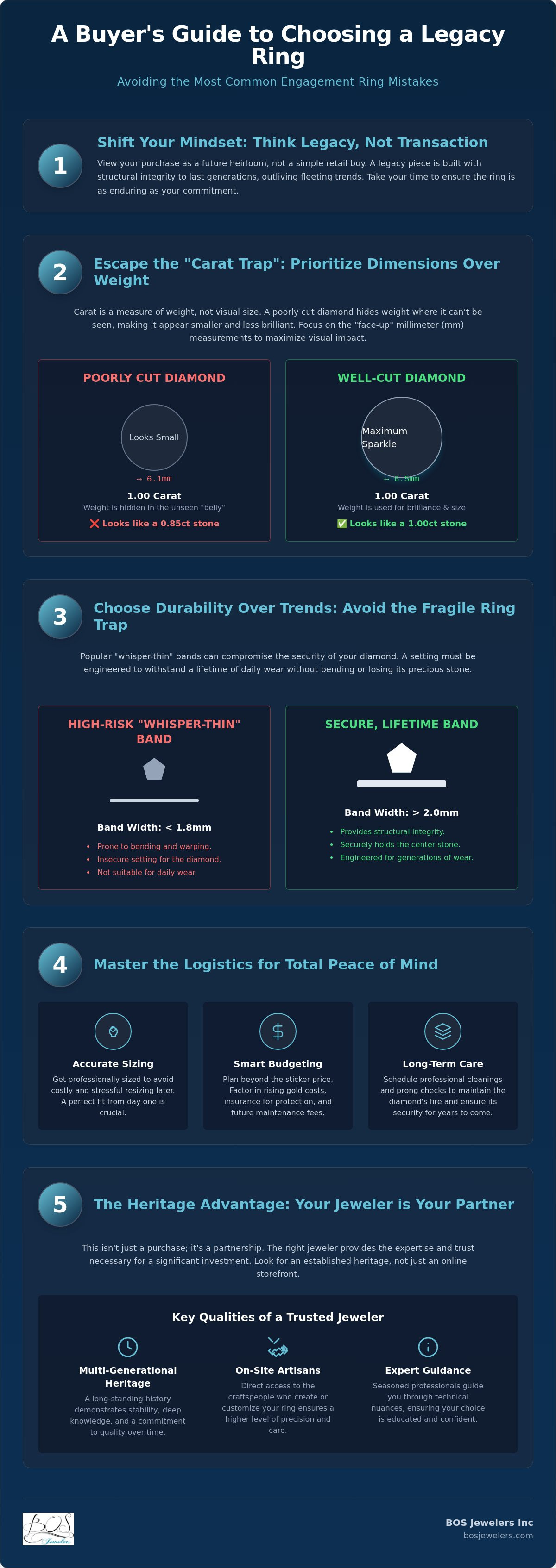
Many first-time buyers walk into a gallery with a specific number in mind, usually a carat weight that sounds impressive. Falling into the "Carat Trap" is one of the most common engagement ring buying mistakes to avoid. Carat is a measure of weight, not visual size. Two diamonds can weigh exactly the same on a scale but appear drastically different when viewed from above. If a diamond is cut too deep, its weight is tucked away in the "belly" of the stone where it can't be seen. You end up paying for weight that adds no beauty and actually hinders the stone's ability to reflect light.
We encourage you to look past the certificate's weight and focus on the "face-up" measurements in millimeters. This is what your eye actually perceives. A poorly cut diamond might hide 20% of its weight below the girdle, making a 1.00-carat stone look like a 0.85-carat stone. By prioritizing the physical dimensions and the quality of the cut, you ensure that every dollar of your investment is visible on her hand. True brilliance comes from how the stone handles light, not how heavily it sits on a scale.
Understanding Diamond "Spread"
The "spread" of a diamond refers to its physical diameter in relation to its weight. A shallow cut might make a stone look enormous, but it often sacrifices the very fire that makes a diamond special. Conversely, a stone with an excellent cut focuses on light return. It's often wiser to choose a 0.90-carat stone with a superior cut and ideal dimensions than a 1.00-carat stone that is poorly proportioned. Always insist on seeing the physical dimensions on the laboratory certificate. When you review GIA's 4Cs of Diamond Quality, you'll see that cut is often considered the most critical factor in a stone's overall allure.
The Brilliance Factor
Light performance is the heartbeat of a fine diamond. A round brilliant cut is engineered specifically to reflect the maximum amount of light back to the eye. Fancy shapes, such as pears or marquises, require even more scrutiny because they can suffer from "bow-tie" effects or light leakage. Warmer 14K yellow gold settings allow for lower color grades without compromising the stone's appearance, as the metal's rich hue masks subtle hints of yellow within the diamond. If you're feeling overwhelmed by these technical choices, our team is here to help you select Diamond Engagement Rings that prioritize true radiance over a simple number on a scale.
Structural Integrity vs. Aesthetic Trends: Avoiding the Fragile Ring Trap
Social media feeds are often filled with "whisper-thin" bands that look incredibly delicate and modern. While these minimalist designs are visually striking, they represent one of the most common engagement ring buying mistakes to avoid. A band that is too thin lacks the necessary metal volume to withstand the pressure of daily life. Over time, a shank that measures less than 1.8mm can warp, thin out further, or even snap. We believe a ring should be a structural legacy, engineered to endure decades of handshakes, door handles, and daily activity without losing its shape.
Choosing the right metal is equally vital for longevity. While 18K gold carries a higher prestige due to its gold content, 14K gold is often the superior choice for an engagement ring meant for daily wear. The higher percentage of alloy metals in 14K gold makes it significantly harder and more resistant to scratches and bending. This durability ensures your setting remains secure. When seeking expert advice on buying an engagement ring, seasoned professionals will always emphasize that the beauty of a piece is secondary to its ability to hold your diamond safely.
Security often comes down to the prongs and the architecture of the head. A "Gallery Rail" is a small band of metal that connects the prongs horizontally. It acts as a safety net; if one prong snags on a sweater and pulls away, the rail keeps the diamond from falling out. Similarly, while four prongs offer a classic look, six prongs provide a higher level of security and better protect the diamond's girdle from accidental chips.
The Myth of the Maintenance-Free Ring
No piece of fine jewelry is truly "set it and forget it." Even the most well-crafted rings require a professional inspection every six months. During these visits, we check for metal fatigue and perform any necessary prong repair to ensure your stone hasn't become loose. Understanding the relationship between band thickness and structural health is also crucial if you ever need a modification. You can learn more about this in our guide on Ring Resizing: The Master Guide to Achieving a Flawless Fit, which explains how the volume of metal affects the resizing process.
Lifestyle Matching
Your partner's daily routine should dictate the ring's design. A high-profile setting that sits far off the finger is stunning but can be a liability for someone with an active lifestyle or a job that requires frequent use of their hands. For those who frequent the gym or work in healthcare, a lower-profile setting or a slightly wider band offers peace of mind. By tailoring the design to their specific lifestyle, you bypass common engagement ring buying mistakes to avoid and ensure the ring remains a comfortable, permanent fixture in their life.
Practical Logistics: From Accurate Sizing to Comprehensive Protection
Securing a masterpiece is only half the journey. Ensuring that it remains comfortably on her finger and is protected from the unexpected is where many well-intentioned plans falter. One of the most common engagement ring buying mistakes to avoid is the urge to guess the ring size based on a temporary fashion ring or a printed paper guide. A ring that is too loose risks slipping off during daily activity; a ring that is too tight causes discomfort and skin irritation. Precision is the only path to a lasting fit.
You must also consider the future "Ceremonial Stack." It is a frequent oversight to select an engagement ring with a unique, low-profile basket that prevents a wedding band from sitting flush against it. This creates an unsightly gap that can lead to metal-on-metal friction. Planning for the wedding band at the same time you choose the engagement ring ensures a harmonious, elegant silhouette. If you find yourself needing technical adjustments to an existing piece, our artisans specialize in Ring Resizing and Prong Repair to restore that perfect, secure balance.
The Science of the Perfect Fit
Finger size is not a static measurement. It fluctuates based on the time of day, the temperature, and even your hydration levels. We recommend being sized in the afternoon when the hands are warm. Cold weather can cause fingers to shrink, leading to a fit that feels perfect in the gallery but becomes dangerously loose outdoors. While a slightly tighter fit is often safer for top-heavy solitaire designs to prevent "spinning," it should never be restrictive. Professional sizing tools are the only way to account for these nuances; avoid the "sizing sheets" found online which often lead to costly remakes.
Protecting the Investment
The moment you leave the gallery, your investment is at risk. Waiting even 24 hours to secure insurance is a critical error. A standard homeowner’s or renter’s policy often limits jewelry coverage to between $1,000 and $2,000; this is rarely enough for a piece that averages over $5,200 in the US market. You need a standalone policy or a specific rider. This protection typically costs between 1% and 2% of the ring’s appraised value annually. We provide detailed appraisals that document every technical specification of your stone and setting, ensuring you have the necessary paperwork for comprehensive coverage. Your first week of ownership should follow a strict rhythm:
- Finalize the Appraisal: Ensure every detail of the 14K gold and diamond quality is documented.
- Activate Insurance: Secure a policy that covers loss, theft, and accidental damage.
- Establish a "Safe Spot": Designate one specific, secure location in your home where the ring lives whenever it is not being worn.
The Heritage Advantage: Why Your Choice of Jeweler Matters
The journey to finding the perfect diamond often ends at a computer screen for many, but this transactional approach is one of the most overlooked and common engagement ring buying mistakes to avoid. Online-only retailers offer a vast inventory, yet they lack the heartbeat of a multi-generational establishment. When you choose a jeweler, you aren't just selecting a product; you're choosing a steward for your family’s most precious symbols. We believe that a purchase this significant requires a personal connection that a digital shopping cart simply cannot provide.
A family-owned business with over 40 years of experience views every client as a lifetime partner. This perspective changes everything about the buying process. We aren't focused on a single sale; we're focused on the decades of brilliance that follow. Our on-site master jewelers are always present to provide essential services such as jewelry cleaning and polishing or ring resizing and prong repair. This local, immediate expertise ensures that your ring never has to be mailed away to a nameless facility, keeping your investment safe and within reach at all times.
Expertise You Can Trust
There is no substitute for seeing a diamond’s fire with your own eyes. Lighting conditions in a gallery are designed to show you the stone’s true character, a nuance that even the highest-resolution video fails to capture. Our artisans guide you through these technicalities with the quiet confidence that only comes from decades of bench experience. This level of mastery extends across all our work, from our bespoke engagement designs to our collection of 14K gold religious pendants. Seeing the breadth of our craftsmanship firsthand allows you to feel the prestige and sincerity behind every piece we create, helping you bypass the common engagement ring buying mistakes to avoid.
Crafting Your Legacy
You’ve now moved from the uncertainty of the "Carat Trap" and the fragility of thin-band trends to a place of confident ownership. You understand that a ring is a structural legacy, a blend of 14K gold durability and diamond brilliance. This knowledge is your greatest asset. We invite you to step into our gallery and experience this artistry in person. Whether you are beginning with a specific vision or need a passionate guide to show you the way, we are here to ensure your story is told with perfection. Visit BOS Jewelers to begin your custom engagement journey and speak with an expert who values your history as much as you do. Let us help you verify every technical specification to ensure your ring remains a source of pride for generations.
Your Journey Toward a Timeless Legacy
Choosing a ring is more than a simple purchase; it's the first tangible piece of your shared history. By prioritizing light performance over weight and choosing structural integrity over fleeting trends, you ensure your investment remains a source of daily joy. Understanding the common engagement ring buying mistakes to avoid transforms a complex process into an empowering, celebratory experience. You now possess the specialized knowledge required to look beyond a certificate and value the artistry that truly endures for generations.
We invite you to bring your vision to life with the quiet confidence of our 40-year family-owned heritage. Our on-site master jeweler specializes in the meticulous crafting of high-quality 14K gold and diamonds, ensuring every setting is as durable as it is brilliant. Whether you're designing a bespoke masterpiece or selecting a timeless silhouette, we're here to serve as your knowledgeable guides. Begin your journey with a trusted heritage jeweler today and discover the peace of mind that comes with genuine expertise. Your forever deserves a brilliance that never fades.
Frequently Asked Questions
How much should I realistically spend on an engagement ring in 2026?
Realistically, you should spend what your personal financial health allows rather than following the outdated "three-month salary" marketing rule. While the average US expenditure sits between $5,000 and $7,829, your budget must account for current market shifts, including the May 2026 gold peak of $4,700 per ounce. Prioritize a balance that allows for a high-quality stone and a structurally sound setting without incurring high-interest debt.
Is it a mistake to buy an engagement ring online without seeing it first?
Buying an engagement ring online without a physical viewing is one of the most common engagement ring buying mistakes to avoid. Diamonds are three-dimensional objects that interact with light in ways a static photo or digital video cannot replicate. A stone might look perfect on a screen but reveal a "bow-tie" effect or dullness in person. Visiting a heritage gallery allows you to see the true fire of the diamond under various lighting conditions.
What is the most common mistake people make with diamond clarity?
The most frequent error in clarity is paying a premium for a "Flawless" grade when an "Eye-Clean" stone looks identical to the unaided eye. Grades like VS1 or VS2 offer incredible value because their inclusions are invisible without a jeweler's loupe. By selecting a slightly lower clarity grade that remains visually perfect, you can reallocate your budget toward a superior cut, which has a much greater impact on brilliance.
Can any engagement ring be resized if I get the size wrong?
No, not every ring can be resized, particularly full eternity bands where diamonds encircle the entire shank. If you are captivated by the continuous sparkle of these designs, you can learn more about Eternity and their precision-crafted jewelry. Certain intricate pavé settings or tension-set designs also present significant technical challenges. It's vital to confirm the resizing potential of your chosen style before finalizing the purchase. Our master jewelers can advise on which designs offer the flexibility for future adjustments and which require an exact initial measurement.
Should I prioritize the diamond or the setting when budgeting?
You should prioritize the quality of the diamond's cut while ensuring the setting provides a robust structural foundation. A spectacular diamond is only as secure as the prongs holding it. While the diamond is the focal point, the setting is the engineering that protects your investment. We recommend a harmonious approach where neither the stone's brilliance nor the band's durability is sacrificed for the other. This balance of aesthetic beauty and structural integrity is a hallmark of all fine jewelry, including the authentic Native turquoise pieces found at silverelegant.com.
How do I know if a diamond is ethically sourced and certified?
A truly ethical diamond must be accompanied by a reputable laboratory certificate from the GIA or IGI. These documents verify the stone's technical specifications and origin. Professional jewelers who value transparency will also confirm their adherence to the Kimberley Process, ensuring your diamond is conflict-free. This certification provides the peace of mind that your symbol of love was sourced with integrity and care.
What happens if I forget to insure my ring immediately?
If you forget to insure your ring immediately, you are personally responsible for the replacement cost if it is lost, stolen, or damaged. Most standard renter’s or homeowner’s policies only cover up to $2,000 for jewelry, which falls short of the current $5,200 national average. Activating a standalone policy within the first 24 hours of ownership is the only way to protect your financial asset against the unexpected.
Why is 14K gold recommended over 18K gold for the band?
We recommend 14K gold for engagement bands because its higher alloy content makes it significantly more durable than 18K gold. While 18K gold is more prestigious due to its higher gold percentage, it is also softer and more prone to scratching or bending under the rigors of daily wear. 14K gold offers the perfect marriage of rich color and long-term structural integrity, ensuring your prongs remain tight and your band stays true.