

Checking Gold Bracelet Clasps: Security & Authenticity
Approximately 70% of jewelry owners wear damaged items for months before seeking repairs, often unaware that a tiny mechanical failure is imminent. It's a quiet anxiety we've all felt while glancing down at a wrist, hoping a family heirloom or a symbolic 14K gold religious pendant is still securely in place. You shouldn't have to live with that uncertainty or the fear of losing a piece that carries so much personal meaning.
Understanding how to check the clasp on a gold bracelet is the most effective way to protect your investment and ensure your jewelry remains a lasting part of your story. We'll guide you through the professional methods for testing mechanical tension, identifying genuine "585" hallmarks, and recognizing when the delicate artistry of a box or lobster clasp requires expert care. Whether you're inspecting a daily diamond tennis bracelet or a cherished gift, you'll learn to distinguish between a secure closure and one that risks a heartbreaking loss. We'll also explore why 14K gold is the preferred choice for these functional components due to its superior durability compared to softer, higher-karat metals. By the end of this guide, you'll have the expert knowledge needed to verify your jewelry's integrity from the comfort of your home.
Key Takeaways
- Identify the significance of "585" hallmarks and the distinct mechanical benefits of lobster, spring, and box clasps to ensure your jewelry meets professional standards.
- Master our professional five-step method for how to check the clasp on a gold bracelet, focusing on visual alignment and the critical "snap-back" tension test.
- Learn the nuance of the magnet test and why high-quality 14K gold jewelry often utilizes internal stainless steel springs for maximum mechanical security.
- Understand how regular professional cleaning preserves the intricate mechanics of your clasps, preventing the accumulation of debris that can lead to unexpected failure.
Understanding Clasp Types and Gold Hallmarks
The clasp is the unsung hero of your jewelry. It's the mechanical heart that keeps your most precious memories safely on your wrist. When considering how to check the clasp on a gold bracelet, the first step is identifying the specific mechanism. Most fine 14K gold pieces utilize one of three styles: the sturdy lobster claw, the classic spring ring, or the elegant box clasp. Each serves a specific purpose, but they all share one critical role: carrying the official "signature" of the gold's purity. Because these components are manufactured with precision, they are almost always the primary location for authenticity marks.
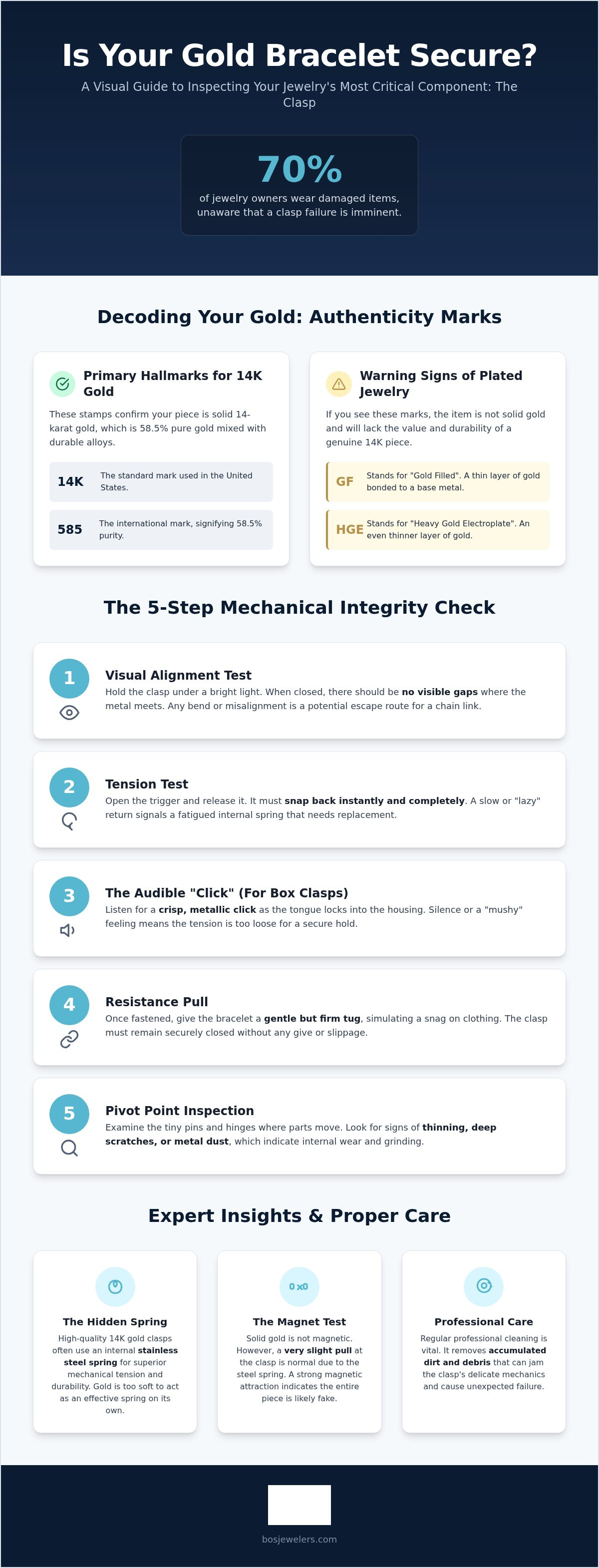
Identifying gold hallmarks is a skill every collector should possess. In the United States, you'll commonly see "14K" stamped into the metal, while international pieces often use the millesimal fineness system. For 14K gold, look for the number "585," which signifies that the metal is 58.5% pure gold. To find these tiny inscriptions, we recommend using a jeweler’s loupe or even the macro lens on your smartphone. These tools reveal the intricate details that ensure your piece is genuine and high-quality.
Common 14K Gold Hallmark Variations
While "14K" and "585" are the standards we look for, you must remain vigilant for other markings that might indicate a different composition. Stamps like "GF" (Gold Filled) or "HGE" (Heavy Gold Electroplate) are warning signs that the item is not solid gold. These pieces won't hold the same lasting value or durability as the solid 14K gold we've worked with for over 40 years. If you're inspecting a cherished antique, don't be discouraged if the mark is faint or missing. Decades of gentle friction against the skin can naturally wear away these stamps, though the metal's distinct weight and warmth often remain as hallmarks of quality.
Clasp Anatomy: Where the Stamps Hide
Stamps are often hidden in the most inconspicuous places to avoid distracting from the bracelet's brilliance. On a lobster claw, check the tiny "trigger" or the flat side of the main body. For box clasps, the hallmark is usually tucked away on the "tongue," the flat piece of metal that slides into the housing. This level of detail is vital for protecting high-value items. For instance, 14K gold religious pendants and heavy bracelets often feature reinforced clasps to secure their spiritual and material significance. Taking a moment to locate these marks ensures your piece is as authentic as the milestones it celebrates.
The 5-Step Mechanical Integrity Check
While a hallmark confirms the soul of your jewelry, its mechanical integrity ensures that soul stays safely on your wrist. Gold is a remarkably resilient metal, but its natural softness means that daily wear can slowly alter the shape of your clasp. Learning how to check the clasp on a gold bracelet involves more than a quick glance; it requires a tactile, rhythmic assessment of the piece's moving parts. We recommend performing this five-step ritual every few months to maintain the security of your collection.
- Step 1: The Visual Alignment Test. Hold the clasp under a bright light. When closed, there should be no visible gaps where the metal meets. Any slight bend or misalignment can allow a thin chain link to slip through unexpectedly.
- Step 2: The Tension Test. Open the trigger of your lobster or spring ring clasp and release it. It should snap back instantly with vigor. A "lazy" or slow return indicates the internal spring is fatigued.
- Step 3: The Audible Click. For box clasps, listen for a crisp, metallic "click" as the tongue seats into the housing. This sound is the signature of a secure lock. If the entry is silent or feels mushy, the tension needs adjustment.
- Step 4: The Resistance Pull. Once the bracelet is fastened, give it a gentle but firm tug, simulating a snag on a sleeve. The clasp must remain closed without any "give" or sliding.
- Step 5: The Pivot Point Inspection. Examine the tiny pins and hinges. Look for signs of thinning or metal dust, which suggests the components are grinding against one another.
If your clasp feels hesitant or fails any of these steps, our expert artisans can restore its original strength through precise adjustment or component replacement.
Testing the Spring Tension
The internal spring is the most vulnerable part of any clasp. A spring that fails to close fully leaves your jewelry in a constant state of peril. This is particularly critical for high-wear items like 14K gold bangles, which often endure more impact and friction than delicate chains. If the trigger stays even a fraction of a millimeter open, the security is compromised. According to the FTC Guides for the Jewelry Industry, manufacturers must ensure their products meet specific quality standards, but time and movement eventually win against any mechanical device.
Structural Wear and Metal Thinning
Over decades, gold-on-gold friction creates a phenomenon known as "knife-edging," where the loops and hinges wear down to a dangerous, blade-like thinness. Check the jump ring, the small loop connecting the clasp to the bracelet body. These often pull apart or wear through first. Because 14K gold is an alloy designed for durability, it resists this wear better than 18K gold, yet it isn't invincible. Identifying these thin spots early prevents the sudden mechanical failure that leads to a lost heirloom.
The Hidden Components: Springs, Pins, and Solder
Beyond the polished surface of a 14K gold clasp lies a world of precision engineering that most owners never see. While the exterior reflects the brilliance of the metal, the internal components are responsible for the constant mechanical tension required to keep the piece secure. When you're learning how to check the clasp on a gold bracelet, you must look past the gold itself and consider the hidden architecture of springs, pins, and solder points. These elements are the silent guardians of your investment, ensuring that the repetitive motion of opening and closing doesn't lead to a structural failure.
The science of solder is equally vital. This specialized alloy acts as the permanent bond between the clasp and the bracelet chain. A professional solder joint should be smooth and virtually invisible. If you notice a jagged edge or a discoloration where the clasp meets the bracelet, it may indicate a weak point or a previous low-quality repair. Our artisans at BOS Jewelers Inc specialize in these technical gold repairs, using four decades of experience to ensure every connection point is as strong as the day it was forged.
The Magnet Test Myth-Busting
The internal spring is usually made of steel because gold lacks the natural elasticity to provide consistent tension over time. This fact often leads to the mistaken belief that a clasp is counterfeit if it shows a slight magnetic pull. To accurately verify your piece, observe where the attraction occurs. If only the tiny trigger mechanism responds while the rest of the clasp body remains indifferent, you're likely looking at a high-quality steel spring inside a genuine gold housing. Professional jewelers often pair magnet tests with precise acid testing to confirm the purity of the surrounding metal without relying on the spring's properties alone.
Gemstone Weight and Clasp Stress
The choice of a clasp isn't just about style; it's about the physics of the stones it must carry. Heavy birthstones, such as deep-cut garnets or amethysts, add significant centrifugal force as you move your arm. This increased load places constant stress on the spring and hinge. While a delicate spring ring might suffice for a light chain, a diamond tennis bracelet or a piece featuring dense gemstones requires the structural reinforcement of a box clasp. For these high-value items, we always recommend a "figure-eight" safety catch. This secondary latch acts as a fail-safe, catching the tongue if the primary lock is ever jarred open by an accidental snag.
Maintenance and Professional Care
While your personal ritual of inspection is invaluable, professional maintenance acts as a sophisticated insurance policy for your most cherished pieces. Dirt, lotions, and microscopic grit can accumulate within the housing of a clasp, slowly grinding away at the internal spring. This invisible wear is why knowing how to check the clasp on a gold bracelet is only half the battle; the other half is ensuring the mechanism remains pristine through expert care. We view this process as a partnership in preservation, honoring the history and emotion invested in every link.
We often see well-intentioned owners attempt to tighten a loose box clasp with household pliers. This almost always results in permanent marring of the 14K gold surface or, worse, a snapped tongue that requires a full replacement. Our artisans use specialized, non-marring tools to adjust tension without compromising the aesthetic brilliance of the metal. If you feel any resistance or hear a grinding sound, it's best to stop wearing the piece immediately and seek professional guidance to prevent a total mechanical failure.
Professional Cleaning vs. DIY
Ultrasonic cleaners use high-frequency sound waves to reach areas a toothbrush simply cannot. This process removes the microscopic debris that causes "lazy" springs and prevents the friction that leads to premature wear. Professional polishing also serves a vital diagnostic purpose. A master jeweler can spot hairline fractures in a hinge or a thinning jump ring that might be invisible to the naked eye. We advise against using harsh chemicals or acidic home remedies, as these can weaken gold alloys over time and damage the delicate settings of your gemstones.
When to Seek Expert Repair
There are moments when a simple adjustment is no longer sufficient. If a lobster claw trigger feels gritty despite a deep clean or a box clasp tongue has lost its metal memory, it's time for a professional replacement. During these visits, we find that prong repair and clasp inspections go hand-in-hand. A secure bracelet is only as safe as the settings holding your diamonds or birthstones. We recommend a yearly "check-up" for any 14K gold item you wear frequently. This small investment in time ensures your jewelry continues to tell your story for generations to come.
Securing Your Most Cherished Milestones
Your jewelry is more than just an accessory; it's a physical testament to life's most significant moments. By understanding the nuances of 14K gold hallmarks and the hidden mechanics of steel springs and solder points, you've taken the first step in protecting these treasures. Mastering how to check the clasp on a gold bracelet allows you to spot subtle signs of wear before they lead to the heartbreak of a lost heirloom. Whether it's a daily bangle or a symbolic religious cross, your collection deserves consistent vigilance to ensure it remains a lasting part of your history.
While home inspections provide a foundation of safety, the specialized tools of a master artisan offer a deeper level of security. We invite you to ensure your jewelry stays secure with professional maintenance at BOS Jewelers Inc. With over 40 years of expertise in gold craftsmanship and on-site technical repairs, our family-owned establishment specializes in the meticulous cleaning and structural reinforcement of fine 14K gold and diamond pieces. Let us help you maintain the integrity of your collection so that your bracelets can be worn with the quiet confidence they deserve. Your legacy is safe in our hands.
Frequently Asked Questions
Why does my gold bracelet clasp feel "sticky" or slow to close?
A "sticky" clasp is typically the result of microscopic debris, such as lotions, perfumes, or dust, becoming trapped within the spring housing. This buildup creates friction that prevents the mechanism from snapping back with its original vigor. Professional ultrasonic cleaning is the most effective solution for restoring smooth movement. This process removes grit from the internal components of your fine 14K gold jewelry without the risk of scratching the polished surface.
Is the spring inside a 14K gold clasp also made of gold?
The internal spring within a 14K gold clasp is almost always crafted from stainless steel rather than solid gold. Gold is a naturally soft, malleable metal that lacks the necessary elasticity to maintain mechanical tension over thousands of uses. By utilizing a resilient steel spring, artisans ensure your bracelet remains secure while the visible exterior maintains the brilliance and purity of genuine 14K gold. This blend of materials is the industry standard for durability.
Can a jeweler replace a clasp without changing the whole bracelet?
We can absolutely replace a faulty clasp without altering the rest of your bracelet. Our master jewelers carefully de-solder the old mechanism and attach a new, high-quality 14K gold component using precision heat and specialized solder. This process is a standard part of our technical repair services. It allows you to preserve the integrity of a cherished heirloom while ensuring it stays safely on your wrist for the next generation to enjoy.
What is the most secure type of clasp for an expensive gold bracelet?
The box clasp paired with a "figure-eight" safety catch is widely considered the most secure option for high-value pieces like diamond tennis bracelets. This dual-locking system provides a secondary layer of protection. If the primary tongue ever jars loose, the safety latch prevents the piece from falling. When learning how to check the clasp on a gold bracelet, always ensure these secondary latches snap firmly into place against the side of the housing with a distinct click.
How much does it cost to have a gold clasp professionally repaired?
The investment required for a professional clasp repair or replacement depends on the weight of the gold and the complexity of the specific mechanism. A simple spring ring replacement is generally more straightforward than the intricate reconstruction of a heavy 14K gold box clasp. Because gold market values fluctuate and each piece has unique structural requirements, we recommend a personal inspection. This allows us to provide an accurate assessment based on your jewelry's specific craftsmanship and security needs.
Will a magnet stick to a real 14K gold clasp?
A magnet will often show a slight, localized attraction to the internal spring of a genuine 14K gold clasp, but it shouldn't stick to the clasp body itself. Since most high-quality clasps utilize a stainless steel spring for mechanical tension, this small magnetic pull is actually a sign of a functional component. If the entire clasp body responds strongly to the magnet, it's a clear indication that the item is not made of solid gold. Knowing how to check the clasp on a gold bracelet using this nuance helps you verify authenticity with confidence.