

21 Essential Questions to Ask When Buying an Engagement Ring (2026 Guide)
What if the most radiant diamond in the display case is actually the one that compromises your long-term investment? When you're standing at the counter, knowing the right questions to ask when buying an engagement ring is the only way to bridge the gap between a beautiful moment and a wise financial decision. It's natural to feel a sense of weight behind this choice. You aren't just buying a piece of jewelry; you're selecting a legacy that will be worn every single day.
We believe that every couple deserves a transparent, celebratory experience that honors their unique story. This guide provides the exact tools you need to navigate the complexities of the 2026 market, from understanding why gold settings have become a larger part of your budget to ensuring you get the perfect fit for a surprise proposal. We'll explore 21 critical questions that cover everything from 14K versus 18K durability to the nuances of stone quality. You'll finish this read with the quiet confidence of a seasoned expert, ready to find a ring that offers both breathtaking brilliance and lasting value.
Key Takeaways
- Align your partner's unique lifestyle with a setting that balances aesthetic beauty and structural longevity for a piece that's truly wearable.
- Uncover the technical questions to ask when buying an engagement ring to verify stone quality and light performance with professional precision.
- Evaluate the artistry of the build by examining shank thickness and construction techniques that guarantee a lifetime of daily wear.
- Establish a lasting partnership with your jeweler by confirming on-site maintenance schedules and expert repair capabilities to protect your investment.
- Navigate the final purchase details with clarity, ensuring a seamless resizing process and a transparent understanding of the total "out-the-door" cost.
Defining Your Vision: Questions to Ask Before You Visit a Showroom
Before you step into a showroom, the most important work happens at home. You're building a foundation for a piece that carries centuries of meaning. While the history of engagement rings shows us that these symbols have evolved from simple bands to intricate masterpieces, the modern challenge is finding a design that fits a 2026 lifestyle. You need to identify the specific questions to ask when buying an engagement ring before you ever see a diamond in person. Start by looking at their existing collection. Does your partner prefer the warmth of 14K gold or the cool brilliance of white metals? Are their pieces delicate and vintage-inspired, or do they lean toward bold, modern silhouettes?
Identifying Style and Lifestyle Constraints
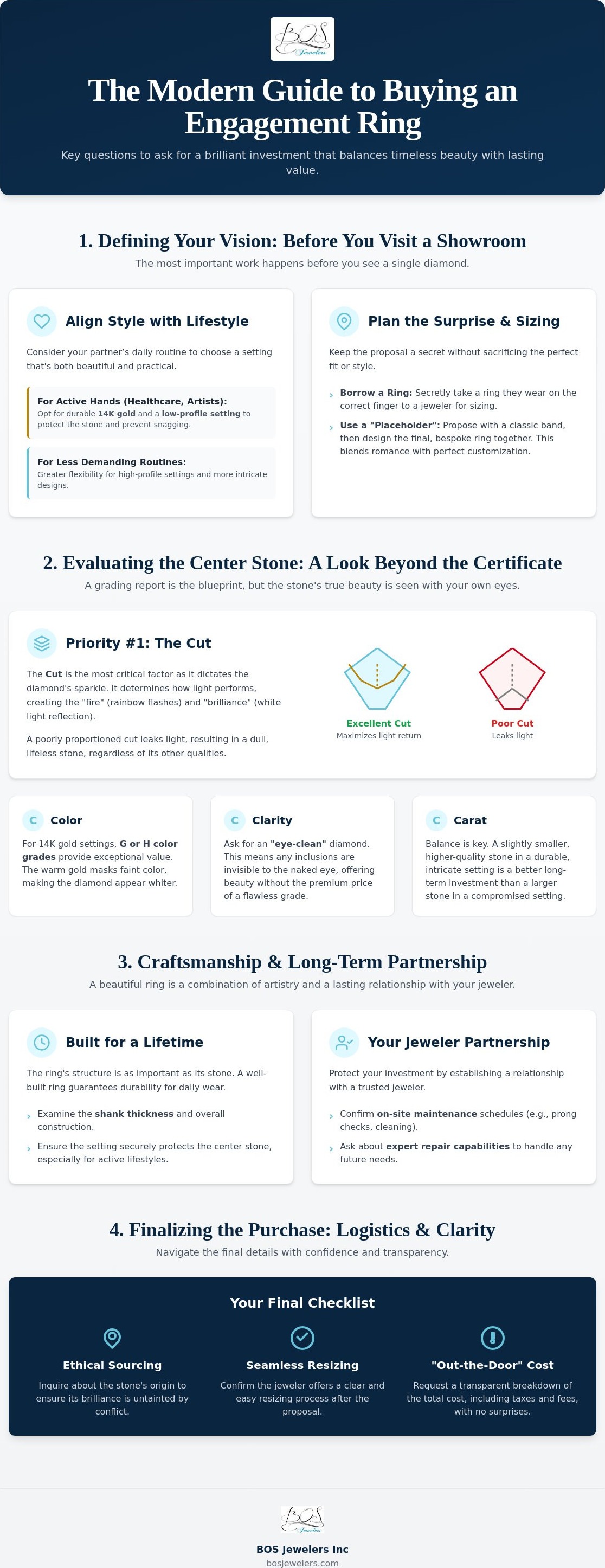
Consider your partner’s daily routine. If they work in healthcare or a creative field where they use their hands constantly, a high-profile setting might snag on gloves or equipment. A low-profile setting sits closer to the finger, offering protection for the center stone. We prioritize 14K gold for these active lifestyles because its composition offers superior durability and scratch resistance. Their dominant hand also matters. The ring will face more impact if worn on the hand they use most for daily tasks, making structural integrity a non-negotiable priority.
The Surprise Factor: Sizing and Secret Planning
Keeping the proposal a secret requires a bit of tactical thinking. You can borrow a ring they wear on their ring finger, but be sure to note which hand they wear it on. If you're truly unsure of their taste, ask us about using a "placeholder" ring. This allows you to create a luxurious proposal experience with a classic band, returning later as a couple to design the bespoke setting together. This collaborative approach ensures they get the exact style they've dreamed of while keeping the initial moment a total surprise. It's a modern way to blend the romance of a secret with the precision of a custom design; for those who want to see how these unique visions are realized, you can explore Bespoke Jewellery Commissions and Transformations.
Evaluating the Center Stone: Technical Questions for Diamond Brilliance
Selecting a diamond is an intimate journey that requires you to look beyond the paperwork. While a grading report provides the technical blueprint, it doesn't capture the soul of the stone. One of the most essential questions to ask when buying an engagement ring is whether you can view the diamond under 10x magnification yourself. A reputable jeweler will always offer a loupe. This allows you to see the unique fingerprint of the stone, including any internal characteristics that define its character and beauty.
Ask how the specific cut proportions influence light performance. A diamond's 'fire' refers to those vivid flashes of rainbow light, while 'brilliance' is the white light reflection. If a stone is cut too shallow or too deep, light leaks out the bottom; this leaves the center looking dark and lifeless. You want a diamond that dances in every lighting environment, from the soft glow of a candlelit dinner to the bright midday sun. Verify if the diamond is 'eye-clean'. This means that even if inclusions exist under magnification, they aren't visible to the naked eye. This often allows you to secure a larger or higher-quality cut stone without paying for a clarity grade that offers no visible difference. Additionally, inquire about the stone’s origin. Ensuring your diamond engagement ring is ethically sourced is a vital part of its story, providing peace of mind that its brilliance is untainted by conflict.
Decoding the 4Cs Beyond the Certificate
Cut remains the most critical factor because it dictates how much the stone sparkles. For those choosing a 14K gold setting, G or H color grades offer exceptional value. The slight warmth of these stones is masked by the gold, allowing you to prioritize a superior cut or higher clarity. Carat is a measurement of the diamond's weight, not its physical dimensions or 'face-up' size.
Understanding Diamond Certification and Appraisals
A grading report from the GIA or AGS serves as an unbiased technical analysis of the stone. However, this is different from a retail appraisal. While the grading report confirms the quality, the appraisal provides a monetary value for insurance purposes. Never finalize a purchase without third-party documentation. This paperwork acts as your safeguard, ensuring that your investment is protected and accurately represented if you ever need to file a claim.
Craftsmanship and Composition: Questions About the Ring’s Construction
The beauty of a ring often blinds buyers to its structural engineering. While the sparkle of a diamond captures the heart, the integrity of the setting ensures that brilliance remains secure for a lifetime. One of the most technical questions to ask when buying an engagement ring involves the method of creation. Ask if the piece is die-struck or cast. Die-struck jewelry is forged under immense pressure, resulting in a denser, stronger metal that resists the thinning and bending that can occur over decades. Cast rings are more common and offer beautiful variety, but they require a higher level of expert finishing to ensure they don't possess hidden porosity.
You must also examine the shank, or the band, with a critical eye. A very thin, dainty band is a popular aesthetic choice, but it can be a liability for a piece intended for daily wear. Ask about the millimeter thickness of the shank. A band that's too thin will eventually warp or even snap under the pressure of everyday tasks. Similarly, inquire about how side stones are secured. Whether you prefer the seamless look of pavé, the protection of a channel setting, or the classic appeal of small prongs, each method requires specific maintenance. Finally, ask if the design allows for a flush-fitting wedding band. Some high-profile settings leave a gap between the engagement ring and the wedding band, while others are specifically engineered to sit side-by-side in perfect harmony.
Why 14K Gold is the Standard for Bridal Longevity
We prioritize 14K gold for engagement rings because it strikes the perfect balance between luxury and resilience. While 18K gold has a higher gold content, it's significantly softer and more prone to deep scratches and prong deformation. The alloy blend in 14K gold provides the hardness necessary to grip a diamond firmly through years of activity. This commitment to durability is why we never offer silver for bridal pieces; it simply lacks the structural "memory" required to keep precious stones safe. You can learn more about the enduring value of this metal in The Essential Guide to 14K Gold Bangles, which explores how gold purity impacts both artistry and investment.
Prong Security and Setting Styles
The choice between four and six prongs is a balance of security and visibility. Six prongs offer a safety net; if one is damaged, the others can often hold the stone until it's repaired. Four prongs allow more light to enter the stone and show more of the diamond's surface. Ask your jeweler about "tipping" or how the prongs are finished. Smooth, rounded tips are less likely to catch on fine fabrics or hair, protecting both your wardrobe and the stone's placement. A custom-designed setting allows our artisans to tailor the prongs to the exact dimensions of your diamond, ensuring a fit that's both elegant and incredibly secure.
The Long-Term Partnership: Questions for Your Jeweler’s Service Suite
Purchasing an engagement ring is the beginning of a beautiful, lifelong journey. It's a piece that will witness every milestone of your life together. Because of this, one of the most vital questions to ask when buying an engagement ring is how your jeweler intends to support you after the proposal. You aren't just selecting a stone; you're choosing a partner to maintain its brilliance. Ask if they perform repairs and maintenance on-site. Many large retailers ship jewelry to third-party facilities, leaving your precious heirloom in the hands of strangers for weeks. We believe in the security and intimacy of local craftsmanship, where the same hands that set your stone are the ones that will care for it over the years.
Inquire about their recommended maintenance schedule. A professional inspection every six months is the gold standard for preserving the structural integrity of your setting. During these visits, we check for loose stones and thinning prongs that could lead to heartbreak. You should also ask about diamond upgrade programs. As your life grows and your milestones accumulate, you may want to celebrate a major anniversary by increasing the size or quality of your center stone. Knowing your jeweler's policy on trade-ins and upgrades ensures your investment can evolve alongside your love story.
Maintenance: Cleaning, Polishing, and Inspection
Daily wear inevitably leads to a buildup of oils and dust that can dull a diamond's fire. Professional cleaning every six months does more than restore sparkle; it's a vital health check for your prongs. Our on-site experts use specialized tools to restore the mirror finish of 14K gold, removing the tiny scratches that accumulate over time. For a deeper look at preserving your piece, explore The Ultimate Guide to Diamond Engagement Rings, where we detail the artistry behind crafting a legacy that lasts. If you're ready to experience this level of dedicated care, you can visit us for professional jewelry cleaning and polishing to keep your treasures looking new.
Warranty, Protection, and Insurance Documentation
Clarity in your warranty is just as important as clarity in your diamond. Ask specifically about "normal wear and tear" and what happens in the rare event of a lost center stone. A detailed receipt is your best protection. It should include the precise gram weight of the metal and specific diamond specifications. This documentation is essential for insurance appraisals. Choosing a family-owned jeweler offers a level of personalized service that big-box chains simply cannot match. We don't see our clients as transactions; we see you as part of our heritage. This personal connection ensures that when you walk through our doors, you're greeted by experts who know the history of your piece and value its significance as much as you do.
Finalizing the Purchase: Logistics, Resizing, and Delivery
The moment of the proposal is the peak of your journey, but the logistics that follow ensure that moment remains perfect for decades. One of the final questions to ask when buying an engagement ring centers on the resizing process. Even with the most careful planning, the fit might need a delicate adjustment once the ring is on your partner's finger. You should also confirm the final "out-the-door" price. This total must include all applicable taxes and the professional appraisal documentation required for your insurance. Ask about the presentation. A piece of this magnitude deserves packaging that mirrors its brilliance, ensuring the ring is both secure and stunning when the box is finally opened. Finally, inquire about adding a custom engraving. Many couples choose to add a secret date or a meaningful phrase to the inside of the band after the proposal to further personalize their legacy.
Clarity on delivery timelines is equally essential, especially if you have a specific date in mind for your surprise. We take great pride in our meticulous finishing process, which ensures every prong is smooth and every facet gleams. This attention to detail takes time, so understanding the window from purchase to pick-up allows you to plan your celebration with total peace of mind. By addressing these final details, you transition from a buyer to a steward of a precious family heirloom.
Resizing and Post-Proposal Adjustments
It's important to understand that certain ring styles possess physical limitations. Full eternity bands, where diamonds encircle the entire shank, generally cannot be resized without compromising the structural integrity of the settings. For most other designs, professional resizing is the only way to ensure a flawless fit. We advise against using temporary "ring guards" or plastic sizers, as these can trap moisture or scratch the surface of 14K gold. To understand the technical artistry involved in this process, you can explore Ring Resizing: The Master Guide, which explains how our artisans maintain the strength and circular shape of your band during an adjustment.
The BOS Jewelers Difference: A Legacy of Craftsmanship
Our family has spent over 40 years fostering multi-generational relationships within our community. This history of expertise translates into a deeply personal experience for you. When you work with us, you aren't just speaking to an intermediary; you're consulting with expert artisans who understand the technical nuances of 14K gold and diamond light performance. We invite you to visit our showroom for a personalized consultation where we can tell the story behind our craft and help you select a piece that reflects your unique bond. Let us be the knowledgeable guides who help you build a lasting personal history, one brilliant stone at a time.
Step Into Your Future with Confidence
You've now mastered the essential questions to ask when buying an engagement ring, transforming from an admirer into a discerning connoisseur. By prioritizing structural integrity, stone brilliance, and the long-term support of a dedicated jeweler, you're ensuring your selection is as enduring as the promise it represents. Each detail you've learned to examine, from the density of the gold to the precision of the setting, contributes to a piece that will stand the test of time. A ring's true beauty always lies in the delicate balance between its romantic allure and the technical expertise of its construction.
At BOS Jewelers, we've spent over 40 years as a family-owned pillar of our community, specializing exclusively in 14K gold and high-quality diamonds. Our expert artisans remain on-site to provide the meticulous resizing and prong repair your heirloom deserves, ensuring it never leaves our care. We don't just create jewelry; we foster multi-generational relationships rooted in sincerity and craftsmanship. We invite you to explore our collection of handcrafted Diamond Engagement Rings and begin your personal legacy. Your story is singular and profound, and we're ready to help you find the perfect symbol to honor it.
Common Questions About the Engagement Ring Journey
What is the most important question to ask a jeweler before buying?
The most critical query involves the presence of on-site master jewelers and their repair capabilities. When you understand the right questions to ask when buying an engagement ring, you'll realize that knowing your piece never leaves the premises provides unparalleled security. This ensures that every adjustment or cleaning is handled by the same artisans who understand the technical nuances of your specific setting and diamond.
Should I buy the diamond and the setting separately?
Purchasing the stone and setting as a cohesive unit is generally recommended to ensure structural harmony. While sourcing a stone independently is possible, a jeweler who creates both can engineer the prongs to the exact dimensions of your diamond. This bespoke approach results in a more secure fit and a balanced aesthetic that highlights the stone's brilliance without compromising the integrity of the 14K gold band.
How can I tell if a diamond is high quality without being an expert?
Focus on the stone's light performance and "eye-cleanliness" rather than just the technical grades on a certificate. A high-quality diamond should exhibit vibrant fire and brilliance even in low-light environments. Ask to view the stone under 10x magnification to check for inclusions; if they aren't visible to the naked eye and the cut is rated "Excellent," the stone will likely possess the radiance you desire.
Is 14K gold better than 18K gold for an engagement ring?
14K gold is often the superior choice for an engagement ring intended for a lifetime of daily wear. While 18K gold possesses a higher gold content, it's notably softer and more susceptible to scratches and prong deformation. The alloy composition of 14K gold provides the structural resilience required to keep your diamond secure through decades of activity while maintaining its polished, sophisticated appearance.
What happens if I get the wrong ring size for a surprise proposal?
If the size isn't perfect, we recommend professional ring resizing to achieve a flawless fit. It's common for surprise proposals to require a slight adjustment. Our expert artisans can typically resize a standard 14K gold band within a few days, ensuring the structural integrity of the shank remains uncompromised. Avoid using temporary sizers or "guards," as these can cause unnecessary wear on the metal.
Do engagement rings come with a lifetime warranty?
Most reputable heritage jewelers offer warranties that cover manufacturer defects, though they typically require regular professional inspections. We recommend a check-up every six months to ensure the prongs remain tight and the metal is sound. It's important to distinguish between a warranty and insurance; a warranty covers craftsmanship, while private insurance is necessary to protect against the total loss or theft of the piece.
How long does it take to get a custom engagement ring made?
A high-quality, handcrafted custom ring typically requires four to six weeks to move from the initial design phase to the final polish. This timeline allows our artisans to meticulously engineer the setting and ensure every facet of the 14K gold is perfectly finished. While some simple settings can be completed faster, rushing the process can compromise the structural integrity and artistic detail that a legacy piece requires.
Is it cheaper to buy an engagement ring online or in-store?
While online retailers may offer lower initial prices, the total cost of ownership is often higher due to the lack of long-term maintenance. Buying in-person at a heritage showroom includes expert guidance on the specific questions to ask when buying an engagement ring and provides immediate access to essential services like cleaning and resizing. These lifetime benefits preserve the ring's value and brilliance far beyond the initial transaction.