

White Gold vs Platinum Durability: A Master Jeweler’s Guide to Wedding Bands
Last Tuesday, a bride-to-be named Elena sat in our Miami showroom, her eyes fixed on two seemingly identical bands while she voiced a fear we hear at least four times a week: "Will this still look like a diamond's perfect partner in twenty years?" It's a valid concern because your wedding ring is the only piece of jewelry you'll likely wear every single day. You want a piece that mirrors the strength of your commitment, yet the technical talk of white gold vs platinum durability for wedding band selection can often feel overwhelming. We understand the anxiety that comes with choosing a high-value item, especially when you're worried about scratches or a white metal eventually turning yellow.
At BOS Jewelers, we believe your ring should be a legacy rather than a source of stress. This guide provides a master jeweler's perspective to help you make a choice that stands the test of time. We'll explore the technical "patina" versus "plating" trade-off and explain how each metal reacts to your specific lifestyle. By the end, you'll have the expert clarity needed to invest in a piece that remains as breathtaking as the day you first put it on. Welcome to the family; let's find your perfect match.
Key Takeaways
- Understand how the unique elemental composition of your band influences its long-term brilliance and natural color.
- Uncover the essential technical differences in white gold vs platinum durability for wedding band selection, focusing on how metal loss and displacement affect your ring’s longevity.
- Discover the distinct maintenance paths required to preserve a mirror-bright finish or embrace the storied character of a natural patina.
- Learn how to match your metal choice to your unique daily rhythm to ensure your jewelry thrives through every activity, from the garden to the gala.
- Explore how the artistry of an on-site master jeweler ensures the structural integrity of a piece destined to become a cherished family legacy.
Understanding the Metallurgy: White Gold and Platinum Beyond the Surface
Choosing a wedding band is one of the most personal decisions you'll make as you prepare for your life together. At BOS Jewelers, we've spent decades guiding Miami families through this selection, focusing on the artistry hidden within the metal. The debate surrounding white gold vs platinum durability for wedding band longevity begins with the elemental makeup of these precious materials. While they may look similar on a jeweler's velvet tray, their physical properties tell two very different stories of strength and character.
Gold is naturally a warm, sun-drenched yellow. To achieve the crisp, silvery hue desired for modern bridal jewelry, master craftsmen must blend it with specific white metal alloys. Platinum, by contrast, is a dense, naturally white metal found deep within the earth. It possesses a significant heft that many of our clients find reassuring. A platinum band typically weighs 40% more than a 14K gold band of the same size; this weight offers a tactile sense of luxury that reflects a commitment to timeless artistry. Selecting the right metal isn't just about the current shine; it's about choosing a material that will carry your legacy for generations.
The Composition of 14K White Gold
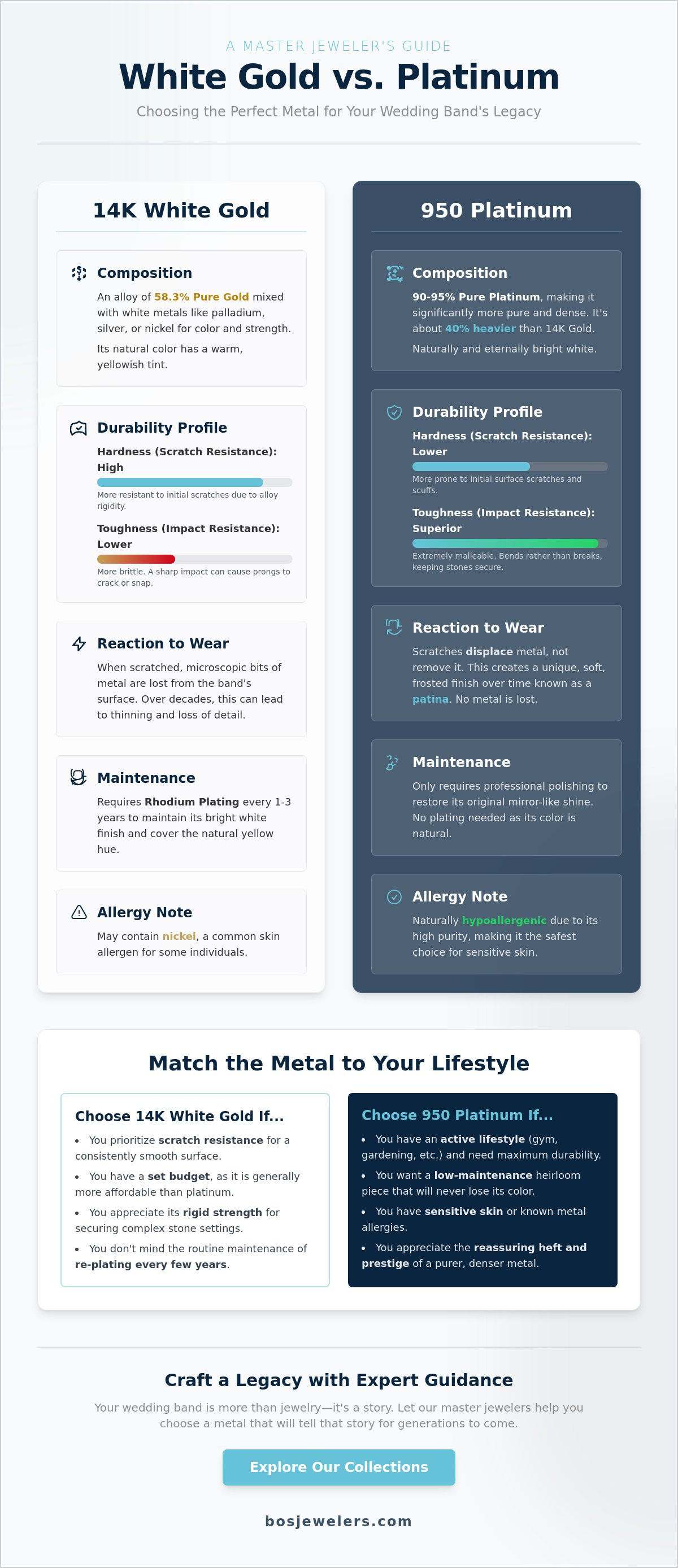
In our workshop, 14K white gold remains a standard of excellence. It consists of 58.3% pure gold, while the remaining 41.7% is a calculated blend of alloys like palladium, silver, or nickel. White gold is an alloy of gold that relies on these secondary metals to provide the necessary hardness for daily wear. Pure 24K gold is too soft for a lifetime of activity; these alloys create a rigid structure that resists bending. This rigidity is exactly why diamond engagement rings frequently utilize 14K white gold for prongs, as it provides a secure, firm grip on your precious center stone.
The Purity and Prestige of Platinum
Platinum is celebrated for its remarkable purity, usually ranging between 90% and 95% in professional-grade wedding bands. This high concentration of a single element makes the metal naturally hypoallergenic, a vital feature for those with sensitive skin who plan to wear their ring every single day. Unlike gold, platinum doesn't require a mixture of alloys to hide a yellow undertone. Its luster is organic and eternal. When considering white gold vs platinum durability for wedding band performance, remember that platinum's natural white color won't fade or require artificial coatings to maintain its brilliance. It stays white forever, ensuring your piece remains as pure as the day you joined our family of clients.
Durability Redefined: Scratches, Dents, and the Patina of Time
When you choose a ring to symbolize a lifetime, you might assume that the hardest metal is naturally the most durable. This is a common misunderstanding we encounter at our Miami showroom. While hardness matters, it doesn't tell the complete story of how a wedding band ages. Truly understanding white gold vs platinum durability for wedding band selection requires looking beyond surface-level scratches and focusing on the long-term integrity of the piece.
Hardness vs. Toughness: The Mohs Scale Fallacy
On the Vickers scale, 14K white gold typically measures around 150 HV, making it technically harder than standard 950 platinum alloys, which often land between 80 and 120 HV. However, hardness only measures a metal's resistance to being scratched. Platinum possesses a superior quality known as "toughness." Toughness is the ability to resist fracturing under pressure. Because gold is harder, it's more brittle; a sharp impact could cause a white gold prong to snap or crack. Platinum is more malleable, meaning it's more likely to bend than break, keeping your precious stones safely encased for decades.
The Reality of Everyday Wear and Tear
Every ring faces the friction of daily life. Activities as simple as gripping a gym weight or gardening create micro-scratches on the surface. White gold was originally developed to imitate platinum, yet these two metals react to friction in fundamentally different ways. When you scratch white gold, a microscopic sliver of the alloy is actually removed from the band. Over a period of 20 or 30 years, this repeated loss can lead to a slight thinning of the shank, eventually requiring a jeweler to add more metal to reinforce the ring.
Platinum doesn't lose its volume when it's bumped or bruised. Instead, the metal "shifts" or displaces. This movement creates a soft, matte finish known as a patina. Many of our collectors at BOS Jewelers cherish this look, viewing it as a beautiful, lived-in record of their journey together. If you prefer the original high-polish shine, our on-site master jewelers can burnish the metal back into place. Since the metal only moved and didn't disappear, the ring retains its original weight and structural legacy. If you want to see these textures in person, we invite you to visit our family-owned showroom to handle both metals yourself.
The Maintenance Lifecycle: Rhodium Plating vs. Professional Polishing
Your wedding band is a lifelong companion that travels through every chapter of your story. While we craft each piece to endure, the long-term choice between white gold vs platinum durability for wedding band owners often rests on the aesthetic upkeep you're willing to embrace. Over a 40-year marriage, these two metals demand different types of care to maintain their prestige. One requires a periodic chemical refresh, while the other demands the skilled hand of a master polisher to manage its evolving surface.
Preserving the Brilliance of White Gold
White gold isn't naturally white; it's an alloy of gold and lighter metals that retains a faint, warm undertone. To achieve that iconic mirror-bright finish, we electroplate the piece with rhodium, a precious metal from the platinum family. This plating is brilliant but sacrificial. As you wear your ring, the rhodium layer gradually thins, revealing the "yellowing" beneath. Most of our clients find they need a re-plating every 12 to 24 months to keep the band looking brand new. Regular professional jewelry cleaning at our Miami workshop is the best way to identify when the plating has worn thin enough to warrant a fresh dip. This process is relatively quick, but it's a recurring commitment for the life of the ring.
Restoring the Luster of Platinum
Platinum offers a different maintenance path because it's naturally white. It'll never turn yellow, and it doesn't require chemical plating to stay bright. Instead, it develops a matte patina as it sustains tiny surface displacements. If you prefer the original high-shine finish, professional polishing is necessary. This isn't a simple buffing job. Because Platinum-Iridium alloys are incredibly dense and "sticky" at a molecular level, they require specialized tools and expert skill to polish correctly. A master jeweler doesn't just remove metal; they smooth and burnish it back into place. You might choose this service every 3 to 5 years, depending on your lifestyle.
Consider the cumulative commitment over 40 years of marriage:
- White Gold: You'll likely visit us for 20 to 30 rhodium treatments to maintain a consistent "store-bought" glow.
- Platinum: You might only need 8 to 10 professional polishings to restore its luster, though many of our clients grow to love the soft patina that develops over time.
- Expert Tip: Always have your settings checked during these maintenance visits to ensure your diamonds remain secure as the metal ages.
We see these maintenance rituals as a way to honor your jewelry. Whether you choose the frequent, bright refresh of white gold or the rare, deep restoration of platinum, we're here to ensure your legacy stays as brilliant as the day you said "I do."
Selecting Your Metal: Lifestyle Considerations for a Lifetime
Your wedding band isn't just a symbol; it's a companion that travels through every chapter of your life. Choosing between metals involves more than comparing aesthetics. It requires an honest look at your daily routines and how you interact with the world. When we evaluate white gold vs platinum durability for wedding band selection at our Miami showroom, we always start with the tactile experience. Platinum offers a luxurious, substantial heft. It's roughly 60% heavier than 14K gold, providing a constant, reassuring presence on your finger. Gold offers a lighter, traditional feel that many of our clients find more comfortable for 24/7 wear, especially if they aren't used to wearing jewelry.
The Active Lifestyle Compatibility Test
For those in medical professions, athletes, or craftsmen, the physical demands on a ring are constant. Platinum is a "sticky" metal. It doesn't lose volume when scratched; instead, the metal merely shifts. This makes it the superior choice for securing precious stones. Prongs made of platinum are less likely to snap off during a hard impact because the metal is malleable. Conversely, 14K white gold is technically harder. It resists the "bending out of round" that can happen to thinner bands during heavy lifting at the gym. If your daily work involves constant contact with hard tools or surfaces, the structural rigidity of gold provides a distinct advantage in maintaining the ring's circular shape.
Hypoallergenic Needs and Skin Sensitivity
Skin chemistry plays a silent but vital role in your long-term comfort. Standard white gold alloys often include nickel to achieve that bright, silvery tone. Data from the North American Contact Dermatitis Group suggests that about 15% of the population experiences a reaction to nickel over time, which can lead to irritation or "wedding ring rash." Platinum is naturally 95% pure and entirely hypoallergenic, making it the safest harbor for sensitive skin. We apply these same rigorous safety standards when curating children’s 14K gold earrings, ensuring that even the youngest members of your family enjoy jewelry without discomfort. If you've ever had a reaction to costume jewelry, platinum is your lifetime solution.
Consider the long-term investment beyond the sentiment. Platinum is thirty times rarer than gold, making it a prestigious heirloom choice. However, gold maintains higher market liquidity. In a global sense, gold is more easily traded and recognized as a universal currency standard. We've served families in our shop for over 40 years who value gold for this specific versatility. When analyzing white gold vs platinum durability for wedding band longevity, remember that platinum will develop a matte "patina" of fine scratches, while gold requires periodic rhodium replating every 12 to 18 months to maintain its mirror-like finish.
Beyond the Metal: Crafting a Legacy with Expert Guidance
Choosing between white gold and platinum is a technical decision, but your wedding band is a piece of your soul. A master jeweler ensures that the metal you choose lives up to its promise. Mass-produced rings often sacrifice thickness to save on material costs. At BOS Jewelers, our on-site masters prioritize structural integrity, creating pieces that won't thin out after twenty years of daily wear. We've seen how white gold vs platinum durability for wedding band selections impacts the way a ring ages over four decades of service in our Miami showroom.
The Importance of Professional Resizing and Repair
Life moves forward. Your ring needs to move with you. Whether it's a change in climate or a milestone anniversary, ring resizing requires a delicate touch. Platinum demands temperatures nearing 3,200 degrees Fahrenheit to solder, which is significantly higher than gold. If a jeweler lacks on-site expertise, they might leave a visible seam where the metal was joined. We use specialized torches and laser technology to ensure your band remains a continuous, perfect circle. Understanding white gold vs platinum durability for wedding band longevity helps you plan for the decades ahead, as each metal reacts differently to the tools of a craftsman.
Custom Design and Structural Integrity
Most commercial rings are created through casting. This process can sometimes leave microscopic porosity in the metal. For those seeking ultimate longevity, die-striking or high-pressure forging creates a denser, more durable band that resists scratches better than standard cast pieces. Our custom process allows us to control every millimeter of thickness. We ensure your band isn't just beautiful today, but strong enough to become a family heirloom for your grandchildren.
We've served the Miami community as a family-owned business since 1980. We don't just sell jewelry; we craft the symbols of your most precious memories. Your wedding band is the beginning of a legacy. Let us help you build it with the care and expertise your story deserves. Welcome to the family.
Crafting a Lifetime of Brilliance
Your wedding band is more than a piece of jewelry; it's a testament to your shared history. Deciding on white gold vs platinum durability for wedding band selection comes down to how you live and how you want your ring to age. Platinum offers a shifting surface that develops a rich patina over decades, while 14K white gold maintains its structured strength through regular rhodium plating. Since 1980, our family has guided couples through these technical nuances to ensure their choice stands the test of time. Our on-site master jewelers specialize in masterfully crafted 14K gold and platinum creations, providing the expert maintenance your legacy deserves. We believe your ring should feel as enduring as your commitment. Whether you prefer the density of platinum or the bright luster of white gold, we're here to ensure your piece remains as stunning as the day you first wore it. Let us help you create your legacy; explore our custom wedding bands and discover the difference that 41 years of craftsmanship makes. We look forward to welcoming you into our family and helping you find the perfect symbol for your journey together.
Frequently Asked Questions
Is platinum more durable than white gold for a wedding band?
Platinum is more durable than white gold because it's a denser metal that doesn't lose volume when it's scratched. While 14K white gold is technically harder on the Mohs scale, every scratch on a gold ring actually removes a microscopic layer of the metal. In contrast, platinum molecules simply shift, creating a finish called patina. Over a 50 year lifetime, a platinum band retains its original mass, while a white gold band might lose 10 percent of its weight.
Does white gold turn yellow over time?
White gold reveals a faint yellowish tint as the outer rhodium plating wears away through daily contact. Since 14K white gold consists of 58.3 percent pure yellow gold mixed with white alloys, it's not naturally bright white. Most of our clients notice this warm hue appearing after 12 to 18 months of continuous wear. We recommend a professional refinishing at our Miami workshop to restore the signature brilliance you fell in love with.
Why is platinum more expensive than 14K white gold if they look the same?
Platinum costs more because it's significantly denser and used in much higher purity levels. A platinum ring is typically 95 percent pure metal, whereas 14K white gold is only 58.3 percent gold. Because platinum is 60 percent heavier than gold, the same ring design requires more physical metal weight. Our master jewelers also spend 30 percent more time hand-polishing platinum due to its unique resistance and high melting point of 3,215 degrees Fahrenheit.
Can you resize a platinum wedding band as easily as white gold?
You can resize a platinum wedding band, though the process requires specialized equipment and a torch that reaches temperatures exceeding 3,000 degrees Fahrenheit. Unlike white gold, which jewelers solder with relative ease, platinum requires a specific high-heat environment to prevent visible seams. Our on-site experts use laser welders to ensure your heirloom remains seamless. This technical precision preserves the structural integrity of your ring for generations to come.
Which metal is better for someone with sensitive skin or metal allergies?
Platinum is the superior choice for sensitive skin because it's naturally hypoallergenic and 95 percent pure. Many white gold alloys contain nickel, which according to the Journal of Clinical and Aesthetic Dermatology, affects approximately 18 percent of the population. If you've experienced redness or itching from other jewelry, choosing platinum ensures your wedding band remains comfortable. It's a worry-free investment in your daily comfort and long-term skin health.
How often does white gold need to be rhodium plated?
White gold typically requires rhodium plating every 12 to 24 months to maintain its bright white finish. The frequency depends on your skin's pH levels and how often the ring contacts abrasive surfaces or household chemicals. When comparing white gold vs platinum durability for wedding band longevity, this recurring maintenance is the primary difference. We perform this service in our studio to ensure your ring returns to its original, breathtaking luster.
Does platinum scratch more easily than white gold?
Platinum shows surface scratches more quickly than 14K white gold because it's a more malleable metal. While gold is brittle and loses metal when struck, platinum displaces and develops tiny ridges that eventually blend into a soft, matte patina. Many families appreciate this look as a symbol of a life well-lived together. If you prefer a high-polish look, a simple professional buffing easily restores the mirror shine.
Will a 14K white gold band thin out over time compared to platinum?
A 14K white gold band will gradually thin out over several decades because friction removes microscopic amounts of metal during daily wear. This is a key factor in white gold vs platinum durability for wedding band comparisons. Industry data shows that gold prongs may need retipping every 7 to 10 years to stay secure. Platinum doesn't thin in the same way; the metal simply shifts, making it a more permanent choice for a lifelong legacy piece.