

The Ultimate Guide to Choosing a Diamond Tennis Bracelet: Artistry and Investment
Last Tuesday, a client walked into our Miami showroom holding a cherished heirloom, terrified because the clasp had finally given way after thirty years of wear. You shouldn't have to worry that your diamond tennis bracelet might snap or lose its luster when you least expect it. We've spent every year since 1982 ensuring that the jewelry we create is as resilient as it is beautiful. We believe your jewelry should offer both peace of mind and unparalleled brilliance.
Selecting an exquisite legacy piece requires more than just a quick glance at a price tag. You're likely looking for a balance between masterfully crafted artistry and a sound investment, yet the technical jargon can feel cold. This guide will help you decode diamond quality and clasp security so you can find a timeless piece that won't lose its fire. We'll explore the meticulous details our on-site jewelers use to ensure every stone is perfectly matched and every link is built to last. Welcome to the family, and let's help you find the brilliance you deserve.
Key Takeaways
-
Discover why consistency is the essential "5th C" when selecting a diamond tennis bracelet, ensuring every stone radiates with uniform brilliance across your wrist.
-
Learn to identify the hallmarks of superior structural integrity so you can wear your investment with absolute confidence and security.
-
Master the "one-finger rule" to find your perfect fit, ensuring your jewelry possesses the elegant drape and comfort of a masterfully crafted piece.
-
Explore how a heritage of custom artistry allows you to transform a timeless classic into a cherished part of your family’s unique legacy.
Table of Contents
What is a Diamond Tennis Bracelet? Defining a Timeless Classic
A diamond tennis bracelet represents the perfect marriage of athletic history and refined artistry. At its core, this piece features a continuous, symmetrical line of diamonds linked by a precious metal. It creates a seamless circle of light around your wrist that moves with you. While we now recognize it as a staple of high fashion, its identity changed forever during the 1987 US Open.
During a vigorous match, professional tennis star Chris Evert lost her diamond bracelet on the court. She requested a pause in play to recover her jewelry, and in that moment, the "eternity line" was rebranded by the public. You can read more about the History of the Tennis Bracelet to see how this 1987 event transformed a classic design into a global icon. For our family at BOS Jewelers, this story highlights the bracelet's unique appeal. It's durable enough for a world-class athlete but elegant enough for a gala.
We view these bracelets as milestone pieces. They're the gifts you choose for a 10th anniversary, a hard-earned graduation, or a significant personal achievement. It's an investment in your own story and a celebration of how far you've come. Whether you're treating yourself or honoring a loved one, this piece carries an emotional weight that few other accessories can match. It's a quiet statement of success that fits every occasion.
The Evolution of the Eternity Line
The design has matured since the early 20th century. Originally called eternity bracelets, older versions used heavy settings that hid the stones. Modern styles use a minimal metal look to maximize light. Our master jewelers reduce prong visibility so every diamond performs at its peak. This symmetrical design remains our most requested style, offering a balanced, liquid-like movement.
Why 14K Gold and Diamonds are the Only Choice
Durability is vital for jewelry you wear every day. We use 14K gold as the industry standard because it provides the structural integrity needed for individual links. Silver is too soft to secure diamonds safely over decades. At BOS Jewelers, we focus on gold and diamonds to ensure lasting value. These are legacy pieces meant to be passed down through your family.
Evaluating Diamond Quality: The 4Cs of a Tennis Bracelet
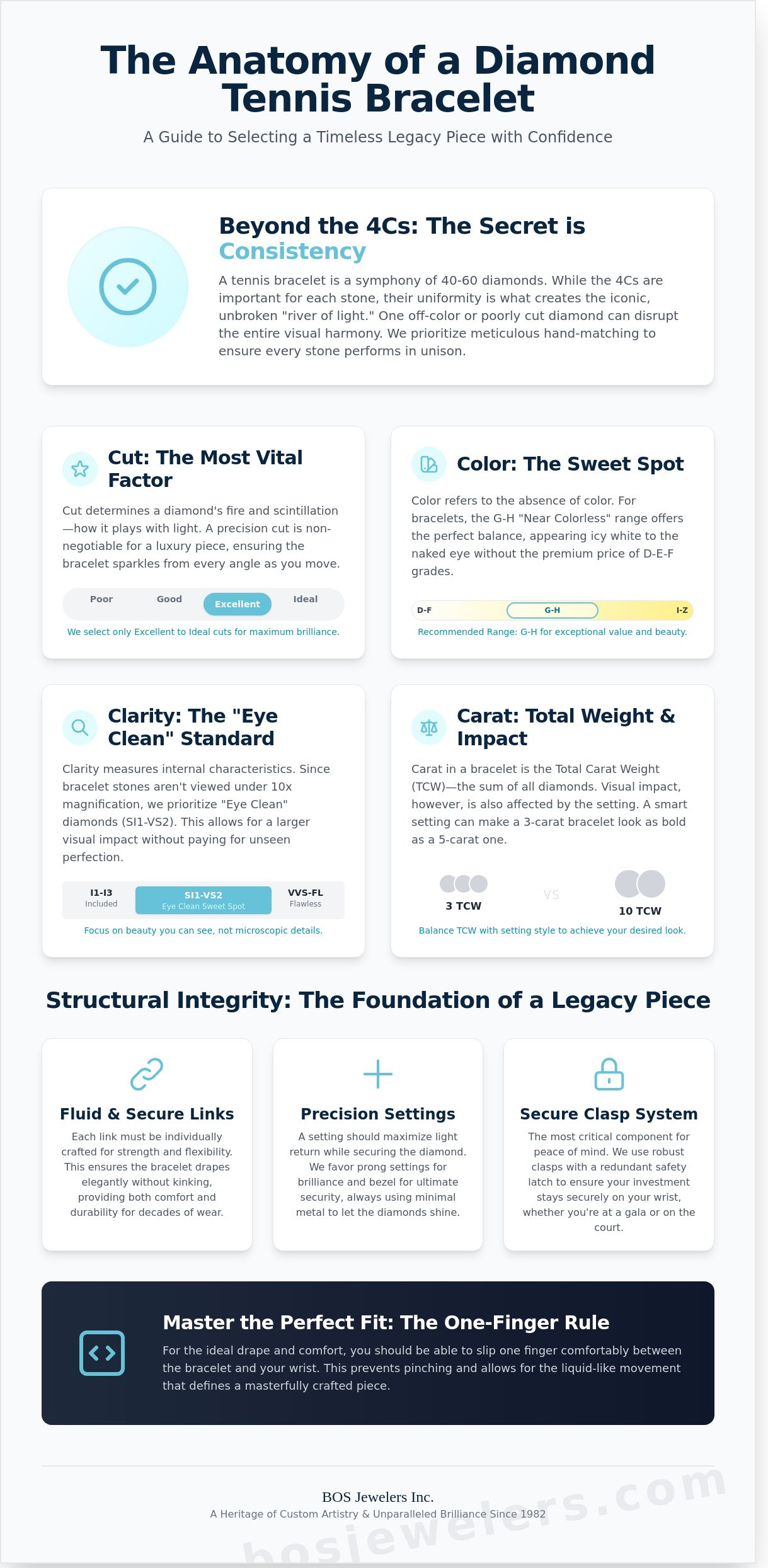
When you select a diamond tennis bracelet, the traditional 4Cs tell only part of the story. While a solitaire ring focuses on the brilliance of a single stone, a bracelet is a symphony of 40 to 60 individual performers. For this reason, we prioritize a "5th C": Consistency. If a single diamond lacks the fire of its neighbors, the entire visual rhythm of the piece falters. Our goal is to ensure that every stone reflects light in unison, creating that iconic, unbroken "river of light" around your wrist.
The cut is the most vital factor in this equation. It dictates how the diamonds handle light, specifically their fire and scintillation. A masterfully crafted cut ensures that even as you move your hand, the bracelet catches the light from every angle. In the vibrant atmosphere of Miami, where the sun provides the ultimate test of brilliance, a precision cut is non-negotiable for a luxury piece.
For the metal settings of 14K yellow or white gold, the G-H color range represents the ideal balance of beauty and value. These "Near Colorless" stones appear icy white to the naked eye without the premium cost associated with D-grade diamonds. Similarly, clarity focuses on "Eye Clean" stones. Since observers rarely view a bracelet under a 10x jeweler's loupe, internal characteristics that don't hinder brilliance are acceptable. This approach allows you to invest in a larger presence and more significant sparkle.
The Art of Stone Matching
Sourcing 40 to 60 diamonds that share the exact same hue, dimensions, and sparkle is a meticulous task that defines true craftsmanship. Our on-site master jewelers spend hours hand-selecting each stone to ensure a seamless flow. A single off-color diamond can act like a visual speed bump, drawing the eye away from the overall elegance of the design. This level of detail is what transforms a standard accessory into a custom creation worthy of your family legacy.
Carat Weight vs. Visual Impact
Total Carat Weight (TCW) represents the sum of every diamond in the piece. A 3-carat diamond tennis bracelet features many smaller stones, whereas a 10-carat piece carries significant individual stone weight. However, the setting style dramatically influences the "boldness" you see. Certain techniques can make a 3-carat bracelet possess the visual impact of a 5-carat design. Consider these factors when balancing your budget:
-
Prong Settings: These allow the most light to enter the stone, maximizing natural sparkle.
-
Bezel Settings: These provide a modern, sleek look and offer maximum protection for the diamonds.
-
Miracle Settings (Illusion Setting): A faceted metal plate around the diamond can make individual stones appear 20% larger.
As you explore these technical details, remember that our family is here to guide you through every choice. You can view our handcrafted collection to see how these elements come together to create a lasting masterpiece.
Structural Integrity: Settings, Links, and Security
The most common question we hear at our Miami showroom doesn't usually involve carats or clarity. It's the simple, heart-stopping fear: "What if it falls off?" We understand that a diamond tennis bracelet is often a milestone gift, a piece of your family legacy that you intend to wear for decades. Ensuring its survival on your wrist requires a marriage of delicate artistry and rigorous engineering. A masterfully crafted bracelet must possess a specific type of flexibility. It should drape like silk over your wrist without feeling flimsy or brittle. We look for links that are substantial enough to resist warping, yet smooth enough to avoid catching on fine fabrics.
At BOS Jewelers, our on-site master jewelers inspect every connection point to ensure the gold isn't "thin" or prone to stretching. We prioritize the "Triple-Lock" security system for every piece intended for daily wear. This system relies on a primary box clasp reinforced by two lateral safety wings. This redundancy ensures that even if you snag the bracelet on a handbag strap or a car door, the piece remains securely attached to your person. Since our founding in 1980, we've believed that the beauty of a diamond is only as good as the metal that holds it in place.
Prong vs. Bezel: Choosing Your Look
Your choice of setting dictates both the brilliance of the stones and the level of protection they receive. The 4-prong setting remains the classic choice for maximum light entry, using four small metal posts to lift the diamond and allow light to enter from every angle. If you prefer a more minimalist, contemporary aesthetic, the 3-prong Martini style reduces metal visibility to create a continuous ribbon of light. For those with an active lifestyle, the bezel setting offers a sleek rim of gold that fully encases the diamond's girdle. This style prevents chipping and ensures the diamond tennis bracelet won't snag on knitwear or athletic gear.
The Mechanics of a Secure Clasp
Selecting a box clasp is the gold standard for luxury jewelry because it hides the mechanical components beneath the diamonds for a seamless look. You should feel a crisp, audible click when the tongue enters the box, signaling a tight fit. The safety wing acts as a secondary mechanical failure protection by providing an external latch that holds the tongue in place if the internal spring fails. If you notice a "soft" click or see visible gaps in the metal links, it's time for a professional inspection. We invite you to bring your pieces into our family-owned shop for a security check, as maintaining these small details is how you protect your investment for the next generation.
How to Size and Style Your Diamond Tennis Bracelet
Selecting your diamond tennis bracelet is only the first step in your journey. Ensuring it rests perfectly on your wrist is what transforms a piece of jewelry into a seamless part of your identity. To find your ideal size, begin by measuring your wrist with a soft tape or a piece of string just below the wrist bone. This measurement provides the base circumference of your arm and serves as the foundation for a comfortable fit.
Once you have that number, add between half an inch and a full inch to the measurement. This creates the "perfect drape," allowing the diamonds to catch the light from every angle without being restrictive. If a bracelet is too loose, it gains momentum as you move. This extra movement increases the risk of snagging the piece on clothing or hitting it against hard surfaces. If it's too tight, the tension can damage the delicate links. For a truly bespoke fit, our on-site master jewelers at BOS Jewelers recommend removing links to reach your exact specifications rather than settling for a standard size that doesn't quite feel right.
The One-Finger Rule for Sizing
The gold standard for testing a fit is simple: you should be able to slide exactly one finger between the bracelet and your skin. This space ensures comfort during your daily activities. If you can't fit a finger, the piece is too tight. When you flex your hand or lean on a table, your wrist expands slightly. A bracelet with no "give" risks snapping the intricate links under that sudden pressure. Just as we emphasize precision in ring resizing, we apply that same technical rigor to adjusting your bracelet links to ensure your investment remains secure for a lifetime.
Layering and Daily Wear
A diamond tennis bracelet is perhaps the most versatile piece in your collection. For a high-contrast, textured look, try pairing it with 14K gold bangles. This mix of shapes and metals creates a sophisticated stack that works as well in a Miami boardroom as it does at a formal gala. You can also create a cohesive, meaningful ensemble by matching the brilliance of your bracelet with gold religious pendants. This combination bridges the gap between personal faith and high-end artistry, allowing your jewelry to tell a complete story of your legacy.
Whether you're wearing it solo for understated elegance or layering it for a bold statement, the key is balance. Evaluate how the piece sits next to your existing watch. A tennis bracelet should complement your timepiece, not compete with it. We invite you to visit our showroom to see how these pieces interact in person.
Ready to find your perfect fit? Explore our custom diamond tennis bracelet collection and let our family help you create yours.
The BOS Jewelers Difference: Customization and Care
Since 1980, BOS Jewelers has served as a family-owned pillar in the heart of Miami’s jewelry district. We invite you to experience a heritage built on over 40 years of trust and technical mastery. Our shop operates with a distinct advantage: an on-site master jeweler and a gemologist who oversee every custom build and repair. This ensures your diamond tennis bracelet never leaves our sight. Unlike many retailers who ship pieces to third-party facilities, we maintain absolute control over quality within our own walls. We are committed to longevity, which is why we exclusively use 14K gold and high-quality diamonds. You won't find silver or plated metals in our workshop, as we believe fine jewelry should be a permanent part of your legacy.
Bespoke Tennis Bracelets
Creating a bespoke piece is a collaborative journey where your vision takes center stage. We guide you through the selection of the ideal Total Carat Weight (TCW), explaining how a 5-carat layout offers a different aesthetic presence than a 10-carat design. You choose the 14K gold color, whether it's the warmth of yellow gold, the crispness of white gold, or the soft glow of rose gold. In our specialized workshop, our master jeweler hand-sets every single diamond. This meticulous process ensures the stones are perfectly aligned for maximum brilliance and the bracelet drapes fluidly against your skin. We don't just assemble jewelry; we create a piece that reflects your personal history.
Maintenance for a Lifetime of Brilliance
Fine jewelry requires proactive care to remain as secure as the day you first wore it. We recommend a professional checkup every 180 days to ensure the structural integrity of your piece. During these visits, we focus on several critical areas of maintenance:
-
Professional cleaning and polishing: We remove microscopic buildup and environmental debris to restore the original showroom shine of your gold.
-
Technical repairs: Our jeweler inspects the 50 or more individual prongs that secure your stones, addressing signs of metal wear before a diamond is ever at risk.
-
Clasp security: We test the tension of the safety latch and the double-locking mechanism to ensure the closure remains crisp and reliable.
A diamond tennis bracelet is more than a purchase; it is a lifelong partnership between you and your jeweler. We are here to ensure your investment continues to sparkle for generations to come. Welcome to the family.
Begin Your Legacy with Timeless Artistry
Selecting a diamond tennis bracelet isn't just about the sparkle; it's a decision that balances technical brilliance with the structural integrity of every link and clasp. You've seen how the 4Cs dictate the fire of your stones and why the security of a professional setting is vital for a piece meant to be worn daily. At BOS Jewelers, we've refined this delicate balance of art and engineering since 1980. As a family-owned and operated establishment for over 40 years, we treat every piece as a milestone in your personal story.
Our on-site master jewelers specialize in custom designs and technical repairs, ensuring your jewelry remains as perfect as the day you first saw it. We work exclusively with 14K gold and high-quality diamonds because we believe in longevity. You aren't just purchasing a luxury item; you're investing in a heritage that lasts. Let us help you create your legacy; explore our masterfully crafted Diamond Tennis Bracelets today. We look forward to welcoming you into our family and helping you find a piece that shines for generations to come.
Frequently Asked Questions
Can I wear my diamond tennis bracelet every day?
You can certainly wear your bracelet daily, provided you treat the piece with the care it deserves. Our on-site master jewelers recommend removing your jewelry during high-impact activities or when using harsh chemicals. Since 1980, we've seen that consistent maintenance ensures the 14K or 18K gold links remain strong and the stones stay secure in their settings. It's a piece designed to live with you, celebrating every moment from morning coffee to evening galas.
How much should a high-quality diamond tennis bracelet cost?
Market pricing for fine jewelry fluctuates based on the 4Cs and metal purity, with the 2023 Global Jewelry Market Report showing wide ranges based on total carat weight. A high-quality piece features diamonds with consistent color and clarity, often graded VS2 or higher, which impacts the final value. Because we're a family-owned establishment, we focus on the artistry and longevity of your investment rather than just a price tag. We invite you to visit our Miami showroom to see how craftsmanship influences value.
What is the difference between a tennis bracelet and a line bracelet?
A diamond tennis bracelet is a modern name for the classic line bracelet, a term that changed forever during the 1987 US Open. When champion Chris Evert paused a match to find her misplaced jewelry, the world adopted the new name for this flexible, symmetrical design. While both terms describe a continuous row of diamonds, the "tennis" style specifically emphasizes a secure, lightweight clasp and fluid movement. It's a timeless silhouette that has remained a staple in our custom creations for decades.
How do I clean my diamond tennis bracelet at home?
You can maintain the brilliance of your diamonds by soaking the bracelet in a bowl of warm water mixed with 3 drops of mild dish soap. Let the piece sit for 15 minutes to loosen any oils or lotions trapped behind the stones. Use a soft-bristled toothbrush to gently scrub the settings, then rinse under warm running water and pat dry with a lint-free cloth. This simple routine keeps your diamonds sparkling between professional cleanings at our workshop.
Should a tennis bracelet be loose or tight?
Your bracelet should fit comfortably enough to slide one finger between the metal and your wrist. If it's too tight, you risk straining the clasp; if it's too loose, it may snag on surfaces or slide off. Most of our clients find that a standard 7-inch length provides the perfect drape. Our experts ensure the fit is just right so the diamonds stay visible on the top of your wrist without spinning excessively.
What is the most secure clasp for a diamond bracelet?
The most reliable closure is a pressure tongue clasp reinforced with two figure-eight safety wings on the sides. This triple-locking system provides peace of mind, ensuring your diamond tennis bracelet stays safely on your wrist during your daily routine. We prioritize these heavy-duty clasps in our Miami workshop because we believe luxury should always feel secure. It's a hallmark of the expert craftsmanship we've provided to our family of customers for over 40 years.
Is 14K gold strong enough for a tennis bracelet?
Yes, 14K gold is the ideal choice for durability because it contains 58.3 percent pure gold mixed with durable alloy metals. This blend makes the metal harder and more resistant to scratches than 18K gold, which is vital for a piece that frequently touches desks or tables. It provides a sturdy foundation for the 50 or more diamonds typically found in a standard design. We often recommend 14K gold for active individuals who want a legacy piece that withstands the test of time.
Can a tennis bracelet be resized if it is too long?
A master jeweler can easily resize your bracelet by removing one or more diamond links to achieve the perfect fit. At BOS Jewelers, we perform these adjustments on-site to ensure the structural integrity and symmetry of the piece aren't compromised. We return any removed diamonds to you, which can later be used in custom creations like a pair of stud earrings or a delicate pendant. It's all part of our commitment to helping you create your legacy through personalized service.