
Oval Cut Diamond Pros and Cons: The 2026 Connoisseur’s Buying Guide
If you believe a diamond's beauty is measured only by its sparkle, you might be missing the shape that currently commands 33% of the modern market. The oval cut is not a simple alternative to the round brilliant; it is a masterfully crafted evolution that maximizes visual scale and personal expression. We know that choosing a stone for a life milestone feels both celebratory and a bit daunting. You likely appreciate the way an elongated shape flatters the finger, yet you're wary of the oval cut diamond pros and cons, especially the technical mystery of the bowtie effect or how the 2026 GIA grading shifts for lab-grown stones might impact your legacy.
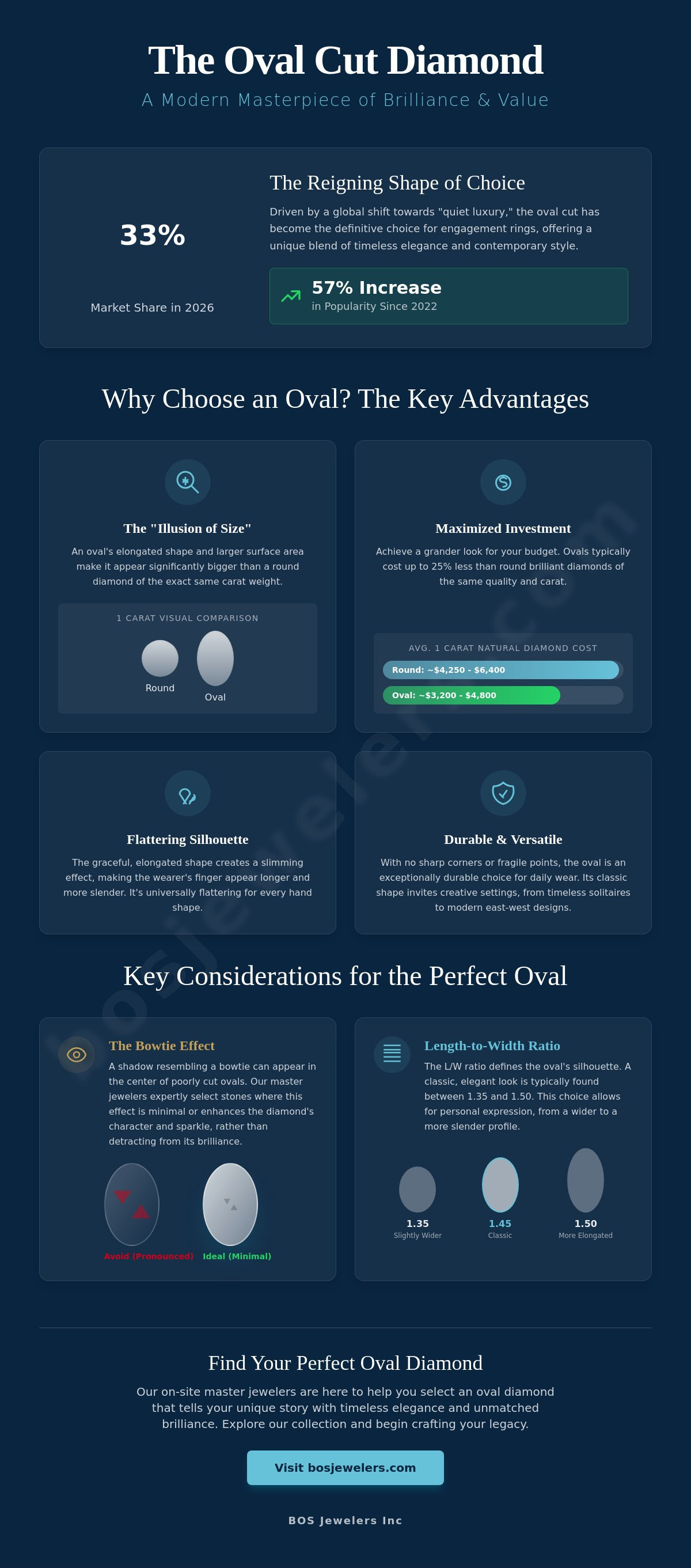
We're here to ensure you feel the quiet confidence of a connoisseur. You'll discover how to find the exquisite balance of brilliance and value, especially since a 1-carat natural oval currently costs between $3,200 and $4,800, which is roughly 25% less than a round stone. This guide explores the nuances of the new Premium and Standard GIA classifications for lab-grown options and reveals the proportions our on-site master jewelers use to eliminate dullness. Let's help you select a diamond that doesn't just shine, but tells your unique story with timeless elegance.
Key Takeaways
- Discover how the oval’s unique proportions create an exquisite "illusion of size," providing a more significant visual presence than traditional round cuts of the same weight.
- Gain the expertise to navigate the oval cut diamond pros and cons, allowing you to choose a stone where the bowtie effect enhances character rather than distracting from brilliance.
- Understand the nuances of color and clarity in elongated shapes to ensure your diamond remains bright and clear from its center to its masterfully crafted tips.
- Explore how custom-tailored settings and strategic prong placement provide the essential protection needed to preserve your diamond’s legacy for generations.
- Learn to select the ideal length-to-width ratio that creates a slimming, sophisticated silhouette perfectly suited to your hand’s natural aesthetic.
The Allure of the Oval: A Silhouette of Timeless Elegance
The oval cut diamond represents a rare harmony between fire and form. It's a modified brilliant cut that takes the unparalleled sparkle of a round stone and stretches it into a graceful, elongated silhouette. At BOS Jewelers, we've watched this shape evolve from a niche vintage choice into a contemporary icon. It offers a bespoke feel that speaks to your unique style while remaining anchored in the prestige of traditional craftsmanship. Choosing this shape means embracing a legacy of artistry that feels as fresh today as it did decades ago.
There's an emotional weight to selecting an oval. It balances the timeless romance of an heirloom with a contemporary edge that's difficult to find in more rigid shapes. We believe that every stone should reflect the sincerity of the person wearing it. When you choose an oval, you aren't just selecting a diamond; you're commissioning a piece of art that bridges the gap between high-end luxury and personal warmth.
The Evolution of the Oval Brilliant
The story of the modern oval began in 1957, when master diamond cutters refined the faceting patterns of the round brilliant and the marquise to create something entirely new. By blending these two lineages, they achieved a stone that maintains incredible brilliance without the sharp, fragile points of other fancy shapes. Modern faceting techniques have only enhanced this effect, often producing a "crushed ice" sparkle that looks magnificent in custom settings. The modern oval cut is a 57 or 58-facet masterpiece of light return designed to maximize internal reflection while providing an elongated profile.
Why Ovals are Trending in 2026
In 2026, the oval cut has officially claimed its place as the definitive choice for engagement rings, capturing 33% of the market. This represents a significant 57% increase in popularity since 2022, driven by a global shift toward "quiet luxury." You'll find that celebrities and tastemakers often choose ovals for their sophisticated profile and the way they naturally lengthen the appearance of the finger. While you weigh the oval cut diamond pros and cons, it's clear that the aesthetic allure of this shape lies in its versatility. It complements a minimalist 14K gold band just as beautifully as it does a complex, hidden halo design created by our on-site master jewelers. The trend isn't just about fashion; it's about finding a shape that offers:
- Visual Scale: A larger surface area that makes the stone appear more substantial.
- Universal Appeal: A flattering silhouette for every hand shape.
- Bespoke Potential: A shape that invites creative, custom settings like east-west orientations.
As we help you create your legacy, we find that the oval's rise is tied to its ability to feel both grand and intimate. It's a shape that invites contemplation, much like the patient, meticulous nature of our jewelry design process itself.
The Advantages: Why an Oval Cut Might Be Your Perfect Match
Choosing a diamond is an intimate journey, one that balances the heart's desire with the practicalities of light performance and value. The oval cut excels in this delicate dance. One of its most compelling attributes is the "illusion of size." Because an oval is cut shallower than a traditional round diamond, much of its weight is distributed across its surface area rather than hidden in its depth. This technical nuance means that when you compare two stones of identical carat weight, the oval will almost always appear significantly larger to the naked eye. It's a masterfully crafted way to maximize your presence without needing to increase your budget.
The aesthetic rewards extend beyond simple dimensions. The vertical elongation of the shape acts as a graceful extension of the hand, creating a slimming and lengthening effect on the finger. It offers a soft, romantic silhouette that lacks the sharp, vulnerable corners found in marquise or pear shapes. This makes the oval an exceptionally durable choice for daily wear. When weighing the oval cut diamond pros and cons, this blend of visual impact and structural integrity often makes it the definitive choice for those seeking a stone that is both grand and resilient.
Maximizing Your Investment
In the current 2026 market, the financial advantages of the oval cut are as clear as the stones themselves. A 1-carat natural oval diamond typically costs between $3,200 and $4,800, which is approximately 20% to 25% less than a round diamond of equivalent quality. This price gap allows you to prioritize higher clarity or color grades, or perhaps invest in a larger "spread." For example, a 1.7-carat oval can often provide the visual impact of a 2-carat round brilliant. For those exploring modern alternatives, the value is even more pronounced; a 2-carat lab-grown oval currently averages around $1,720, allowing for a truly spectacular centerpiece that fits comfortably within a thoughtful budget.
The Aesthetic Versatility of the Elongated Form
The oval's silhouette is a canvas for personal expression. It serves as the perfect anchor for diamond engagement rings, transitioning seamlessly from minimalist solitaires to intricate, vintage-inspired halos. We often see clients opting for "East-West" settings, where the stone is set horizontally for a bold, contemporary look that defies tradition. Whether set in a classic vertical alignment or a bespoke modern mounting, the oval maintains a sophisticated profile that never feels severe. If you're ready to see how this shape can complement your style, we invite you to explore our custom creations and let our on-site master jewelers bring your vision to life.
The Considerations: Navigating the Bowtie Effect and Technical Nuances
While the visual scale and slimming effects we previously explored are certainly alluring, a true connoisseur understands that every masterpiece has its complexities. Understanding the oval cut diamond pros and cons means looking beyond the surface and into the very heart of the stone's light performance. Because the oval is an elongated brilliant cut, it doesn't always distribute light with the same mathematical uniformity as a round stone. This leads to unique characteristics that require a discerning eye and the guidance of an expert who values artistry over a simple transaction.
You may have heard of the "crushed ice" look versus "chunky facets." This refers to how the diamond's internal light is reflected. Modern ovals often feature many tiny facets that create a shimmering, ice-like sparkle. In contrast, some ovals are cut with broader facets that produce larger flashes of light, reminiscent of vintage heritage pieces. Neither is objectively better; rather, the choice depends on the emotional resonance you seek in your custom creation. Our on-site master jewelers often suggest viewing these variations in person to see which light pattern speaks to your personal style.
Mastering the Bowtie Phenomenon
The bowtie effect is a dark, butterfly shaped shadow that appears across the center of nearly all elongated brilliant cuts. It happens when the depth of the pavilion facets causes light to be blocked by your own head and shoulders as you look into the stone. While some retailers suggest avoiding the bowtie entirely, a complete absence of it often indicates a stone that is cut too shallow, leading to a dull, lifeless appearance. A subtle bowtie provides a necessary contrast that makes the surrounding facets pop with brilliance. A master jeweler uses the bowtie to create a sense of movement within the stone. When you inspect a stone at our Miami showroom, we'll show you how to move the diamond under different light sources to ensure the shadow remains a graceful feature rather than a distracting "dead spot."
Finding the Ideal Length to Width Ratio
The silhouette of your diamond is defined by its length to width ratio, a metric that determines if the stone appears "fat" or "skinny." As of early 2026, the industry sweet spot, often referred to as the Golden Ratio for ovals, falls between 1.35 and 1.50. This range provides the most balanced, elegant profile that most people find flattering.
- 1.30 to 1.34: A fuller, rounder look that offers great durability.
- 1.35 to 1.50: The classic oval silhouette that maximizes the lengthening effect on the finger.
- Above 1.50: A very elongated, slender form that requires a bespoke setting to protect the narrower ends.
Symmetry is the final pillar of a harmonious oval. We meticulously check that the rounded ends, or "heads," are identical and that the curves are smooth and continuous. A stone with "flat shoulders" or uneven sides loses the timeless elegance that makes the oval so desirable. We invite you to lean on our heritage of craftsmanship to find a stone with the perfect proportions for your legacy.
Evaluating Quality: The 4Cs Through the Lens of an Oval Cut
Evaluating the 4Cs for an oval requires a more nuanced approach than the standardized grading of a round brilliant. While the Gemological Institute of America (GIA) provides a formal cut grade for round stones, they do not offer one for ovals as of May 2026. This creates a "cut grade mystery" that forces you to rely on visual inspection and the expertise of a master jeweler. When considering the oval cut diamond pros and cons, this lack of a standardized grade is a significant factor. It means two stones with identical depth and table percentages can look vastly different. One might radiate an exquisite brilliance while the other appears dull or "leaky."
Carat weight in an oval is also deceptive. Because the shape is elongated, the weight often "hides" in the belly or the depth of the stone. A masterfully crafted oval will balance this weight to ensure the stone doesn't look too "fat" while maintaining enough depth to prevent a "fisheye" effect. This is a dull grey ring that appears in the center of the stone when the pavilion is cut too shallow, causing light to pass straight through rather than reflecting back to your eye.
Smart Scaling: Prioritizing Clarity and Color
Ovals are remarkably forgiving when it comes to clarity. The complex, brilliant faceting pattern excels at masking small inclusions. You'll find that an SI1 clarity grade can often look "eye-clean" in an oval, allowing you to allocate more of your budget toward a larger stone. However, color requires a more watchful eye. Unlike round diamonds, ovals tend to concentrate warmth at their rounded tips. If you're sensitive to yellow tints, we recommend staying within the D to F range for a colorless look. If you're setting your diamond in a warm 14K gold band, a G or H grade will offer a seamless, elegant look that feels both timeless and sophisticated. For those considering lab-grown stones, remember the GIA's late 2025 update; stones are now classified as "Premium" or "Standard," which helps you quickly identify top-tier D-color and VVS-clarity options.
The Role of Symmetry and Polish
While the formal cut grade is absent, symmetry and polish are non-negotiable for a stone that will define your legacy. We always look for "Excellent" symmetry to ensure the stone's silhouette is perfectly balanced. "Uneven shoulders," where one side of the oval is flatter than the other, can ruin the sophisticated profile of the piece. Polish is equally vital; it gives the diamond that "liquid" surface look, ensuring light reflects off the facets with crisp precision. If you want to see these nuances in person, schedule a private consultation at our Miami showroom to compare stones side-by-side. Our family-owned heritage ensures you receive the honest, expert guidance needed to select a stone of truly exceptional quality.
Crafting Your Legacy: Selecting the Ideal Setting for an Oval Diamond
The journey of selecting a diamond culminates in the choice of a setting, a decision that is as much about structural security as it is about aesthetic harmony. While we've explored the oval cut diamond pros and cons in terms of light performance and market value, the setting is what ensures your investment remains a protected heirloom. An oval’s elongated form requires a bespoke approach that a standard, mass-produced mounting simply cannot provide. At BOS Jewelers, our on-site master jewelers utilize over 40 years of craftsmanship to ensure every prong is placed with surgical precision, balancing the stone’s unique length-to-width ratio with the need for long-term durability.
We believe that a setting should act as a silent guardian of your stone's brilliance. In our Miami showroom, we often see how a custom-tailored seat can transform a beautiful diamond into a masterfully crafted legacy piece. By choosing a design that respects the specific geometry of your oval, you mitigate the risks of chipping or stone loss, ensuring the jewelry can be passed down through generations with its beauty intact. It's a celebratory final step that bridges the gap between technical selection and personal expression.
Structural Integrity and Master Craftsmanship
The security of an oval diamond depends on the relationship between the stone’s girdle and its metal seat. Because ovals don't have the uniform circumference of a round stone, a "stock" setting often leaves tiny gaps that can lead to instability. We generally recommend a minimum of four prongs, though six prongs offer a higher level of protection for the stone's rounded ends. Beyond the initial build, ongoing maintenance is crucial for a stone of this value. If your ring doesn't fit perfectly, professional ring resizing is vital. A ring that is too loose can cause the setting to knock against hard surfaces, eventually loosening the prongs. Our team handles these delicate adjustments in-house, ensuring the integrity of the design remains uncompromised.
Design Inspirations for the Modern Bride
As of May 2026, we're seeing a significant shift toward settings that offer both security and a "secret" sense of luxury. These designs allow you to navigate the oval cut diamond pros and cons by providing the protection an elongated stone needs while maintaining a sophisticated profile.
- The Hidden Halo: This design places a delicate row of diamonds beneath the center stone, adding brilliance without altering the classic oval silhouette.
- Bezel Settings: For those with an active lifestyle, a 14K gold bezel provides a sleek, contemporary finish while completely encasing the diamond’s edge for maximum protection.
- The Cathedral Setting: This style uses arches of metal to raise the stone, providing a grand profile and extra points of contact for structural support.
Choosing the right setting is the final act in creating a piece that transcends temporary trends. We invite you to become part of our family and collaborate with our experts to design a custom creation. Let us help you create your legacy today.
Begin Your Journey Toward a Timeless Legacy
Selecting a stone that represents your most cherished milestones requires more than just a glance at a grading report. You now possess the specialized knowledge to navigate the oval cut diamond pros and cons with the quiet confidence of an expert. From mastering the nuances of the bowtie effect to selecting the ideal length-to-width ratio for your silhouette, you've seen how this shape offers an exquisite balance of modern brilliance and timeless elegance. Every technical detail we've explored serves one purpose: ensuring the diamond you choose remains a brilliant reflection of your personal story.
At BOS Jewelers, we've been a pillar of the Miami community since 1980, fostering multi-generational relationships through our dedication to artistry. Our on-site master jewelers specialize in transforming high-quality 14K gold and diamonds into bespoke creations that transcend temporary trends. We invite you to let us help you create your legacy with a custom oval engagement ring that reflects the sincerity of your commitment. Whether you're celebrating a major anniversary or preparing for a proposal, we're here to ensure every detail is masterfully crafted. Welcome to the family.
Frequently Asked Questions
Do oval diamonds have a bowtie effect?
Nearly all oval diamonds exhibit some degree of a bowtie effect, which appears as a dark shadow across the center of the stone. While a prominent, black bowtie is considered a drawback, a subtle one is actually desirable because it provides the contrast necessary for the diamond to sparkle with depth. Our master jewelers look for stones where this effect is minimal and serves to enhance the diamond's character rather than distracting from its brilliance.
Is an oval cut diamond more expensive than a round cut?
An oval diamond is significantly more affordable than a round brilliant of the same quality. As of March 2026, a 1-carat natural oval diamond costs between 20% and 25% less than a 1-carat round natural diamond. This price difference allows you to invest in a larger stone or a higher quality grade while staying within your original budget. It is one of the most compelling reasons to consider the oval cut diamond pros and cons during your search.
What is the best length-to-width ratio for an oval diamond?
The industry standard for a classic, elegant silhouette is a ratio between 1.35 and 1.50. This range provides the traditional elongated look that flatters the finger without making the stone appear too narrow or too round. Choosing a ratio outside of this window is a matter of personal style, though stones above 1.50 often require bespoke settings to ensure the narrower ends are properly secured by masterfully crafted prongs.
Do oval diamonds look bigger than other shapes?
Oval diamonds possess a larger surface area than round diamonds of the same carat weight, creating an impressive "illusion of size." Because they are cut shallower, more of the diamond's weight is visible on the top of the stone rather than being hidden in its depth. This makes an oval look roughly 10% larger than a round brilliant, providing a grander presence on the hand for a more accessible price point.
Which setting is best for an oval cut diamond?
A 4 or 6-prong setting is typically the best choice to showcase the stone's brilliance while keeping it secure. For those with an active lifestyle, a bezel setting in 14K gold provides maximum protection by encasing the entire perimeter of the diamond. We always recommend custom-tailored settings that are designed specifically for your stone's unique proportions to prevent any movement or potential stone loss over time.
Can an oval diamond chip easily?
Oval diamonds are remarkably durable because they lack the sharp, pointed corners found in marquise or pear cuts. These rounded edges are much less likely to snag on clothing or chip during daily wear. While no diamond is indestructible, the oval’s curved silhouette makes it one of the most resilient fancy shapes available, especially when paired with a masterfully crafted 14K gold mounting from a trusted family-owned jeweler.
How do I choose the right color grade for an oval diamond in a gold ring?
If you are choosing a 14K gold band, a color grade of G or H often provides the most exquisite value. Ovals tend to concentrate slight warmth at their tips, but the yellow tones of a gold setting help mask this, making the diamond appear whiter than its technical grade suggests. This is a key part of understanding oval cut diamond pros and cons, as it allows you to prioritize a larger carat weight without sacrificing the stone's visual beauty.
Is an oval cut diamond a "trendy" choice or a "timeless" one?
The oval cut is a timeless choice that has seen a massive surge in popularity, growing from a 21% market share in 2022 to 33% by 2025. While it's currently a favorite for modern engagement rings, its lineage dates back to the mid-20th century, ensuring it won't feel dated in the decades to come. It bridges the gap between contemporary fashion and heritage craftsmanship, making it a sophisticated anchor for your family's legacy.